When a haunting is a feeling in the air rather than a face in the hall
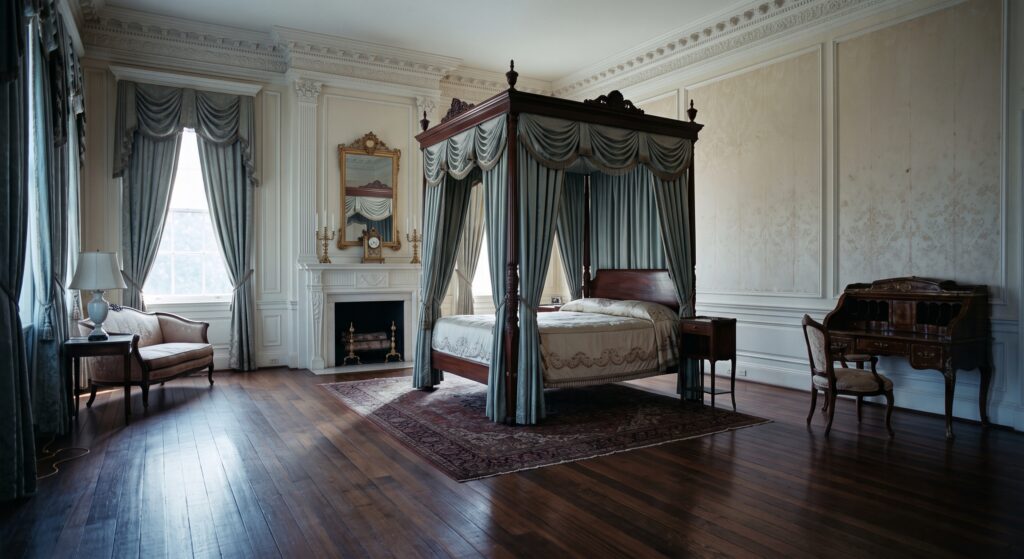
Lynda Bird Johnson slept in a room that should have come with a warning. Children had died there. Autopsies, including Lincoln’s, had reportedly been performed there. She described a strange coldness and once said plainly that she lived in a room where many sad things took place.
Her haunting breaks the usual mold. No figure appears. No voice calls out. Instead, there is dread, a heaviness in the air, and the sense that the room itself remembers what happened in it.
A presidency under pressure
The Johnson years sat under enormous strain. The Vietnam War escalated abroad while the Civil Rights Movement transformed the country at home. The atmosphere inside the White House grew tense and grim, a national mood that the building seemed to absorb.
Lady Bird Johnson reported her unease, including a strange chill near a plaque honoring Lincoln. The first family lived inside a structure already saturated with loss during a decade that kept adding to it.
The room where Willie died
The specific space mattered. Willie Lincoln died on the second floor in 1862, and the room carried that history. Living in it, the Johnson family encountered not a ghost exactly but an emotional residue, a coldness that resisted explanation. Press secretary Liz Carpenter was among those who spoke of sensing Lincoln’s presence during these years.
It is worth noting that Lynda Johnson later said the rumor she had seen and spoken with Willie’s ghost was untrue. The enduring report is subtler than a sighting. It is the feeling of a room that holds too much.
Stirred by turmoil
This haunting supports the idea that the White House spirits act as monitors of honor, stirring when the present grows heavy. The turmoil of the 1960s did not summon a costumed phantom. It thickened the air.
That may be the most honest kind of haunting the house produces. Not a top hat in the doorway, but a cold spot in a room where a child died, felt most keenly by a family carrying the weight of a hard decade. Sometimes the past does not appear. It just presses down.
The room that held too much
The specific history of that second-floor room explains a great deal. Willie Lincoln died there in 1862. Beyond that, the space reportedly served at times for the grim practical work of the era, including autopsies. A room can accumulate associations, and this one accumulated some of the heaviest in the building. Lynda Bird Johnson, living in it during the 1960s, described a coldness she could not shake and named it for what it felt like: a place where many sad things happened.
There is an important honesty in how this haunting is reported. It is not dressed up. No one claims a dramatic apparition. Lynda herself dismissed a rumor that she had seen and spoken with Willie’s ghost. What remains is quieter and arguably more convincing: a persistent unease, a chill, a sense of accumulated grief soaked into the walls.
Ghosts as judges of the present
The Johnson era provides the clearest support for one of the oldest ideas about the house, that its spirits act as monitors of honor. In this reading, the ghosts are not random echoes. They stir when the living face grave decisions, as if the past were measuring the present.
The 1960s offered plenty to measure. The Vietnam War deepened, casualties mounted, and the Civil Rights struggle forced a national reckoning. Inside that pressure cooker, the first family felt the house grow heavy. One later observer even wondered, only half in jest, whether Johnson’s restless spirit might linger in the halls speaking with successors who escalated unpopular wars of their own. The notion is unprovable and a little uncanny, but it captures the era’s haunting precisely. Here the past does not entertain. It judges.
A note on the heavy material
A brief, sincere word before the references. The emotional weight of these rooms is real history, including the death of a child and a nation’s grief. If that brings up something heavy for you, reach out to someone you trust or a professional who can help. Stories about loss can stir real feelings, and there is no shame in tending to them.
The haunting you feel instead of see
The Johnson-era haunting matters because it expands what the word even means. Most White House ghost stories deliver a figure: a top hat, a violin, or an apparition with laundry. The Johnson account delivers none of that. It offers atmosphere, a coldness, and a dread that settles over the room. This is the haunting mood rather than manifestation.
That form may be the most psychologically honest in the whole series. We know rooms can hold associations. We feel this when we walk into a hospital, a courtroom, or the site of an old loss. The second-floor room where Willie Lincoln died had absorbed more sorrow than almost any space in the building, and the people who lived in it during a sorrowful decade reported feeling exactly that. No costume required.
It also fits the theory of the ghosts as monitors of honor better than any flashy sighting could. The past did not appear to entertain the Johnsons. It pressed on them, heavy and cold, during years when the nation’s choices weighed heavily indeed. A haunting you feel in your chest rather than see with your eyes is, in the end, just the past that refuses to be forgotten.
That is why the Johnson haunting lingers in the mind longer than some of the flashier sightings. A coldness in a room where a child died, felt by a family during a heavy decade, needs no special effects to unsettle you. It draws its power from something everyone has felt: walking into a space and sensing, without explanation, that sorrow happened there. The house simply makes that feeling literal.
More in This Series: White House Hauntings
- The Cabinet of the Dead: Inside the Most Haunted House in America
- The Resident Who Never Left: The Strange Persistence of Lincoln’s Ghost
- Old Hickory’s Eternal Grudge: The Auditory Haunting of Andrew Jackson
- Laundry in the East Room: The Eternal Diligence of Abigail Adams
- The Ghost Who Stopped the Shovels: Dolley Madison’s Floral Legacy
- Faint Melodies in the Yellow Oval Room: Thomas Jefferson’s Spectral Violin
- One Month in Office, Eternity in the Attic: The Harrison Haunting
- Proposals in the Blue Room: The Romantic Specter of John Tyler
- Death in the Executive Mansion: The Lingering Presence of Zachary Taylor
- The Bride of the Blue Room: The Eternal Youth of Frances Cleveland
References & Further Reading
Saturday Evening Post: Killer in the White House

[…] Echoes of Sad Things: The Haunted Weight of the Johnson Years […]
[…] Echoes of Sad Things: The Haunted Weight of the Johnson Years […]
[…] The tragedy extended to other presidents of the era. Zachary Taylor’s sudden passing left a lingering presence in the Executive Mansion. Jane Pierce’s overwhelming grief over the death of her son still lingers at the Willard Hotel. The weight of the era even affected later leaders; the Johnson years were marked by echoes of sad things. […]
[…] Echoes of Sad Things: The Haunted Weight of the Johnson Years […]
[…] Echoes of Sad Things: The Haunted Weight of the Johnson Years […]