The president who barely lived in the house and never stopped searching it
Servants kept hearing noises in the attic on the third floor. Eventually someone went up to look and saw a figure rummaging through the stored boxes, a distinctly horse-faced man searching for something he could not name. The face belonged to William Henry Harrison, a president who held office for just thirty-one days.
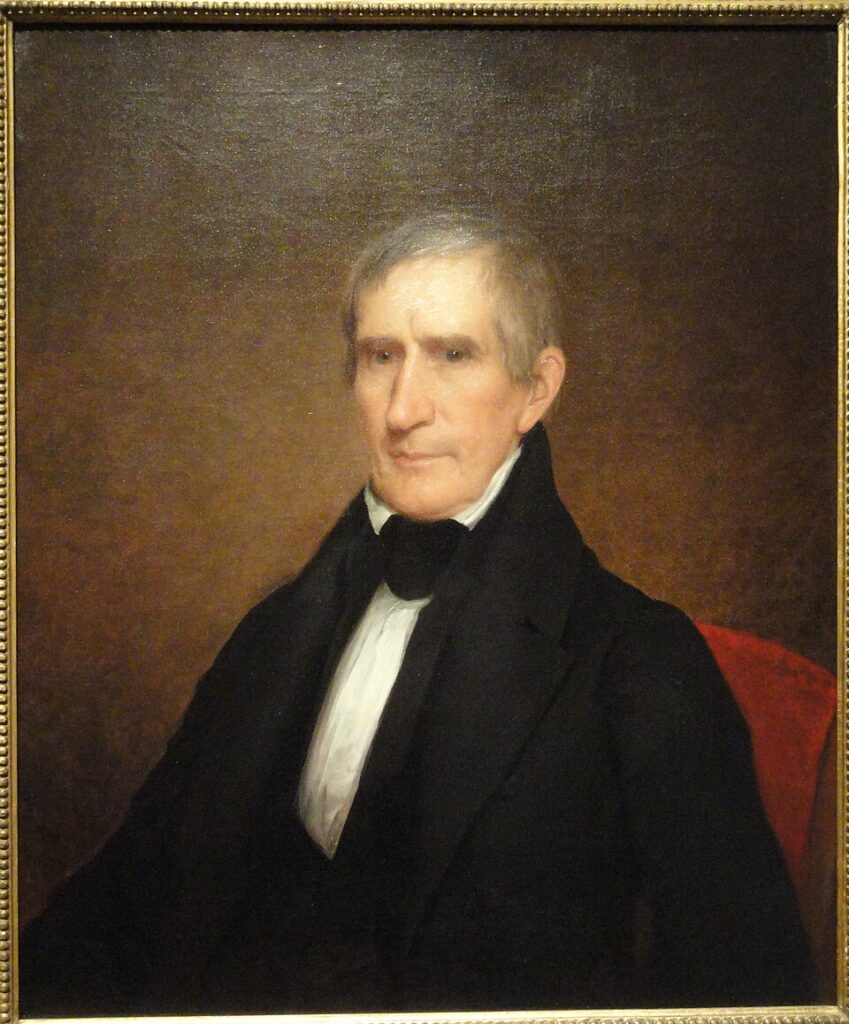
Most ghosts return to a place they knew well. Harrison’s tragedy is the opposite. He haunts a house he never really got to live in.
Thirty-one days
Harrison delivered a punishing inaugural address on a cold, wet March day in 1841 without a coat or gloves. He fell ill soon after and died on April 4, the first president to die in office. His entire administration lasted barely a month. He left behind no laws, no reforms, only a vacancy and a story.
His ghost appears in the attic, sometimes described as having a faint blue glow and a hacking cough, forever rummaging. The detail reads almost unbearably sad.
The curse he started
Harrison anchors one of the most famous patterns in American folklore, the so-called Curse of Tippecanoe. The story traces it to 1811, when Harrison’s forces defeated a Native American alliance at the Battle of Tippecanoe and burned Prophetstown. Legend holds that Tenskwatawa, brother of the leader Tecumseh, cursed the presidents to come.
From 1840 onward, every president elected in a year divisible by twenty died in office, from Harrison through Lincoln, Garfield, McKinley, Harding, Franklin Roosevelt, and Kennedy. Reagan, elected in 1980, survived an assassination attempt, and the streak broke. Historians treat the pattern as coincidence and folklore rather than fact, a textbook case of cherry-picked dates. The legend persists anyway, because a tidy twenty-year rhythm is difficult to forget.
The campaign that killed him
There is a bitter irony in how Harrison died. He won the 1840 election on a carefully crafted image as a rugged frontier soldier, the hero of Tippecanoe, sold to voters with log cabins and hard cider. To prove his vigor, he delivered the longest inaugural address in history, running well over an hour, outdoors, hatless and coatless, in cold March rain.
The performance of toughness became the cause of his collapse. He fell ill within weeks and died on April 4, 1841, after roughly a month in office. The man who campaigned as indestructible became the first president to die in the job, undone by the very image he sold. The attic ghost, searching forever for something it cannot name, is a fitting afterlife for a presidency that never had time to discover its purpose.
Respecting the real history
The Curse of Tippecanoe makes for an irresistible story, but it rests on real people and a real tragedy that deserve recognition. Tecumseh was a brilliant Shawnee leader who tried to unite Native nations against the loss of their lands. His brother Tenskwatawa, known as the Prophet, led the spiritual side of that resistance. Harrison’s forces broke the alliance at Tippecanoe in 1811 and burned Prophetstown.
Folklore later reframed the event as a supernatural revenge plot, with the curse striking down zero-year presidents from Harrison to Kennedy. Reagan’s survival in 1981 broke the streak, and historians and skeptics treat the whole pattern as coincidence dressed up as fate. We should recognize both truths at once. The curse is a compelling piece of American mythology, and it is also a story that flattens a genuine Indigenous struggle into a spooky footnote. The attic ghost is folklore. The dispossession that produced him was not.
A presidency that became a cautionary tale
Harrison’s afterlife in folklore outsizes his actual presidency by an almost comic margin. He governed for roughly a month and passed no significant legislation, yet he anchors one of the most durable legends in American political culture. The reason is structural: a story needs a clean starting point, and Harrison’s sudden death in 1841 gave the curse legend its perfect origin.
That mismatch, between a tiny presidency and an enormous myth, is itself the lesson. Harrison is remembered not for what he did but for what happened to him and for the eerie pattern his death seemed to begin. The attic ghost rummaging endlessly captures that emptiness precisely. There is nothing to find because there was no presidency, only a vacancy and a story that grew to fill it.
Modern skeptics have thoroughly dismantled the curse as statistical coincidence, noting the cherry-picked dates and the streak’s clean break with Reagan. Yet the legend persists because it does emotional work that facts cannot. It imposes meaning on a string of presidential deaths that would otherwise feel random and frightening. A curse, however false, is strangely easier to live with than pure chance. Harrison’s ghost endures for the same reason the curse does: people prefer a story to a void.
In the end, Harrison may be the most American ghost of all. He won the highest office through spectacle, held it for a heartbeat, and left behind a legend far larger than the man. The attic ghost searching forever for something it cannot find is almost a parable about ambition that arrives too late to mean anything. He reached the summit and found only boxes in an attic.
So the attic ghost rummages on, searching a house that barely knew him, anchoring a curse that historians have long since debunked. Harrison wanted the presidency badly enough to risk his health for it, and it cost him everything within a month. Few American lives turn so completely on a single cold and rainy morning.
More in This Series: White House Hauntings
- The Cabinet of the Dead: Inside the Most Haunted House in America
- The Resident Who Never Left: The Strange Persistence of Lincoln’s Ghost
- Old Hickory’s Eternal Grudge: The Auditory Haunting of Andrew Jackson
- Laundry in the East Room: The Eternal Diligence of Abigail Adams
- The Ghost Who Stopped the Shovels: Dolley Madison’s Floral Legacy
- Faint Melodies in the Yellow Oval Room: Thomas Jefferson’s Spectral Violin
- Proposals in the Blue Room: The Romantic Specter of John Tyler
- Echoes of Sad Things: The Haunted Weight of the Johnson Years
- Death in the Executive Mansion: The Lingering Presence of Zachary Taylor
- The Bride of the Blue Room: The Eternal Youth of Frances Cleveland
References & Further Reading
Wikipedia: Curse of Tippecanoe
White House Historical Association: William Henry Harrison
Fairweather Lewis: Ghosts of the White House
Theresa’s Haunted History: The Attic Ghosts of the White House
Benjamin Harrison Presidential Site: The White House of Horrors
For more on this topic, see our complete guide to the Ghosts of the Founding Fathers and the Haunted White House.


[…] One Month in Office, Eternity in the Attic: The Harrison Haunting […]