The famous porch photo is real, but the date attached to it rarely is.
An Inn That Became an Army Camp Overnight
Built around 1797 along the Chambersburg Pike, the Cashtown Inn earned its name from an innkeeper who accepted only cash. That policy outlived the man who set it, giving the whole crossroads village its permanent name.
For decades the inn served ordinary travelers moving between Chambersburg and Gettysburg, offering food, a bed, and little else worth recording. That quiet history changed completely in the span of a single week in 1863.
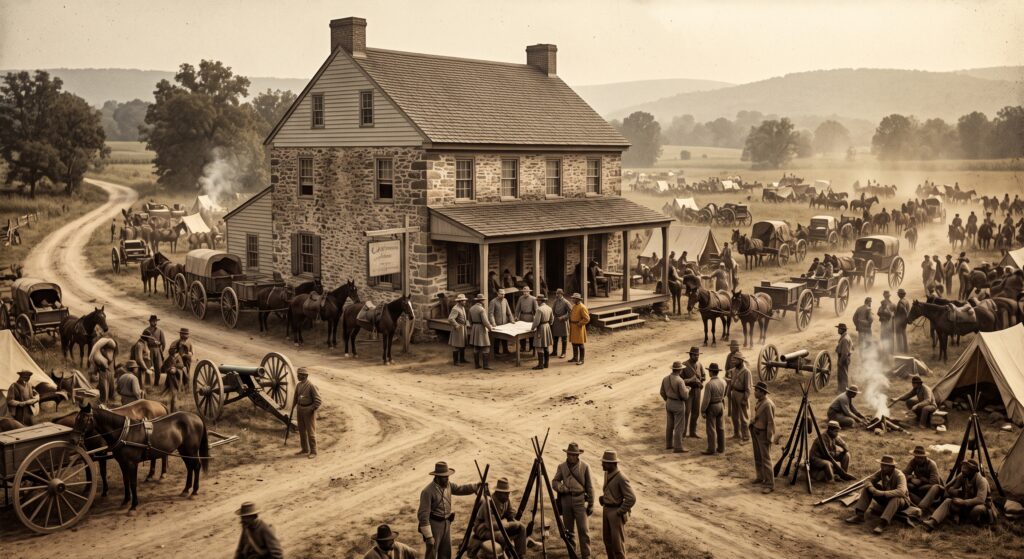
In late June 1863, Confederate General A.P. Hill made the inn his headquarters as Lee’s army converged on the area. Generals Henry Heth and John Imboden passed through as well, and the surrounding fields filled with wagons, cannon, and thousands of soldiers within days.
When the fighting at Gettysburg began eight miles away, the inn’s cellar became a surgical theater. Surgeons reportedly performed so many amputations that severed limbs piled outside the cellar window, blocking daylight from entering the room below.
The inn’s owner later tallied his own losses from that week separately from the human cost. He lost a wagon, a horse, a steer, fifty chickens, a hundred apple trees, and nearly five hundred gallons of whiskey and brandy to the passing armies.
The Photograph That Launched a Legend
Sometime after the war, someone photographed the inn’s front porch. The image shows one clearly focused man standing near the doorway, and beside him, a second figure that appears translucent.
You can make out his stance and the rough shape of his legs, but a porch post is visible straight through his shoulder. He casts no shadow, and he does not match the sharpness of the man standing beside him.
Paranormal writers have circulated this image for decades as proof of a lingering Confederate spirit. One retelling insists the transparency defies photographic explanation, ruling out both blur and double exposure outright.
That confidence outpaces what the photograph itself can support, and the date usually attached to it deserves scrutiny too. Most retellings imply the photo dates to the Civil War years themselves, which would make the figure a contemporary witness rather than a later visitor.
What Old Cameras Actually Do to People
A separate paranormal reference source dates the same photograph to 1896, roughly thirty-three years after the battle. That detail rarely survives in retellings, since a Civil War-era photo carries far more dramatic weight than a Gilded Age one.
The same source also offers the far more mundane explanation that many retellings skip entirely. Cameras from this period required subjects to stand motionless for several seconds. Anyone who moved during that exposure would appear blurred, faint, or partially see-through, while a stationary subject stayed sharp.
That is a well-documented quirk of early photography, not a paranormal anomaly. A person shifting their weight or walking past the lens would produce exactly the transparent effect visible in the Cashtown photo. So would someone who simply failed to hold still for the full exposure.
None of these details proves the figure was an ordinary passerby rather than something stranger. The photo’s most dramatic claim that it defies any earthly explanation is somewhat inaccurate. The camera itself offers one.
Does the Validity of the Photo Really Matter?
Skepticism about one photograph does not erase what actually happened inside the inn. Real amputations took place in that cellar. Actual generals planned troop movements from their rooms hours before one of the war’s bloodiest battles began nearby.
Guests today report heavy boots pacing empty hallways and doors that rattle with nobody behind them. Some describe the sudden smell of pipe tobacco in rooms where no one smokes. A swing on the porch reportedly moves with no wind and no rider.
Whether or not the transparent man on the porch was ever a spirit, the inn does not need him to justify its reputation. A cellar that swallowed daylight under a pile of amputated limbs earns its haunted status without any help from a camera’s limitations.
The Cashtown Inn remains open today, still welcoming guests into rooms named for the generals who once planned a war from its floorboards.
A Building Renovated, Not Erased
Recent owners have worked to restore the inn’s oldest features rather than cover them further. Beneath multiple layers of modern flooring, they uncovered the original wide plank boards where Hill and Lee reportedly once paced while planning their next move.
Some paranormal researchers claim renovation work like this tends to quiet a haunted building’s activity, disrupting whatever pattern the previous decades established. Cashtown Inn’s guest logbooks, kept since 1996, suggest reports have continued anyway, if perhaps in a gentler form than before.
Visitors can still request rooms named after the Confederate generals who once stayed there. They sleep in the same spaces where wounded men once waited for surgery, just steps below the floorboards.
That continuity, a building still standing, still hosting guests, still carrying its original name and function, is rare for a structure of this age. Cashtown’s ghosts may or may not be real, but the inn’s survival across two centuries certainly is.
Anyone booking a room here today sleeps under the same roof that once sheltered generals plotting a battle that changed the country. Whatever else lingers in the hallways, that history alone justifies the trip.
The transparent man on the porch may never get a firm explanation either way. Its floorboards, and the cellar below them, do not need one. They were there, and what happened in them is beyond dispute.
That is ultimately the most honest way to leave the story. One photograph invites debate. A cellar full of documented amputations does not, and it never has.
[…] holds the scars of the Civil War. The field hospitals of Cashtown and the bloody ground of Gettysburg remain some of the most active haunted sites in the country. In […]