Imagine dying in one city, resting in peace for twenty-seven years, then being dug up and shipped hundreds of miles to a strange new grave.
According to Richmond folklore, that is exactly what happened to James Monroe. His spirit, the legend says, never made sense of the disruption.
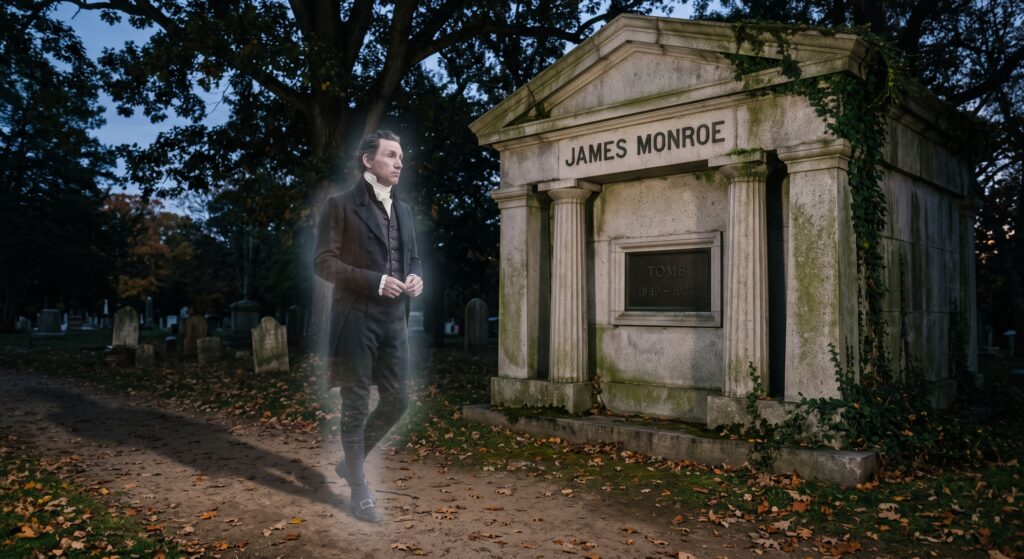
Witnesses claim his ghost wandered confused between two states, searching for a resting place that would not stay put. Today he lies inside a striking iron cage at Hollywood Cemetery.
Some say the fifth president is still trying to figure out how he ended up there.
The Soldier and the Statesman
Monroe was far more than a diplomat and a president. In life he was tall, broad, and physically imposing, a genuine Revolutionary War soldier who bled for the cause of independence.
At the Battle of Trenton in 1776, a musket ball struck his shoulder and lodged near an artery. Surgeons could not safely remove it. He carried that lead in his body for the rest of his life, a permanent souvenir of the war for the nation he would one day lead.
His career climbed steadily after the war. He served as a diplomat, a governor, a senator, and a secretary of state before winning the presidency. His two terms gave the country the Monroe Doctrine and a stretch of national confidence.
Then he died on July 4, 1831, in New York City. He became the third president to die on Independence Day, following John Adams and Thomas Jefferson. His family buried him in a crypt in the city, and for a time, the matter seemed settled.
The Presidential Relocation
Virginia wanted him back. In 1858, in a burst of state pride tied to Monroe’s centennial year, officials exhumed his remains. They transported the body south to Richmond, his home state’s capital.
They reinterred him at Hollywood Cemetery, a rolling burial ground that holds Confederate dead, other presidents, and generations of Virginia luminaries. The setting was grand, the intent was honor, and the disturbance was real.
They housed him in something unusual. A gothic cast-iron monument, ornate and cage-like, encloses his tomb. Visitors nicknamed it the Birdcage. Its dark spires and iron tracery give the grave a brooding, theatrical gloom found nowhere else in the cemetery.
Cemetery legend claims the move unsettled his spirit. Soon after the exhumation, people reported seeing his ghost near his old New York crypt, looking lost and bewildered. Then the figure would vanish and reappear far away in Richmond, as if chasing after his own scattered bones.
The Vigil in the Birdcage
At Hollywood Cemetery, the sightings settle into a quieter pattern. Witnesses describe Monroe seated near his tomb in deep contemplation. Some say he nurses the old shoulder wound that never fully healed in life.
Others report a more imposing sight. They claim to see his broad, muscular figure standing inside the iron cage at night, still and watchful behind the gothic bars. The image is striking, a soldier-president framed by dark ironwork like a portrait in a haunted gallery.
The monument shapes the entire mood of the haunting. Its cage-like design turns a simple grave into something that looks purpose-built for a ghost. The legend rose to match the architecture, feeding on the drama of the ironwork.
Visitors often linger at the spot, drawn by both the history and the strangeness. The Birdcage is one of the cemetery’s most photographed graves, and its atmosphere tells much of the story.
A Founder’s Long Journey Home
Monroe belonged to the last of the founding generation to hold the presidency. He fought in the Revolution as a young man, crossed the Delaware with Washington, and carried a wound from that war for life.
His death on the Fourth of July linked him to the two presidents who died on that date before him. The coincidence struck many Americans as almost providential, a sign of the founders’ special bond with the nation’s birthday.
For twenty-seven years he rested in New York, far from the Virginia soil that shaped him. Then his home state reclaimed him, moving his remains to Richmond in a grand act of civic pride.
The relocation was meant as an honor. Yet folklore turned it into the source of his unrest, the disturbance that supposedly left his spirit wandering between two graves.
Where the Dead Draw Crowds
Hollywood Cemetery is no ordinary graveyard. Perched above the James River, it holds two presidents, a Confederate general, and thousands of soldiers, all among rolling hills and dramatic monuments.
The cemetery leans into its history and its legends. Visitors come for the views, the statuary, and the stories, and Monroe’s iron birdcage is one of its signature sights.
That atmosphere shapes how people experience the Monroe legend. Standing before the gothic ironwork at dusk, with the river below and the old graves all around, the imagination needs little encouragement.
The setting does half the work of the haunting. A tomb built like a cage, in a cemetery built for contemplation, almost demands a ghost story to complete it.
The Gothic Aesthetic of Mourning
There is a gentle irony at the center of this legend. Monroe spent his life moving with purpose, from the battlefield at Trenton to statehouses, embassies, and the world stage. He was a man who acted on his terms.
In death, others moved him without asking. They opened his crypt, carried his remains across state lines, and sealed him inside an iron monument he never chose. The confusion the folklore describes almost feels earned.
The nineteenth century loved this kind of ornate, gothic mourning. Elaborate ironwork and dramatic monuments turned cemeteries into places of somber spectacle. Monroe’s tomb became a centerpiece of that fashion, and the ghost story grew alongside it.
If his spirit truly lingers in the birdcage, perhaps it wants something simple. After a life of service and an afterlife of interruption, it may only be waiting to be left, at last, in peace behind the iron bars.
References & Further Reading
• Listverse: Locations Haunted by U.S. Presidents