Boston visitors feel an authoritative chill beside his monument, but history suggests his body may not even be there anymore
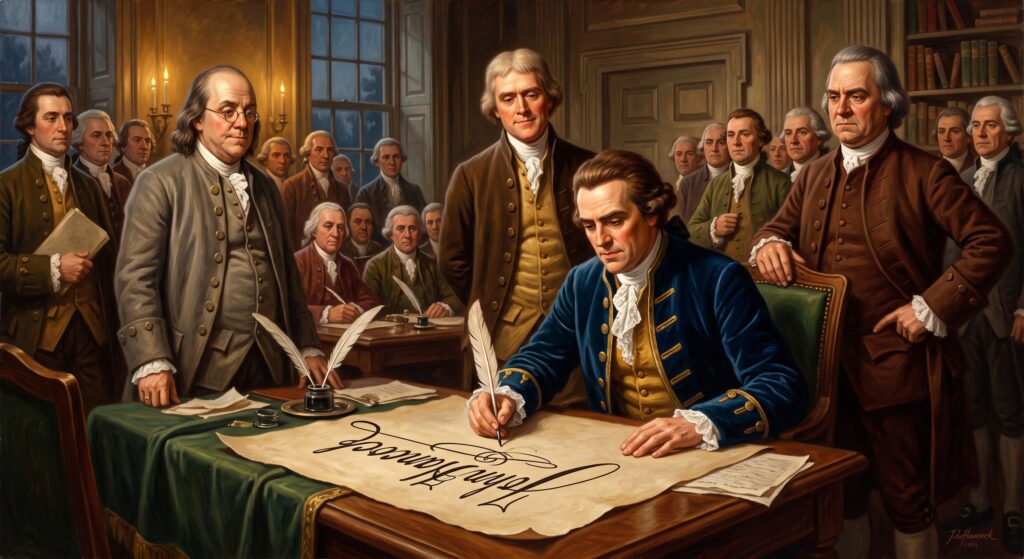
The Man Behind the Famous Signature
John Hancock became the first delegate to sign the Declaration of Independence on August 2, 1776. He penned an iconic, flamboyant signature nearly five inches long, and his name has meant “signature” in American English ever since. Legend holds that Hancock wanted his name large enough for King George III to read without his spectacles. Historians cannot fully verify the story, but it captures Hancock’s flair for public gesture.
Hancock was already one of the wealthiest merchants in the colonies before the war, having inherited a shipping fortune from his uncle. He served as President of the Second Continental Congress. He then became the first governor of Massachusetts, a position he held for most of the rest of his life. When he died in 1793 at age fifty six, Boston gave him the largest funeral the state had ever seen.
He was buried in the Granary Burying Ground, a cemetery founded in 1660 that now holds Paul Revere, Samuel Adams, James Otis, and five victims of the Boston Massacre. A tall, elaborately carved obelisk marks his grave along the far wall today, though it was not the marker originally placed above him.
A Chill With No Explanation
Unlike Wythe’s visually active haunting in Williamsburg, Hancock’s presence is described as something felt rather than seen. Visitors standing near his monument report sudden, sharp temperature drops even on warm days.
Photographers describe unexplained mist and shadows appearing in images taken near the obelisk, with nothing visible to the naked eye at the time. Many report an overwhelming sensation of being watched by someone used to command.
The Legend of the Missing Hand
Local lore adds a gruesome detail that may explain some of that unease. According to the story, grave robbers tried to steal the rings from Hancock’s fingers not long after his burial. When the rings would not slip off easily, the thieves allegedly cut off his hand and fled with it still attached.
No period document confirms this story, and historians treat it as unverified legend rather than fact. Still, the tale has circulated for well over a century, passed from guidebook to guidebook with the same grim details intact. Some versions add that the thieves took both hands rather than one, unwilling to risk being caught working slowly on stubborn fingers in a dark cemetery.
The Grave That May Be Empty
Here is where the story gets stranger than any single missing hand. In the mid-1800s, workers renovating a basement on nearby Park Street accidentally broke through the wall of several old burial vaults, Hancock’s included. Bricks, stones, and skeletons tumbled down into the basement excavation below.
According to an 1886 account, the workers cleared the debris using the bricks and stone for their own project, since building material was building material regardless of its history. Hancock’s lead coffin was reportedly sold and melted down into plumbing pipes, and the remaining bones were treated as ordinary rubble rather than the remains of a former governor. The tall obelisk visitors see today was not erected until 1896, a full decade after that account surfaced, replacing an older marker that had already deteriorated past recognition.
No one has ever definitively proven whether Hancock’s remains still rest beneath that monument or whether they scattered into a Boston basement over a century ago. That uncertainty may explain the unease so many visitors report. You may be standing beside a grave, a monument, or simply an empty patch of consecrated ground.
A Life That Matched the Legend
Hancock’s flair for theater extended well beyond his signature. He funded much of the early resistance movement personally and hosted lavish parties for revolutionary leaders. He even rode into his own governorship inauguration with a level of ceremony some contemporaries considered closer to royalty than republicanism. Critics in his own era accused him of vanity, while supporters saw a leader who understood that a new nation needed confident, visible symbols.
He was also notoriously careful with money for someone so willing to spend it publicly, a contradiction his contemporaries noted often. That mix of generosity and calculation may explain why witnesses describe his presence as commanding rather than warm. He gave generously, but he always expected the gesture to be noticed.
That larger-than-life persona may help explain why his afterlife reportedly feels so different from those of other signers. Where Wythe’s ghost seems trapped reliving a specific injustice, Hancock’s presence reads more like a lingering assertion of authority. He remains a governor who still expects the room, or the graveyard, to notice when he arrives.
A Note on the Wrong Hancock Building
One quick correction worth making. The John Hancock Center skyscraper in Chicago has its own reputation for hauntings, including reports tied to construction accidents and the death of comedian Chris Farley. That tower takes its name from an insurance company, not from the Founding Father. John Hancock’s own restless energy, real or imagined, stays firmly in Boston.
Visiting the Granary Burying Ground
The Granary Burying Ground sits on Tremont Street in downtown Boston and is open daily, generally from around 9 a.m. to 4 p.m. It remains free to visit and forms part of the official Freedom Trail.
Whether or not you feel that authoritative chill near the obelisk, the Granary rewards a slow walk rather than a rushed photo stop. Between Hancock, Adams, Revere, and the Boston Massacre victims, a small patch of ground carries an outsized share of the nation’s founding story. That holds true whether or not the hand, or even the body, remains.
Bring comfortable shoes and expect company. The cemetery draws over a million visitors annually, and Hancock’s obelisk, being the tallest marker inside the gates, is usually easy to spot even through a crowd.
References & Further Reading
The hand that belonged to John Hancock – Gravely Speaking
NEW ENGLAND FOLKLORE: John Hancock’s Uneasy Afterlife
Granary Burying Ground – Boston.gov
Cemetery of the Week #61: Granary Burying Ground – Cemetery Travel
For more on this topic, see our complete guide to the The Most Haunted Places in America: A State-by-State Guide.


[…] Corwin Curse, while Boston’s colonial history echoes through the Green Dragon Tavern and the Granary Burying Ground. Further west, the ghosts of Minute Man National Historical Park still […]
[…] the Granary Burying Ground holds the uncertain grave of John Hancock, where visitors report a distinct, freezing presence. The eccentric patriot James Otis Jr., who […]