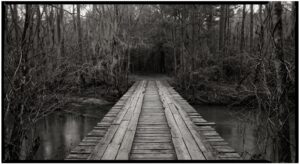
You noticed it somewhere around mile marker fourteen. A soft white glow at road level behind you, keeping pace. Not quite a headlight, too diffuse, too low, unpaired. You sped up, and it matched you. You slowed, and it matched you. At the crossroads you pulled over, and it simply was not there anymore. In the morning, locals told you that happens on this road. Has for a hundred years.

Ghost lights, persistent, mobile, unexplained lights observed at ground level on rural roads and open landscapes, are among the most consistently documented paranormal reports in the world. They appear on every inhabited continent, have their own regional names and folklore traditions, and have attracted formal scientific investigation programs. They are, by any reasonable measure, a real phenomenon. What they actually are is where the serious disagreement begins.
The Standard Explanation and Where It Falls Short
The most common debunking of ghost lights relies on distant headlight refraction, atmospheric conditions bending light from vehicles on a far highway into an apparent moving source closer to the observer. A University of Texas at Dallas study concluded that headlights from vehicles on Highway 67 explain a significant portion of documented Marfa Lights sightings, and this explanation is correct for many cases.
It does not account for the historical record predating motor vehicles, the cases where lights behave in ways inconsistent with any refracted source, or the sustained scientific investigation programs that have produced data pointing toward genuine atmospheric and geological phenomena. The honest assessment requires looking at specific documented cases rather than applying a single explanation across all of them.
The Marfa Lights
The Marfa Lights have been observed near the West Texas town of Marfa since at least the 1880s, long before the automobile era. Ranchers, Indigenous people of the region, and early settlers all documented the phenomenon. The Texas Department of Transportation eventually constructed a designated viewing area nine miles east of Marfa on US Highway 67, and the lights have become one of the state’s most significant tourist attractions.
Scientific hypotheses range from atmospheric optical effects, mirages produced by temperature-layered air bending light from distant sources, to piezoelectric discharge from the volcanic rock beneath Mitchell Flat. The piezoelectric theory holds that pressure on crystalline rock generates electrical charge, which, under certain atmospheric conditions, can manifest as plasma-like luminescence. The most responsible scientific position acknowledges that the historical record and the physical behavior of certain lights—splitting, merging, hovering, and accelerating in ways inconsistent with any known refracted source—remain not fully explained.
The Hessdalen Lights
The Hessdalen Valley in central Norway has generated sustained unexplained light sightings since at least the 1930s, with a particularly intense period in the early 1980s attracting formal scientific investigation through Project Hessdalen, established in 1983 and still active today. The project has produced the most rigorous sustained dataset of any ghost light phenomenon in the world.
A 2007 analysis using cameras and intensity plots pointed toward combustion of airborne dust meeting geological gases as a contributing mechanism, with the Norwegian press briefly declaring the mystery solved. Subsequent researchers have found the explanation incomplete. Other proposals include piezoelectric activity from the region’s significant scandium deposits generating self-sustaining plasma phenomena. No single explanation accounts for all observed characteristics, and the lights continue to be measured.
The Brown Mountain Lights
The Brown Mountain Lights in the Appalachian foothills of North Carolina have been reported for centuries, with Indigenous oral traditions referring to them predating European contact. United States Geological Survey investigations have been conducted multiple times since 1913. A 1922 USGS study attributed the majority of observations to locomotive, automobile, and stationary light refraction. But accounts persist of lights seen under conditions that rule out those sources, including observations during the 1916 and 1940 floods, when no traffic was moving through the area at all.
The Folklore Framework
Ghost light folklore follows remarkably consistent narrative templates across independent cultures. The lantern bearer, a figure who wanders with a light, searching for something lost or guiding travelers toward danger, appears in North Carolina’s Brown Mountain legend, in British will-o’-the-wisp traditions, in Finnish and Scandinavian marsh ghost lore, and in Australian Min Min Light accounts. The cultural universality suggests either a common human tendency to narrativize unexplained luminescence in terms of the searching dead or a common experience of an actual phenomenon that produces similar stories independently.
What to Do If You See One
Stop the vehicle safely and note the time, your location, the light’s apparent size, color, height above ground, and whether it responds to your own lights or vehicle movement. Take video if possible; standard phone cameras in auto mode often fail to capture subtle luminescence, so switch to manual exposure if you can.
Check whether your location correlates with known ghost light sites. Several documented databases cover most US states and a number of other countries. The most valuable contribution any witness can make is an independent account from a location that already has a report history. If you are the hundredth person to see a light on that road, your account adds to a pattern that may one day yield a definitive explanation.
References & Further Reading
• Texas State Historical Association: The Marfa Lights
• TVI Show: The Hessdalen Lights, Norway’s Ongoing Light Phenomenon