For over a century, a mysterious light appeared along the railroad tracks near Maco, North Carolina, west of Wilmington. Witnesses described a single glowing light that moved along the rails, swinging as if someone carried it by hand. Sometimes it appeared as one light, and sometimes as two lights of different colors.
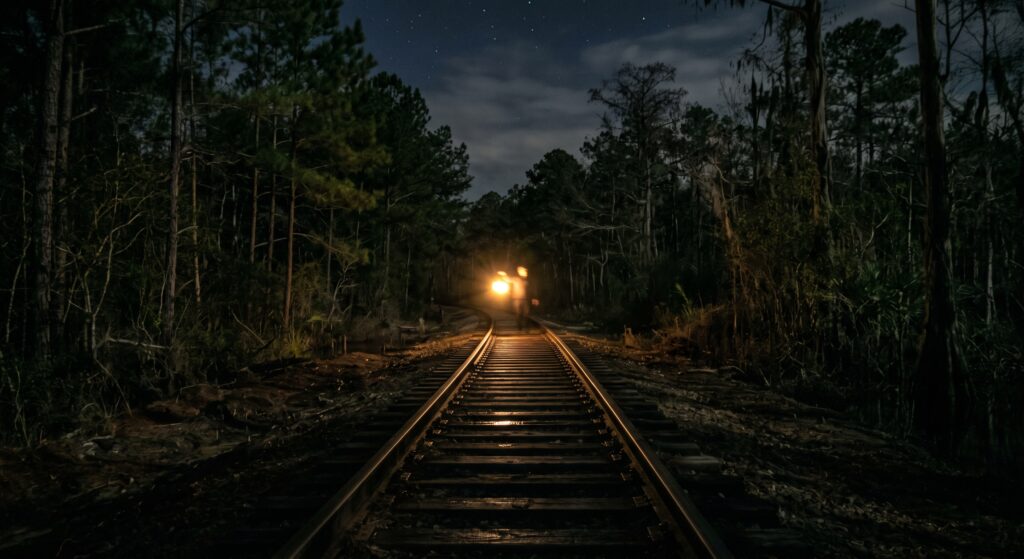
The Maco Light became one of the South’s most famous railroad ghost stories. The light drew crowds for generations. People parked near the tracks at night, hoping to watch it approach along the line. Its fame spread far beyond the local area.
According to popular accounts, the light attracted notable visitors over the years, and it appeared in newspapers and books about Southern folklore. The Maco Light became a fixture of North Carolina ghost lore, tied inseparably to the railroad that crossed the swampy coastal lowland.
The legend of Joe Baldwin
The classic story names the ghost Joe Baldwin, a railroad brakeman or conductor. According to legend, Baldwin was riding in the last car of a train when it became uncoupled and stalled on the tracks. Seeing another train bearing down, he stood on the rear platform and frantically swung his lantern to warn it off.
The oncoming train could not stop in time. The collision killed Baldwin, and legend says the impact took off his head. His body and head were reportedly never reunited. The story holds that his ghost still walks the line, swinging his lantern in an endless search for his missing head in the dark.
It is a vivid and tragic tale that gave the light its identity and its eerie purpose. As with most ghost lights, the specific details of Baldwin’s death are folklore, embellished and reshaped over decades of retelling. Records do not cleanly confirm the dramatic decapitation at the heart of the story.
The natural explanations
Skeptics offered grounded theories over the years. The most common explanation is distant headlights or lantern light. Such light, refracted and channeled along the flat, swampy terrain, could travel toward viewers on the tracks and appear to move and swing.
Others proposed swamp gas, reflections off the rails, or other atmospheric effects. The behavior of the Maco Light fit the general pattern seen at other Southern railroad ghost lights. That pattern pointed toward a mundane physical cause rather than a wandering spirit.
The single most telling fact is what happened next. The railroad tracks at Maco were removed in the late 1970s. After the tracks came out, the light reportedly stopped appearing entirely. That timing strongly supports a mundane cause tied to the rail line and its sightlines, rather than a ghost independent of the tracks.
The legend’s afterlife
With the tracks gone and the light no longer reported, the Maco Light now lives on in story rather than in sightings. It remains a cornerstone of Wilmington-area folklore and a favorite example of the classic American railroad ghost light.
The disappearance of the light along with the rails tells its own quiet, revealing story about the phenomenon’s likely origin. Joe Baldwin’s headless search is pure legend, but a memorable one. The Maco Light endures in the region’s imagination even though no one can watch it swing along the rails anymore.