The driver pulled over because the young woman looked stranded. She was pale, her dress was wrong for the weather, and she gave an address across town. She was quiet the whole ride. When the driver reached the address and turned around to ask which house, the back seat was empty. He knocked on the door anyway. An elderly couple answered. Their daughter had died on this road, they said. Twenty years ago tonight.
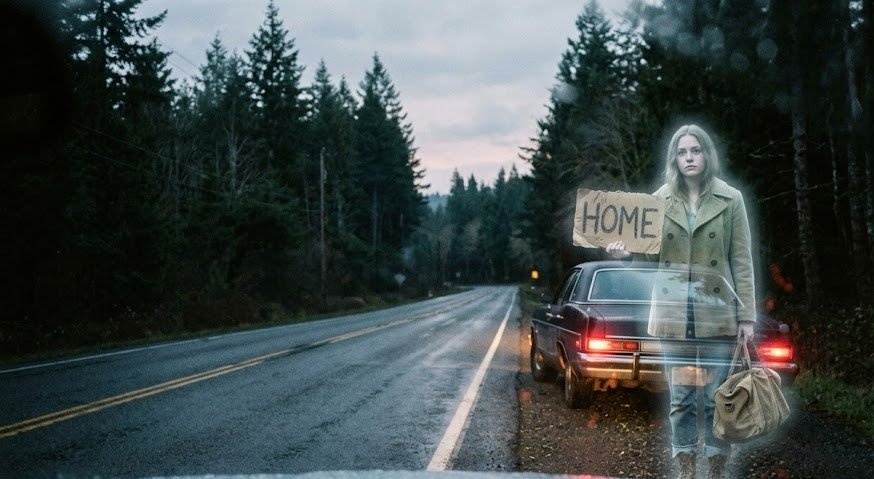
This story has been told in Illinois, Texas, Hawaii, South Korea, and Colombia. The specific details change. The structure does not. The phantom hitchhiker is one of the most globally consistent folk narratives ever documented, and understanding how it spreads, mutates, and roots itself to specific roads tells you something important about how communities process grief, fear, and the strangeness of travel.
Older Than the Automobile
Most people assume the phantom hitchhiker is a twentieth-century American story, born from car culture and highway anxiety. The scholarship tells a considerably older story. Folklorist Jan Harold Brunvand, whose 1981 book The Vanishing Hitchhiker remains the foundational scholarly text, traced versions to at least the 1870s in American newspaper records. Other researchers have pushed the documented history further, to a 1602 account of a priest and two farmers in Vastergotland, Sweden, who picked up a maid on the road who subsequently vanished.
The legend connects to Roman road ghosts dispensing wisdom to travellers, to a New Testament account in Acts where the Apostle Philip appears to an Ethiopian charioteer and then disappears, and to the Scottish tradition of ghost travellers on horseback. The automobile did not create the phantom hitchhiker. It gave an ancient story a new vehicle.
Four Core Variants
American anthropologists Richard Beardsley and Rosalie Hankey collected 79 accounts across the United States in their 1942-43 study and identified four structural variants that account for almost every version of the legend:
- The hitchhiker gives an address; the driver learns afterward that the hitchhiker was a ghost who died near the pickup location. This is the most common version, found across 16 states.
- The hitchhiker delivers a prophecy or warning before disappearing, often predicting a disaster that subsequently occurs.
- The hitchhiker requests a specific destination, typically a church or cemetery, and disappears on arrival.
- A more intimate variant in which the hitchhiker and driver develop a relationship across multiple encounters before the truth is revealed.
Regional American Variants
Illinois, Resurrection Mary
The Archer Avenue corridor in Chicago is home to the most documented American version. A young woman in white is reported near Resurrection Cemetery, asking for rides to a dance hall and vanishing before arrival. Independent accounts stretch back to the 1930s. The location is specific and consistent across nearly a century of reports, with the most recent credible sightings occurring well into the 2000s.
Hawaii, The Goddess on the Road
In Hawaii the hitchhiker is identified with the volcano goddess Pele, who tests drivers and rewards or punishes them based on their behaviour. This represents a deliberate cultural adaptation of the European template to a specifically Polynesian spiritual framework, the same structural story, carrying entirely different theological weight.
Texas and the Southwest
Several documented Texas variants involve a recurring male hitchhiker who offers no conversation, leaves no trace, and is identified post-journey as a soldier killed in a highway accident. Route 66 has generated its own sustained variant tradition, with spectral figures reported at specific mileposts across multiple decades.
International Variants
The cross-cultural reach of the legend is striking. A 1980s French account describes a truck driver who picked up a young woman near Marseilles; she left a scarf in his cab but vanished during the ride. When he brought the scarf to her address, her parents confirmed she had died in a motorcycle accident five years earlier, wearing that exact scarf. The Korean ghost of a young woman in hanbok on the Seoul-Busan highway, the South African phantom miners near abandoned gold mines, and the Russian soldier on the road to Moscow all follow the same four-part template Beardsley and Hankey identified in American accounts.
Why the Story Keeps Surviving
Three mechanisms keep the phantom hitchhiker legend alive and geographically specific. Local anchoring attaches the story to actual fatal accident sites, where real deaths create an emotional gravity that makes the legend feel plausible. Template diffusion carries the core structure through oral telling, with each community adapting it to local geography and cultural identity. And media amplification, from the Twilight Zone episode ‘The Hitch-Hiker’ in 1960 to regional newspaper accounts, generates new reports from readers who now have a framework for their own roadside experiences.
The Archer Avenue corridor has generated new independent sighting accounts in every decade since the 1930s. Whether that means something genuinely anomalous persists on that road, or whether an extraordinarily robust cultural script shapes how local residents interpret ambiguous experiences when they drive it alone at night, remains genuinely open. What is not open is that something about that road keeps making people stop their cars.
References & Further Reading
• Atlas Obscura: The Vanishing Hitchhiker Legend Is an Ancient Tale That Keeps Evolving
• Snopes: The Vanishing Hitchhiker
• Curious Roads: Vanishing Hitchhiker, Famous Cases and Urban Legend Origins


[…] Phantom Hitchhiker Stories by State: How Road Ghost Legends Spread […]
[…] dynamic, where a social crisis generates its evidence through the behavior it provokes, appears in paranormal rumor cycles when a building develops a reputation and residents begin reporting experiences that match the […]
[…] Phantom Hitchhiker Stories by State: How Road Ghost Legends Spread […]
[…] Phantom Hitchhiker Stories by State: How Road Ghost Legends Spread […]
[…] Phantom Hitchhiker Stories by State: How Road Ghost Legends Spread […]
[…] Phantom Hitchhiker Stories by State: How Road Ghost Legends Spread […]