You notice it somewhere past mile marker fourteen. A shape at the edge of your headlights, person-height, perfectly still, not reacting to the light. You slow down. By the time you draw level, there is nothing there. In the morning, locals tell you that stretch of road has been like that for years.
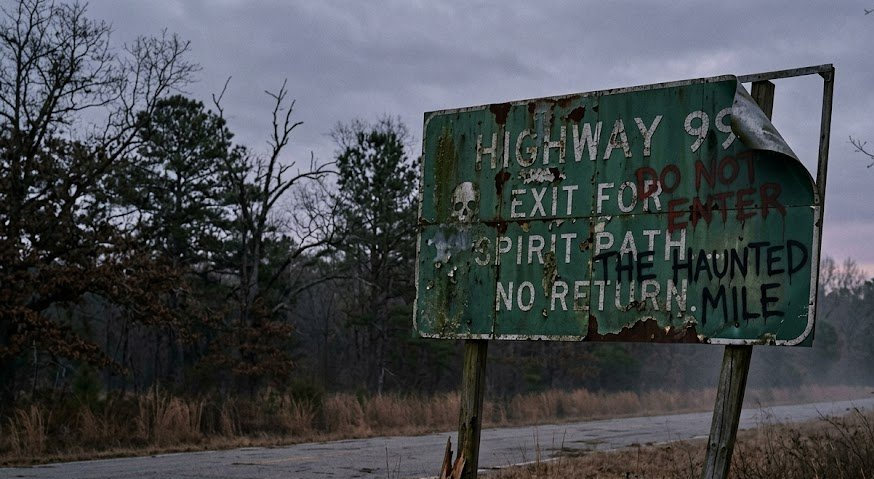
Experiences like this are more common than most people expect. A survey by Lance Surety Bonds found that 13 percent of American drivers have reported a paranormal experience while driving, with 63 percent of those incidents occurring after dark and 55 percent on rural roads or highways. What is actually happening on these roads at night, and what is your brain doing when it turns a roadside shape into something more than shadow?
Why Night Driving Creates the Conditions for Apparitions
Several well-documented psychological and environmental factors converge on rural roads at night to produce experiences that feel genuinely paranormal, even when they are not.
Peripheral vision dominates in low light. The rods responsible for night vision are concentrated outside the fovea, meaning you see better in the dark by not looking directly at something. Objects at the road’s edge register most strongly in your high-sensitivity peripheral zone, and when you shift your gaze to look straight at them, the image dissolves. The figure that was clearly there a moment ago is gone the instant you try to see it properly.
Pareidolia operates on high contrast. The brain’s face and body recognition circuits fire readily on ambiguous shapes in low-light, high-contrast conditions. A reflective post, a roadside memorial cross, a pale tree trunk at the treeline, all can briefly activate the pattern-recognition system before the conscious brain corrects the interpretation. The correction happens fast. The initial perception stays with you longer.
Highway hypnosis compounds both effects. Extended monotonous driving produces a dissociative state in which the visual system processes information without full conscious engagement. Objects experienced during highway hypnosis feel more vivid and strange than they would under normal attentional conditions. The combination of peripheral sensitivity, pareidolia, and hypnotic dissociation on a dark road is precisely the combination most likely to produce a convincing apparition from nothing more remarkable than a fence post.
The Most Reported Roadside Apparition Types
The Standing Figure
A person-shaped silhouette at the road’s edge that does not move and does not respond to headlights. Most commonly reported near bends, tree lines, and road junctions. The stillness is what makes it wrong; a real person at the roadside at night moves, flinches, raises a hand.
The Woman in White
One of the most globally consistent paranormal road motifs. A woman in pale clothing, sometimes in the road itself, sometimes at the verge. Variants appear across the United States, Malaysia, Korea, Australia, Colombia, and the United Kingdom. The consistency across cultures that developed these traditions independently is one of the more genuinely puzzling features of road ghost folklore.
Lights That Follow
Moving light sources at road level that maintain pace with or track a vehicle. These account for some of the most persistent documented road mystery reports and sit in a separate category from apparition sightings, with their own scientific investigation programs. The Marfa Lights in West Texas and the Hessdalen Lights in Norway are the most studied examples.
The Roads With the Longest Records
Clinton Road in New Jersey holds the record for the most sustained paranormal report density in the United States, with accounts spanning decades. Cuba Road in Illinois, near White Cemetery, generates consistent independent reports of orbs, phantom vehicles, and a lantern-carrying woman who vanishes when approached. Route 666, officially renamed Route 491 in 2003, accumulated a striking number of fatality-linked apparition reports during its operational history, along with a persistent problem with sign theft.
What these roads share is not anything obviously supernatural about the road itself. They share a density of documented fatal accidents, a corresponding concentration of roadside memorials, and a community memory that has given the road a specific identity. Once a road is known as haunted, every ambiguous experience on it gets interpreted through that frame. Whether that means the hauntings are purely cultural or whether the emotional weight of a place generates something more is the question that keeps investigators coming back.
What to Do If You See Something
Do not stop on an unlit rural road at night. The physical safety risk of stopping significantly outweighs whatever investigative value the moment might offer. Note your precise location, the time, and a description of what you saw as soon as you can. If you want to return and investigate further, do it in daylight, with company.
Check whether the location has a documented report history. The Wikipedia list of reportedly haunted highways and regional paranormal investigation databases cross-reference locations against historical accounts. If independent witnesses have reported the same shape at the same milepost across thirty years, that pattern is worth taking seriously. If yours is the first account, honest self-assessment is the right response before anything else.
References & Further Reading
• TheStreet: America’s Haunted Highways
• Wikipedia: List of Reportedly Haunted Highways
• Grokipedia: Haunted Highways, Categories and Folklore Analysis
• GSNSP: Haunted Highways, 10 Roadside Ghost Stories Across America
[…] Haunted Road Signs at Night: What Drivers Report and How to Stay Safe […]
[…] Haunted Road Signs at Night: What Drivers Report and How to Stay Safe […]