The Story That Arrived Fully Formed
Urban legends usually develop slowly, accumulating details and variations over decades as they pass through communities. The Black-Eyed Children legend is unusual in that it appears to have a specific, traceable origin point: a 1998 post by Texas journalist Brian Bethel on a ghost-related email list called the Ghost Wrote. Bethel described an encounter in Abilene, Texas, in which two pale children approached his car at night and asked to be let inside. When he looked at them, he noticed that their eyes were entirely black, with no iris or white visible. He felt an overwhelming compulsion to comply with their request, a compulsion he described as distinctly unnatural, and he drove away instead.
That post, and a follow-up account Bethel published a year later, spread through early internet paranormal communities and became the foundation for one of the most distinctive supernatural entities to emerge from the internet era.
What the Accounts Describe
Across hundreds of subsequent reports, collected on forums, submitted to paranormal researchers, and shared on social media over the following two decades, a consistent picture has developed. The children are typically between six and sixteen years old, often in pairs. They approach at night, sometimes knocking on doors and sometimes approaching parked cars. They ask to be let inside, always framing the request as a need: they need to use the phone, they need a ride home, they are lost and cold. The requests are mundane. The children are not.
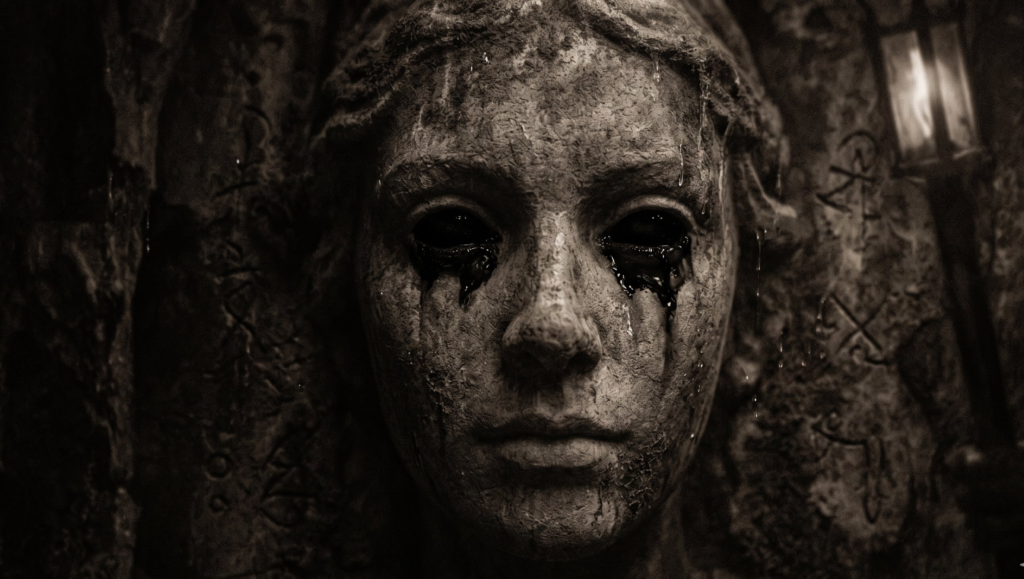
Witnesses consistently report an overwhelming sense of dread, a feeling that complying with the request would be catastrophic without being able to say exactly why. The children are described as pale, often dressed in outdated or nondescript clothing, and speaking with an oddly formal or flat affect. The defining characteristic, the fully black eyes, is described not as a feature noticed casually but as something that produces immediate, visceral fear.
The Spread and the Problem of Verification
Unlike some folklore traditions with deep roots in specific communities, Black-Eyed Children accounts are geographically diffuse. Reports have come from across the United States, the United Kingdom, and internationally. This diffusion is consistent with an internet-born legend spreading through a global audience, but it also means that the accounts cannot be easily assessed through the normal tools of regional folklore study.
Brian Bethel himself has consistently maintained that his original encounter was real. Skeptics have noted that the timing, just as paranormal content communities were developing online, and the completeness of the first account, which contained most of the elements that would define the legend, are consistent with a fabricated narrative that found a receptive audience. Bethel has pointed out that he had no incentive to fabricate the story and no particular public profile that would have benefited from it.
Interpretations Across Traditions
The Black-Eyed Children do not map neatly onto any prior folklore tradition, which is part of what makes them interesting. Some researchers have connected them to demonic encounter narratives, citing the compulsion element and the sense that entry or compliance would constitute a kind of surrender. Others have placed them in the tradition of fairy changelings, beings that resemble children but are fundamentally other. Psychological interpretations have focused on the accounts as expressions of anxieties about children, strangers, and the violation of domestic boundaries.
Why the Legend Endures
The Black-Eyed Children legend is a near-perfect vehicle for a specific category of dread: the encounter with something that looks human, asks for ordinary human things, but is wrong in a way that the conscious mind cannot immediately name. The eyes are the tell, but the fear, according to witnesses, precedes the eyes. That quality, the wrongness that bypasses rational analysis, is among the most consistently reported features of genuinely disturbing paranormal encounters and of effective horror fiction. Whether the Black-Eyed Children are real, fabricated, or something in between, they articulate something true about how certain fears feel.
References & Further Reading
• Know Your Meme: Black-Eyed Children Origin Documentation



[…] The Origin of the Black-Eyed Children Urban Legend […]
[…] The Origin of the Black-Eyed Children Urban Legend […]
[…] of a friend. It is one of the oldest and most studied mechanisms in folklore, and it explains why urban legends, paranormal rumors, and ghost stories feel so much more convincing than fiction ever could. […]
[…] The Origin of the Black-Eyed Children Urban Legend […]
[…] The Origin of the Black-Eyed Children Urban Legend […]