In Egypt and across the Arab world, the night visitor has a name drawn straight from the sensation. Al-Jathoom. That which sits heavily. The broader term for the experience is “kabus,” nightmare.
And this tradition offers something the others only hint at. There is strong evidence here. What you believe about the attacker can change how often, how long, and how terribly you suffer.
This article is one in our series on cross-cultural sleep paralysis experiences; for a deeper dive, click here.
The jinn in the corner
In Islamic understanding, the attacker is a jinn, a powerful spirit created from smokeless fire. Jinn are real theological beings, capable of shapeshifting and, in some traditions, of causing madness, harm, or death.
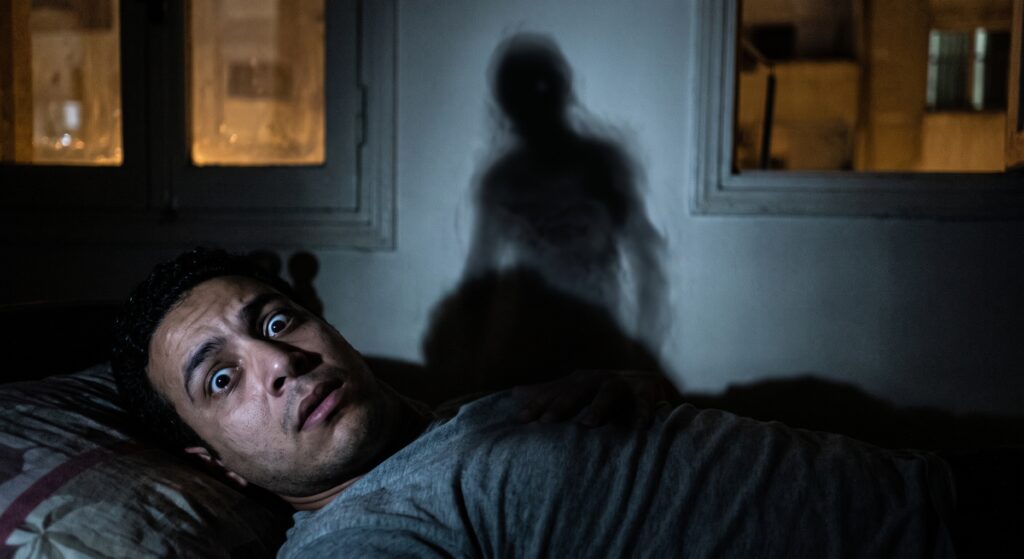
During an attack, the sleeper wakes to find a dark, faceless, or mutated figure standing beside the bed. A crushing pressure bears down on the chest and throat. A heavy force envelops and suffocates them. An overwhelming sense of pure evil fills the room.
The experiment that changed the field
Here is where Al-Jathoom becomes scientifically important. Neuroscientist Baland Jalal compared sleep paralysis in Egypt with Denmark, two cultures with very different beliefs about it.
Egyptians widely interpret the experience as a jinn attack. Danes tend to shrug it off as a harmless physiological quirk. The consequences of that difference are dramatic. Jalal found sleep paralysis to be far more common in Egypt, with his accounts suggesting it was up to around three times as frequent as in Denmark.
Roughly half of Egyptian sufferers feared they could die from an episode, against only about 17 percent of Danes. Egyptians also reported longer paralysis, averaging over five minutes, compared with just over four minutes for Danes, and many more lifetime episodes.
The contrast is stark. Egyptians widely read the event as a jinn attack. Danes shrug it off as harmless biology. Those beliefs produced sharply different rates, durations, and levels of terror.
How belief becomes biology
The mechanism Jalal proposes is a feedback loop, and it is genuinely unsettling. Because Egyptian culture reinforces the reality of a deadly jinn, sufferers go to bed with higher baseline anxiety about being attacked.
That anxiety disrupts sleep architecture and increases the wrong-moment REM intrusions that cause paralysis. When an episode hits, the expected terror amplifies the fear, which prolongs the paralysis, which deepens the dread of the next night. Fear does not just accompany the attack. Fear helps manufacture it.
This is the strongest proof in the whole field that culture shapes the raw experience. The brain supplies the event. Belief can turn the volume up or down.
The loop is what makes this data so important. Fear is usually treated as a reaction to an event. Here, fear is partly a cause of the event. Expectation reaches back and shapes the body’s sleep.
Half of Egyptian sufferers feared death from an episode. Far fewer Danes did. Anxiety about the attacker disrupted sleep further, which invited more attacks. The fear became part of the cause.
The Throne Verse as a calming anchor
Islamic tradition offers powerful defenses. Sufferers recite specific verses of the Quran. Most notable is Ayat al-Kursi, the Throne Verse. They also recite the verses of refuge, Al-Falaq and Al-Nas.
There is a psychological reading of why this practice helps, entirely respectful of its spiritual meaning. During an episode, the mind is trapped in a spiral of panic. Reciting a known, sacred text redirects focus onto familiar words and steady rhythm. That focused attention pulls the mind away from the terror. And as fear drops, the episode tends to shorten. Faith and neuroscience point at the same calm.
The mechanism is the same one that closes this series. Focused attention on a steady, familiar anchor pulls the mind out of its panic spiral. Whether the anchor is scripture or a calm memory, the effect on fear is real.
Islamic tradition offers powerful defenses. Sufferers recite the Throne Verse and the verses of refuge during an attack.
There is a respectful psychological reading. During an episode, the mind spins in panic. Reciting known, sacred words redirects focus to a steady rhythm.
That focused attention pulls the mind away from the terror. As fear drops, the episode tends to shorten. Faith and neuroscience point toward the same calm.
Ancient theology, modern diagnosis
Islamic thought categorized and explained this experience centuries before sleep laboratories existed. The jinn framework gave sufferers a coherent account of a baffling event: why the body freezes, why evil seems present, why the chest is crushed.
That it now maps onto REM intrusion and amygdala-driven fear does not diminish it. It shows an old tradition tracking a real feature of human sleep with remarkable consistency.
The most important data in the field
Of every tradition in this series, Al-Jathoom offers the strongest scientific payoff. The Egypt-Denmark comparison is a natural experiment in how belief shapes the body.
Two cultures. One neurological event. Wildly different outcomes. Where a deadly jinn is expected, episodes are more common, longer, and far more terrifying. Where the event is shrugged off, it stays mild.
This is not speculation. It is measured, replicated, and consistent. Culture is not just decoration on top of sleep paralysis. It reaches into frequency, duration, and fear itself.
The practical lesson is genuinely useful. Understanding the mechanism and lowering the fear around it are not soft comforts. The data suggest it can change the experience itself.
The lesson of the heavy sitter
Al-Jathoom carries the single most practical lesson in this series. The attacker’s power depends partly on what you believe about it.
What weighs heavily feels a little lighter to the sleeper who understands the mechanism. Fear feeds the jinn. Knowledge, calm, and a focused mind starve it. The Egyptian and Danish data prove it is not just a comforting idea. It is measurable.
References & Further Reading
Sleep Paralysis and the Monsters Inside Your Mind (Scientific American, Baland Jalal)
Sleep Paralysis Looks Different in Different Places (TIME, Baland Jalal)