If you’re worried about ghosts more broadly, see our guide on How to Investigate a Haunting: The Complete Guide to Ghost Hunting.
TL;DR
Old Hag Syndrome is the folk name for sleep paralysis paired with hallucinations. You wake fully aware, unable to move, with a crushing weight on your chest and the certainty that something threatening is in the room. It is a timing error in the mechanism that paralyzes your muscles during REM sleep, not a supernatural attack and not a disorder.
Roughly one in three people experience it at least once. What makes it remarkable is its consistency: nearly every culture on earth, with no contact between them, describes the same paralysis, the same chest pressure, and the same hostile presence. The brain supplies the universal raw material. Culture supplies the costume. Understanding the mechanism is also the best defense, because knowing what is happening reduces the fear and shortens the episodes.
Please Note: This article is provided for informational and educational purposes only. It does not constitute medical advice and should not be treated as a substitute for professional diagnosis or care. If you regularly experience sleep paralysis, or if your episodes are frequent, distressing, or accompanied by other symptoms, please consult a qualified doctor or sleep specialist.
This “Old Hag” is Nobody’s Meemaw
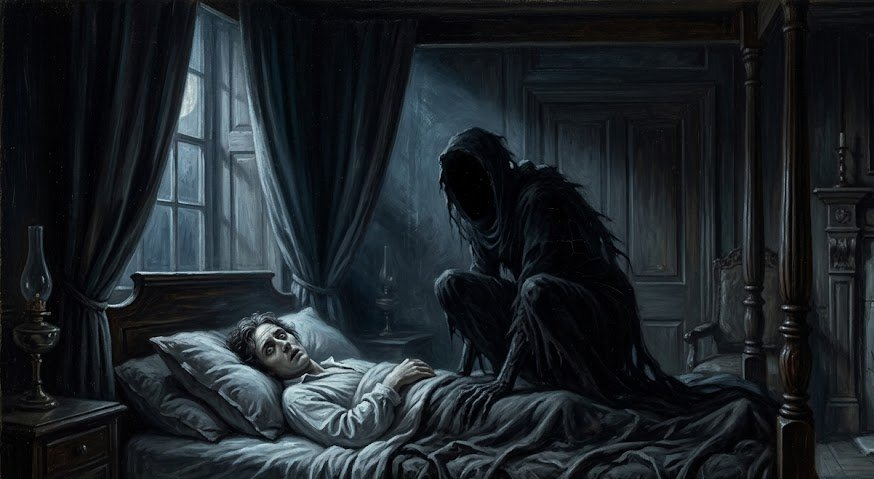
You wake at 3 a.m. Your room looks exactly like you left it. The lamp. The curtains. The ceiling. Everything sits where it should. Except you cannot move. Not a finger. Not your head. A weight presses on your chest that should not be there, a crushing presence settled on your sternum like something is sitting on you. Then, at the edge of your vision or directly above you, certainty arrives, something is in the room. You want to scream. You cannot.
This experience has a name. In Newfoundland, they call it “the Old Hag”. In China it is “gui ya chuang,” the ghost pressing on the bed. The Inuit of the subarctic describe “uqumangirniq”, attributed to shamanic spell work. West African and Caribbean traditions speak of “kokma”, a spirit that jumps onto the chest and squeezes the throat. Italian folklore from the Abruzzo region has the “Pandafeche”, a witch who may become a black cat.
Here is what unsettles researchers: none of these cultures borrowed from one another. The Tupi people of Brazil had their own version before European contact No other paranormal experience on earth carries this kind of consistency. Not ghost sightings. Not cryptid encounters. Not near-death experiences, which vary widely across cultures. The Old Hag is the one experience nearly every culture describes in near-identical terms. That fact alone demands a closer look.
The Folklorist Who Took the Hag Seriously
In the early 1970s, folklorist David Hufford traveled to Newfoundland expecting to document a regional legend. What he found redirected his career and eventually reshaped the academic study of paranormal experience. Residents of a northeast Newfoundland community described, independently and in striking detail, an experience the locals called “being hag-ridden.” Hufford assumed these accounts spread through storytelling until people expected the experience and therefore had it.
He was wrong. When he widened his search, he found people who had never heard the term “Old Hag,” people with no link to Newfoundland folklore, describing the same event. The paralysis. The chest pressure. The threatening presence. The dread that felt, by their accounts, different from ordinary fear.
His 1982 book The Terror That Comes in the Night, published by the University of Pennsylvania Press, advanced what Hufford called the “experience-centered approach.” His core claim: the supernatural interpretation did not come first. The experience came first. People across cultures were having an identical neurological event, and each culture independently built a narrative to explain it. The Old Hag was not a story that caused the experience. The experience generated the stories.
Hufford estimated that roughly 15 percent of people have the Old Hag experience at some point. More recent meta-analyses put the lifetime prevalence of sleep paralysis, the neurological event at the center of these accounts, as high as 30 percent. A 2024 review in Cureus analyzed 76 studies across 25 countries and over 167,000 participants and found a global prevalence of 30 percent. That is not rare. That is one in three people.
What Is Actually Happening to Your Brain
Sleep paralysis is not a disorder. It is a timing error in a protection mechanism that exists for good reasons. During REM sleep, the brain sends signals that temporarily disable the voluntary muscles, stopping you from acting out your dreams. The system works correctly millions of times a night in sleeping people worldwide. Occasionally the timing slips. Consciousness returns before paralysis lifts.
The result is full or near-full wakefulness, in which you see your real room and feel your real bed, yet cannot move. The brain, now awake but receiving no normal motor feedback, begins to fill in explanations. It reads the restricted breathing of REM sleep as weight on the chest. Something is sitting there. The threat-detection regions fire without a specific threat to attach to, so the brain constructs one: a figure, a watcher, a presence at the edge of the room.
Research by neuroscientist Olaf Blanke at EPFL identified the mechanism by which the brain generates the sense of an unseen presence (often called a sensed presence at night). Stimulating the sensorimotor cortex in patients produced the feeling of another being in the room, reliably and repeatably. The brain is not detecting something external. It is generating something internal and projecting it into the perceived environment.
The hallucinations fall into three categories researchers document across cultures: the sensed presence, the chest pressure, and the visual or auditory intrusion. The entity appears inserted into reality, not into a dream. Sufferers see their actual room. They recognize their furniture and ceiling. The intruder appears to inhabit real space, which is exactly why the experience feels categorically different from a nightmare and stays so hard to dismiss afterward.
The Core Symptoms, One by One
The individual symptoms recur with remarkable consistency. Each one maps to a specific part of the neurological event, and understanding them removes much of their power.
Paralysis of the Voluntary Muscles
The defining symptom is the inability to move the limbs, trunk, or head despite being fully or partially conscious. The paralysis is complete in most episodes. Sufferers cannot move a finger, turn their head, or sit up. They can typically still breathe, though breathing may feel labored or restricted.
Chest Pressure or Weight
A heavy pressing sensation on the chest appears in most cases and ties most directly to the syndrome’s name. The pressure ranges from mild heaviness to an overwhelming crushing weight. It frequently arrives with the sense that something is physically sitting on the body.
The Presence
Somewhere between 50 and 75 percent of episodes involve a perceived intruder: a figure, shape, or entity sensed or seen in the room. The entity is almost always threatening in character. It may stand in the doorway, approach the bed, or hover directly over the sleeper. In some accounts it speaks. In most, it is simply and terribly there.
Alan Cheyne, who studied sleep paralysis extensively, documented a telling account. A Native American woman’s episode featured a figure from her own mythology: Spider Woman descending from the ceiling to wrap her in webs. The brain, when generating the presence, reaches for the most familiar threatening archetype in the sleeper’s cultural vocabulary.
Auditory and Visual Hallucinations
Sounds including breathing, footsteps, whispering, or voices appear frequently. Visual hallucinations range from shadow people to fully realized faces or forms. These hallucinations occur against an accurate backdrop. Sufferers see their real room, their real ceiling, their actual surroundings. The entity slots into reality, not into a dreamscape, which drives much of what makes the experience feel so unlike a nightmare.
Difficulty Breathing
Many sufferers describe a struggle to draw breath, sometimes feeling as if something compresses the lungs or sits on the diaphragm. Breathing does continue throughout an episode. The sensation of restriction, though, is real and distressing, and it feeds directly into the panic that lengthens the event.
Fear and Dread
The emotional component is not merely strong fear. Researchers and sufferers consistently describe a specific quality of dread: a certainty of imminent harm combined with total helplessness. This emotional signature stays remarkably consistent across cultures and centuries. Hufford used that consistency to argue the experience itself drives the supernatural interpretation, rather than the interpretation being culturally inherited.
A World Map of the Same Nightmare
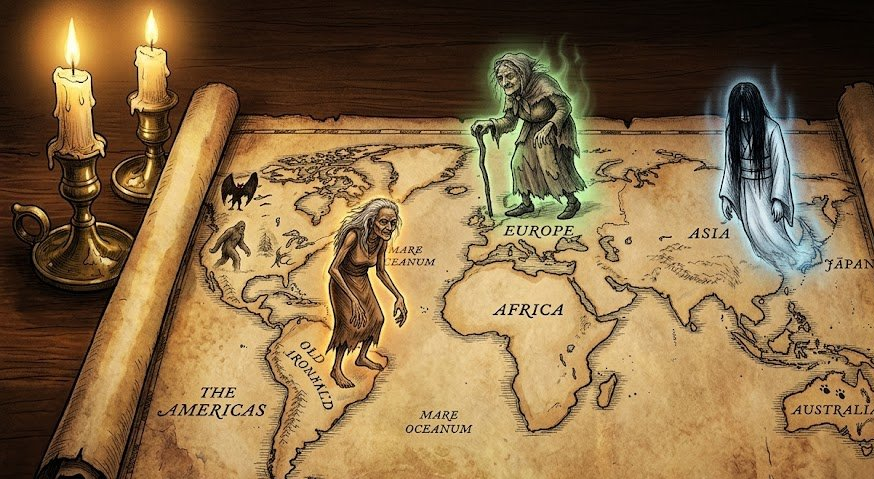
The cultural catalog of Old Hag equivalents is one of the most compelling documents in the study of human experience. Each tradition reached the same core elements through independent routes.
In medieval Europe, the creature was the “mare,” a spirit that rode sleeping people, giving us the word nightmare. The ancient Hebrew tradition gave the same role to Lilith, a night spirit who preyed on sleeping men and newborns. The English word “haggard” traces to the same tradition, meaning “ridden by the hag.” In Germany, the entity entered through the keyhole. In Scandinavian tradition it was the “mara,” a spirit sent to suffocate and terrorize.
Henry Fuseli captured the experience in visual form in 1781 with his oil painting “The Nightmare,” now held at the Detroit Institute of Arts. The painting shows a woman draped across a bed, her body limp, with a grotesque incubus crouching on her chest while a pale horse peers from behind a curtain. Critics at the Royal Academy were both disturbed and fascinated. Fuseli reportedly drew on his own sleep paralysis, and the painting became his first commercial success. Distributed widely as an engraving, it influenced Gothic fiction writers, including Mary Shelley.
In Brazil, the “Pisadeira” is a gaunt old woman with long dirty nails, tangled white hair, and green teeth. She waits on rooftops and descends to press the chests of people who sleep on their backs after eating heavily. The description is so specific that researchers believe it reflects genuine physical observation. Episodes grow more frequent and more vivid in the supine position, and they connect to digestive disruption.
In Japan, “kanashibari” carries added layers. The term comes from a medieval paralysis spell practiced by priests of Onmyodo, the Japanese system of yin-yang divination. A description of magical coercion became the folk name for a neurological event. Japanese folklore frames kanashibari as a premonition of a supernatural encounter, a moment when the boundary between worlds thins.
Elsewhere the names multiply. In Mexico, “se me subio el muerto” translates as “a dead body climbed on top of me.” In the Philippines, “bangungot” describes a deadly nightmare caused by spirits. In Egypt, the “kabus” is a heavy presence that presses the chest and blocks breathing. The South African “Segatelelo” assault is attributed to black magic and dwarf-like demonic creatures called the “Tokoloshe.”
The three core elements, paralysis, chest pressure, and threatening presence, hold across every culture.
Why This One Experience Generates Universal Mythology
Most paranormal experiences stay culturally specific. The Black Shuck of English folklore, the Kelpie of Scottish tradition, the Wendigo of Algonquian culture: these creatures belong to places and peoples. They do not appear in identical form across cultures with no contact history.
The Old Hag differs. Hufford argued that this difference matters, that a universal experience with consistent phenomenology deserves more serious treatment than experiences that vary widely. The cultural source hypothesis, the idea that supernatural beliefs create experiences that seem to confirm them, cannot explain the Old Hag. People who never encountered the cultural narrative report the same experience in the same detail.
The question this raises is not whether sleep paralysis is “really” a supernatural attack. The neurological explanation for paralysis and hallucination is well established. The sharper question asks why a specific neurological event produces a specific subjective quality, that dread Hufford described as the signature of the experience. It also asks why every culture that named the event reads it as an encounter with a hostile entity.
One answer involves the amygdala, the brain’s threat-detection center, and its interaction with the motor cortex during REM transitions. The experience is not just paralysis plus hallucination. It is paralysis plus hallucination plus an overwhelming sense that the perceived entity intends harm. The chest pressure itself comes from the brain misreading restricted REM breathing, which adds a genuine physiological component to the terror. You cannot move, your breathing feels obstructed, and something appears to cause both.
The entity emerges from the convergence of those signals. Threat-detection active. Motor control absent. Breathing restricted. The visual system generates hallucinations against a real room. The brain resolves all of it into the simplest possible narrative: there is something here, and it means harming me.
How an Episode Feels, and How Long It Lasts
Most episodes run between a few seconds and two minutes, though distorted time perception can stretch them in memory. Episodes resolve on their own as the brain completes its transition to full wakefulness.
The key distinction from a nightmare is the quality of consciousness. Nightmares occur during REM sleep, when the sleeper does not know they are dreaming. The Old Hag occurs in the transition to waking, when the person is aware of their real environment. They know they are in their bedroom. They recognize their furniture. The perceived entity does not replace reality; it appears to exist within it. That is why the experience proves so much harder to dismiss the next morning.
The Medical Classification
Sleep medicine classifies these experiences as hypnagogic hallucinations, occurring at sleep onset, or hypnopompic hallucinations, occurring on waking, in the context of sleep paralysis. The condition is not itself a disorder but a neurological event that can feature in otherwise healthy sleep, particularly when sleep is disrupted. When episodes are frequent or arrive with other symptoms, assessment for narcolepsy or REM sleep behavior disorder becomes appropriate.
What Increases the Risk, and What Reduces It
Sleep paralysis is not random. Certain conditions reliably raise the odds of an episode, and understanding them gives people practical control.
The supine position is the best-documented risk factor. Episodes grow more frequent, more vivid, and more distressing when people sleep on their backs. The reason connects directly to the chest pressure symptoms. Lying face-up increases the signals of restricted breathing during REM sleep, which the paralyzed brain amplifies into weight. Multiple research sources recommend side sleeping as a first preventive step.
Sleep deprivation is the second major factor. Disrupted sleep, irregular schedules, jet lag, shift work, and significant stress all increase REM intrusions into waking consciousness. A sleep-deprived brain tries to enter REM faster and more aggressively, which raises the risk of these transitional states striking at the wrong moment.
Anxiety shows a documented two-way relationship with sleep paralysis. The first episode often triggers anticipatory anxiety about sleep, which disrupts sleep architecture, which invites further episodes. Breaking that cycle is a primary goal of treatment.
Cognitive-behavioral therapy adapted for sleep paralysis reduces both the frequency of episodes and the severity of the fear response. The core mechanism is educational. People who understand what happens during an episode, who recognize paralysis as a timing error rather than genuine danger, report less intense fear and shorter episodes. Knowledge lowers the dread, and lower dread appears to shorten the event.
Useful in-episode strategies include focusing attention on moving a single small muscle, a finger or a toe, which can break the episode earlier. Controlled breathing, slow and deliberate despite the sense of restriction, counters the panic response. Attempting to vocalize, even a sound rather than a word, has also shortened episodes for some.
What does not help and may worsen things: fighting paralysis aggressively, which tends to spike panic. The cycle of fear, restricted breathing, and greater perceived weight is a trap. Calm is the exit.
The Question Sleep Science Does Not Answer
The neurological framework for sleep paralysis is well established and genuinely useful. Understanding the mechanism strips away the power that ignorance hands these episodes. The experience is not psychosis. It is not a sign of supernatural danger. It is a timing error in a protective system, and that explanation is both accurate and, for most people, helpful.
What the framework does not fully answer is Hufford’s deeper question. Why does this specific event, across every culture, generate such a specific quality of terror? Not ordinary fear. Not the fear of a loud noise or a sudden fall. That dread of imminent, intelligent harm from a hostile presence. Some experiencers also report a sulfur smell during episodes — a detail that bridges the neurological and the demonic in folklore.
Hufford never argued that the Old Hag is supernatural. He argued that the experience is real and that its subjective content stays consistent and universal in ways that demand explanation. Dismissing these accounts as simple hallucination or cultural contamination, he held, misses something important about how human consciousness behaves at its edges.
The Old Hag sits at that edge. She appears when the brain is not quite asleep and not quite awake, when normal categories turn briefly unstable. She has been sitting there as long as human beings have slept in beds. She has a thousand names and one face.
Whether that face belongs to a neurological event or to something older is a question every person who has felt that weight will answer differently. The research tells us what the brain is doing. It does not tell us what, if anything, is in the room.
What the Symptoms Tell Us
The consistency of Old Hag symptoms across geography and centuries carries real weight. It ranks among the strongest arguments for a universal human experience with a specific neurological cause, not a story passed down the generations. The chest pressure, the paralysis, the threatening presence, the quality of the fear: these elements surface in accounts from medieval England, nineteenth-century Newfoundland, contemporary Japan, and modern American emergency room reports. Same symptoms. Different stories to explain them. Same experience underneath.
Frequently Asked Questions
<p>It is the folk name for sleep paralysis with hallucinations (often described as a <a href=”https://paranormaltrip.com/sleep-paralysis-ghost-on-your-chest-science-folklore/” style=”color: #c084fc;”>sleep paralysis ghost on your chest</a>). You wake unable to move, feel a crushing weight on your chest, and sense a threatening presence in the room. The name comes from the belief that a witch or hag sits on sleepers and steals their breath.</p>
<p>No. Isolated episodes are common and harmless. They are a timing error in the system that paralyzes your muscles during REM sleep, not a sign of illness or supernatural danger.</p>
<p>A 2024 review of 76 studies found a global prevalence near 30 percent. Roughly one in three people has at least one episode in their lifetime.</p>
<p>During REM sleep your breathing is naturally restricted. A half-awake brain reads that restriction as weight and builds a figure to explain it.</p>
<p>Because the experience comes first and the story comes second. The brain generates the same paralysis, pressure, and dread everywhere, and each culture names the entity in its own way.</p>
<p>Try to move one small muscle like a finger or toe. Breathe slowly and stay calm. Fighting the paralysis tends to increase panic and prolong it.</p>
References and Further Reading
David J. Hufford, The Terror That Comes in the Night (University of Pennsylvania Press, 1982)
NCBI StatPearls: Sleep Paralysis (Updated 2023)
AASM Sleep Education: Sleep Paralysis Overview
Wikipedia: The Nightmare by Henry Fuseli
Detroit Institute of Arts: The Nightmare (1781)
Mythfolks: Sleep Paralysis Folklore and Nightmare Creatures Around the World
Neurolaunch: The Hag Sleep Paralysis
Healthline: All About Old Hag Syndrome or Sleep Paralysis
Dream Studies Portal: Sleep Paralysis Creatures Around the World
Springer: The Old Hag Phenomenon as Sleep Paralysis: A Biocultural Interpretation (1978)

[…] For a cross-cultural deep dive on sleep paralysis, see our post here. […]
[…] Across Southern Africa, the night attacker is not a towering demon. It is small. In Sotho and Tswana it is segatelelo, the pressing assault. In Zulu and Xhosa it is the Tokoloshe, a dwarfish water sprite. And the traditional defense against it is oddly specific: put your bed up on bricks. This post is a part of a series on cross-cultural sleep paralysis; for a deep dive, click here. […]
[…] This article is one in our series on cross-cultural sleep paralysis experiences; for a deeper dive, click here. […]
[…] For a deeper dive on cross-culture sleep paralysis experiences, click here. […]
[…] are terrifying but harmless. For a deeper dive into sleep paralysis experiences across cultures, click here. The Filipino tradition is different. Here the folklore attached itself to something that genuinely […]
[…] For more on this topic, see our complete guide to the Old Hag Syndrome: Sleep Paralysis, Folklore, and the Science Behind the Presence. […]
[…] Most Hat-Man encounters happen during sleep paralysis. This occurs in the gap between REM sleep and full waking. For more on sleep paralysis, click here. […]
[…] If you wake up paralyzed and sense a presence in the room, you are likely experiencing Old Hag Syndrome or sleep paralysis. This state can produce terrifying hallucinations, including shadow people and a […]