She appears once in the Hebrew Bible, in Isaiah 34:14, in a list of animals and creatures that will inhabit the desolate ruins of Edom: ‘There the night creature shall repose and find herself a place of rest.’ The Hebrew word is “lilit” or “lilith,” and its translation is contested. Some render it as ‘screech owl. ‘Others as ‘night monster.’ Others, following the Septuagint’s Greek version, use ‘onokentauros.’ The ambiguity of that single biblical line fed three thousand years of elaboration.
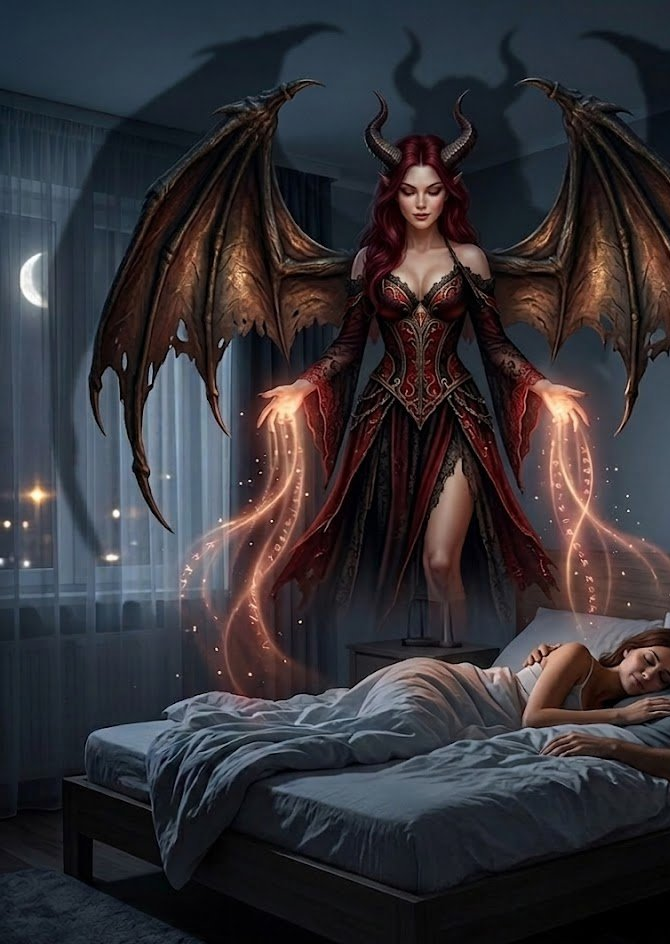
Lilith is one of the most layered figures in paranormal and demonological tradition: a Mesopotamian wind spirit, a Jewish night demon, the apocryphal first wife of Adam, a Kabbalistic queen of the demonic realm, a 19th-century feminist symbol, and a contemporary icon of feminine autonomy. Understanding which of these Liliths is real, in the historical sense, requires untangling a tradition that has been accreting material for millennia.
The Mesopotamian Origins
The name Lilith connects to the Akkadian word lilitu, referring to a class of wind and storm demons in Mesopotamian religious tradition. The Lilitu, along with related figures including Ardat Lili and Lilu, was a malicious, winged spirit associated with disease, miscarriage, and infant death. Amulets and incantation bowls designed to protect pregnant women and newborns from Lilitu have been found across Mesopotamian archaeological sites, some of the oldest examples dating to approximately 3000 BCE. This protective tradition, the warding of the vulnerable against night-flying demons, represents the oldest layer of the Lilith tradition.
The connection between the Mesopotamian Lilitu and the later Jewish Lilith is linguistic and thematic rather than documented as a direct transmission, but the overlap is substantial enough that most scholars treat the Mesopotamian figures as the origin of the later tradition.
The Biblical Ambiguity
The single appearance of the name in Isaiah does not tell us much. The passage is describing the desolation of a fallen kingdom, listing creatures that will inhabit the ruins, and the Hebrew “lilit” appears in that list. Whether it was understood by the original audience as a specific demonic entity or simply as a night creature of some kind is not recoverable from the text alone. What is recoverable is that the word was there, and it was available for elaboration.
Later Jewish magical texts seized on it. Incantation bowls from the 6th century CE onwards explicitly name Lilith as a female demon and depict her with bound or chained imagery, the visual vocabulary of a dangerous entity being restrained for the protection of the household. These bowls were placed under the floors of homes, particularly in rooms associated with sleeping women and newborn children.
The Alphabet of Ben Sira
The most influential expansion of the Lilith tradition appears in the Alphabet of Ben Sira, a text dated by scholars to between the 7th and 10th centuries CE. The text is widely regarded as satirical or polemical in character, possibly a critique of contemporary religious attitudes rather than a sincere theological statement, but it was adopted by medieval Jewish mysticism and became the authoritative account of Lilith’s origin.
In the Alphabet, Lilith is Adam’s first wife, created simultaneously with him from the same earth (in contrast to Eve, who was created from Adam’s rib, as described in Genesis 2). When Adam insisted that Lilith adopt a submissive position during intercourse, she refused, asserting that they were equals. She then spoke aloud the ineffable name of God, which gave her the power of flight, and left the Garden of Eden. God sent three angels, Senoi, Sansenoi, and Semangelof, to retrieve her. She refused to return, was condemned to lose one hundred of her demon-children each day, and in response became the killer of human infants and a seducer of men sleeping alone. The three angels’ names became the basis for amulets worn by newborns for protection.
Lilith in the Kabbalah
Medieval Jewish mysticism, particularly the Zohar compiled in 13th-century Spain and attributed to Rabbi Moses de Leon, gave Lilith her most elaborate theological treatment. In Kabbalistic cosmology, Lilith is paired with Samael, the great adversarial angel, as his consort on the Sitra Achra, the Other Side: the demonic mirror of the divine. She is the dark counterpart of the Shekhinah, the divine feminine presence that dwells with Israel. Where the Shekhinah represents nurturing and protective divine love, Lilith represents its inversion: seduction, destruction, and spiritual corruption. She rules the night alongside Samael and sends demonic offspring into the world.
The Modern Feminist Lilith
Lilith’s contemporary cultural life began in the 19th century when Romantic poets and artists, particularly the Pre-Raphaelites, depicted her as a figure of dangerous feminine beauty. Dante Gabriel Rossetti’s 1868 painting Lady Lilith presents her as a hypnotic, autonomous woman who is the ancestral seductress of the race. This reframing, from demonic threat to emblem of female autonomy and refusal of submission, gained significant traction in 20th-century feminist spirituality.
The Lilith Magazine, founded in 1976 as a Jewish feminist publication, chose the name explicitly to reclaim the figure from its demonic framing. Figures including Judith Plaskow in her 1972 midrash ‘The Coming of Lilith’ argue that Lilith’s crime was asserting equality and that a tradition demonizing that assertion reveals its own values rather than Lilith’s nature.
What is important to note, given the complexity of this tradition, is that the ‘first wife of Adam who asserted equality’ is a medieval story, not an ancient one. The Alphabet of Ben Sira is not biblical, was probably satirical, and was never canonical. The feminist reclamation of Lilith is a contemporary religious and cultural development built on medieval folklore. It is not a recovery of ancient wisdom. It is an active creation of new meaning, which is a legitimate and interesting thing to do with old material, as long as the distinction is clear.
References & Further Reading
• Jewish Women’s Archive: Lilith
• New World Encyclopedia: Lilith
• Thalira Wisdom: Lilith, the Goddess Tradition vs the Kabbalistic Demon



[…] sleeping people, giving us the word nightmare. The ancient Hebrew tradition gave the same role to Lilith, a night spirit who preyed on sleeping men and newborns. The English word “haggard” […]