A vanishing dancer on Archer Avenue, two candidates for her identity, and the evidence that quietly favors one.
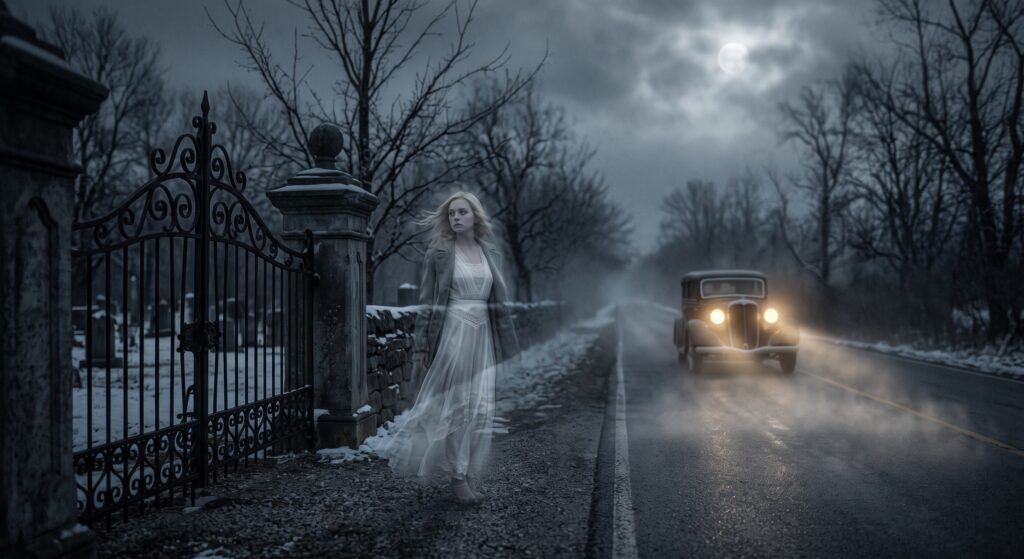
Picture a lone driver on a dark road southwest of Chicago. A young woman in a white dress asks for a ride. Miles later, near a cemetery gate, she is simply gone. This is the vanishing hitchhiker, and Chicago tells it better than almost anyone.
Researchers have spent decades trying to name her. Two women lead the list. The evidence for one keeps falling apart, and most articles never mention why.
The Story of Mary
The tale traces to the 1930s. A young woman leaves a night of dancing at the Oh Henry Ballroom in Willow Springs, later renamed the Willowbrook. She walks or hitches home along Archer Avenue and dies in a crash.
Since then, drivers have reported a pale, blonde passenger who says little and stares ahead. Near the gates of Resurrection Cemetery in Justice, she vanishes. The graveyard gave her both her haunt and her name.
The Famous 1970s Sighting
The legend gained hard edges in the 1970s. In one widely repeated 1976 account, a passerby saw a girl gripping the cemetery’s iron bars. Later, two of those bars were found bent apart and scorched, with marks resembling handprints.
The cemetery eventually replaced the section. To believers, the burned bars suggest an entity that produces intense heat. To skeptics, they suggest a story that grew a physical anchor. Either way, they cemented Mary’s fame.
Candidate One: Mary Bregovy
For years, researchers pointed to Mary Bregovy, killed in a 1934 car accident. She is buried at Resurrection Cemetery, which fits the name neatly. The rest fits poorly.
The problems pile up. Bregovy had dark hair, while the ghost is famously blonde. Her fatal crash happened downtown in the Loop, an hour from Archer Avenue, not near the ballroom. Some accounts even list her as Czech rather than Polish. The tidy candidate does not match the witnesses.
Candidate Two: Anna Norkus
Author Ursula Bielski proposed a stronger fit: Anna Norkus, who died in a 1927 crash while heading home from the Oh Henry Ballroom. She was young, blonde, and connected directly to the right dance hall.
One wrinkle helps rather than hurts. Anna sometimes went by Marija, close to Mary. Records suggest a possibility that, during a gravediggers’ strike, her remains were temporarily placed at Resurrection Cemetery. The ballroom link and the physical description both favor Norkus.
An Old Tale in Chicago Dress
Mary belongs to a global family of stories. Folklorists call it the vanishing hitchhiker, or the woman in white, and versions appear across many cultures. Chicago alone claims several ethnic variants of the phantom rider. Mary is simply the Polish-American telling that outgrew the rest.
The city keeps her close. At Chet’s Melody Lounge, across from Resurrection Cemetery, staff have long kept a drink waiting for Mary at the bar. Small rituals like that are how a legend stays alive. She has inspired ballads, television segments, and decades of roadside claims.
A Legend That Outruns Its Facts
No candidate closes the case, and that is part of the charm. Resurrection Mary behaves less like a looping replay and more like an aware presence, which is why she keeps generating new encounters.
Would you stop for a lone traveler on a dark road at night? Along Archer Avenue, plenty of drivers say they did, and lived to tell a story they still cannot explain.
References & Further Reading
Resurrection Mary, Chicago History Museum
Chicago Hauntings: Resurrection Mary, CBS Chicago