Picture the moment the last story ends. Not a gasp, not a punchline, just silence. The fire has burned low. Nobody reaches for their phone. Nobody breaks the quiet with something ordinary. For a few seconds, everyone in the circle is still.
That stillness is not accidental. It is the point.
Ghost stories told around a fire are among the oldest forms of human social communication, and they work in ways that have nothing to do with whether the stories are true. The fire, the dark, the group, the voice in the middle of it all, all of that is doing psychological work. Knowing why scary stories are told in groups, and why they’ve always been told at night, reveals something fundamental about fear as a social experience.
Fire and Story Have Always Gone Together
Archaeological evidence places storytelling around fire at the origins of human social life. Fire provided warmth and protection and gathered communities into tight physical proximity after dark. The same conditions that made fire a practical necessity also made it the ideal setting for narrative.
In darkness, with vision limited and hearing sharpened, stories land differently than they do in daylight. The brain’s threat-detection systems, already elevated by low-light conditions, process narrative differently when primed. Details feel more vivid. Stakes feel higher. The imagination fills in what the eyes cannot see.
Supernatural storytelling, in Celtic and Norse traditions, was particularly associated with liminal times and places: crossroads, seasonal transitions, the hours after midnight. These were understood as periods when the boundary between the living world and the spirit world thinned. The campfire gathered the community at exactly such a boundary, the edge of the dark.
The Group Multiplies the Effect
Horror experienced alone and horror experienced with others are not the same. Group settings amplify fear through emotional contagion, a phenomenon where emotions spread between people in close physical proximity through facial expression, posture, and involuntary vocalization.
When one person in a campfire circle flinches, others register it. When someone holds their breath at a story’s climax, the people beside them do the same without deciding to. Fear in a group becomes synchronized, which intensifies it beyond what any individual would feel reading the same story privately.
This amplification serves a social function. Researcher Margaret Kerr, who studies horror psychology, has noted that shared fear creates solidarity and a sense of unity within a group. The people who survived a frightening story together feel more bonded than they did before it. The shared vulnerability of being scared and the shared relief of surviving the story build trust.
Jonathan Gottschall, author of books on narrative and the human brain, has pointed out that ghost stories speak to very primal fears: death, the unknown, the mystery of what lingers after a body stops. These are not culturally specific fears. They are universals, which is part of why the tradition of telling ghost stories around a campfire appears across every human culture independently.
Why Darkness Is Not Incidental
The setting matters. Campfire ghost stories told in a well-lit room, at a kitchen table, in the middle of the afternoon, lose most of their power. This is not simply atmosphere. It is neuroscience.
In low light, the eye shifts from cone-based to rod-based vision. Rods are more sensitive to motion and less capable of resolving detail, which means the peripheral visual field becomes more active. Movement perceived in peripheral vision in the dark triggers threat responses that would not activate in the same peripheral location in daylight.
The darkness surrounding the campfire’s light creates a genuine boundary. Everything inside the fire’s reach is known and safe. Everything beyond it is obscure and potentially threatening. A story told in that setting does not have to work very hard to make the dark feel occupied. The setting has already done it.
One scoutmaster who collected campfire story practices noted that the most requested campfire event, across ten years of working with young people outdoors, was stories that evoked fear. Not silly stories. Not adventure stories. Scary ones. The instinct to seek controlled fear in a safe group context is deeply rooted.
What Scary Stories Actually Teach
The function of frightening stories in group settings goes beyond entertainment. Across cultures, oral horror traditions have carried practical information, behavioral norms, and community values in formats that are memorable precisely because they are disturbing.
Cautionary tales embed warnings in narrative. Tales of strangers overly eager to offer help, roads leading somewhere they shouldn’t, actions inviting unwanted attention from the unseen world encode social rules that the listener remembers. The reason a scary story well told can be remembered with more detail and clarity than a lecture on the same subject is that a story activates the same memory processes as a real experience.
Contemporary ghost stories continue this tradition. Urban legends about dangerous places, about what happens when you ignore warning signs or mock the supernatural, are doing the same work that ancient cautionary tales always did. The setting has changed. The mechanism has not.
The Role of the Storyteller
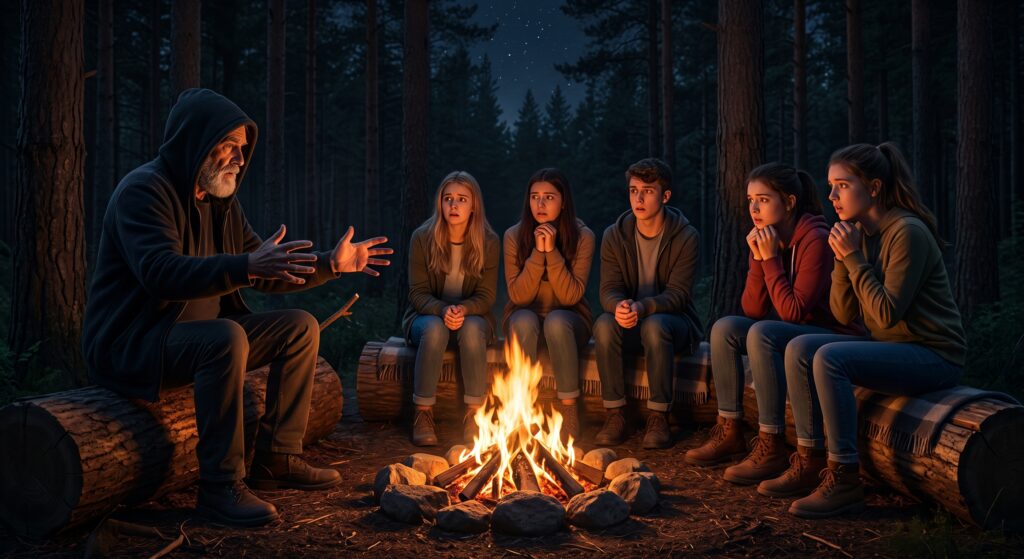
In every culture with a campfire storytelling tradition, the teller occupies a distinct social position. The storyteller controls pace, detail, and the strategic pause at the moment of highest tension. Voice drops to a whisper at the key line. A sudden sound punctuates the climax. The circle leans in.
This is a skilled performance, and the skills are teachable. Timing matters more than content. A mediocre story told with perfect timing will frighten more reliably than a brilliant story told badly. The teller manages the audience’s nervous system through sound, rhythm, and control of information.
The best campfire stories, as the folklore researcher Alvin Schwartz observed in his Scary Stories to Tell in the Dark collections, invoke universal and primal themes through ordinary surfaces. A woman with a ribbon around her neck. A couple parked on a dark road. A figure standing at the foot of the bed. The horror is rarely complex. What the teller does with the space around it is what makes the story work.
Why the Tradition Survives
The campfire ghost story has survived every technological development that might have replaced it. Cinema, television, recorded audio, and streaming horror have all contributed to the survival of the campfire ghost story. Technology has extended the tradition, as creepypasta, found-footage video series, and group horror-watching rituals demonstrate.
The reason is that the campfire story provides something recorded media cannot: participation. The group is not watching something happen to fictional characters on a screen. They are inside the story’s atmosphere together, sharing a physical space, affecting each other’s experience in real time. The storyteller knows the room. The story adapts to the audience. Nobody else will ever hear this particular telling again.
The fire burns down. The stories end. Everyone goes to bed a little more alert than they were before, which is almost certainly the point.
References & Further Reading
Audible: Let’s Never Lose This Terrifying Tradition
Psychology Today: The Psychology of Ghost Stories
Cider Spoon Stories: The Structure of Screams, Composing Campfire Stories
Seattle’s Child: Why Do We Tell Stories Around the Fire?
Sierra Club: Tell a Really Good Ghost Story Around Your Next Campfire