Jacob Waltz hid a fortune and took its location to the grave. More than a century later, people are still dying to find it.
Adolph Ruth mailed a cheerful note to his family in June 1931. He had entered the Superstition Mountains east of Phoenix to hunt for a legendary gold mine. He felt confident. He believed he held a map that others lacked.
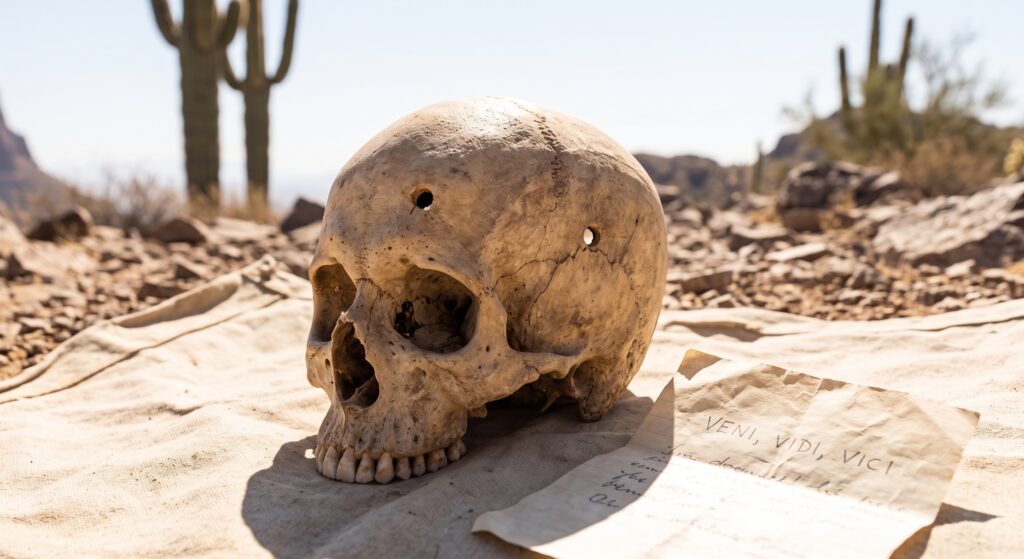
Six months later, searchers found his skull on a desert ridge. Two neat holes pierced the bone, spaced like the entry and exit of a bullet. His body lay somewhere else entirely, scattered across the rocks. Here is the detail that haunts treasure hunters still. A note in his effects read, in Latin, ‘veni, vidi, vici.’ I came, I saw, I conquered.
Did Ruth find the mine before he died? Did someone kill him to keep it secret? The questions never closed. They only deepened a legend that has drawn the desperate and the dreaming for generations. And the body count keeps climbing.
This is not just a story about gold. It is a story about a curse that people take seriously because the deaths are real. The Superstitions have killed for well over a century, and they show no sign of stopping.
The Dutchman and His Deathbed Gold
Jacob Waltz was German, not Dutch. Frontier tongues slurred the word “Deutsch” into “Dutchman,” and the mistaken name stuck forever. He emigrated to the United States and chased gold across the American West before settling near Phoenix.
Waltz claimed he had found a fabulously rich vein hidden somewhere in the Superstitions. He guarded its location fiercely and shared it with no one alive. Neighbors knew him as a secretive old man with an impossible secret.
When Waltz died in 1891, roughly aged eighty-three, admirers made a stunning discovery. Beneath his deathbed sat a candle box packed with high-grade gold ore. The gold was real, and it was rich.

That ore fueled everything that followed. It proved, to believers, that the mine existed and held a staggering fortune. On his deathbed, Waltz supposedly whispered clues to a caretaker, describing landmarks near a distinctive peak called Weavers Needle.
The clues raised more questions than they answered. They pointed vaguely at a vast, brutal wilderness. Anyone who wanted the gold would have to search thousands of acres of cliffs and canyons, and the hunt began almost immediately.
Adolph Ruth and the Skull on the Ridge
Ruth was an amateur explorer with a damaged leg and boundless enthusiasm. He believed he possessed a map that traced back to the Peralta family, Mexican miners who were said to have worked the region long before Waltz. In the summer of 1931, he set out alone into the brutal heat.
He never returned. An initial search failed to find any trace of him. The desert had simply swallowed the old man, and hope faded as the weeks passed.
Months later, a hunting party recovered his skull, and eventually his scattered remains turned up nearby. The two holes in his cranium ignited a firestorm of speculation across national newspapers. Editors ran with the murder angle, and the legend exploded into public consciousness.
Investigators eventually offered a calmer theory. They suggested Ruth likely died of exposure or a heart attack, with animals scattering his bones afterward. The holes could have come from natural causes rather than gunfire.
Even so, the murder theory refused to die. Ruth had written that he found the mine, and someone, people whispered, had silenced him for it. His Latin boast of conquest only sharpened the mystery.
Jesse Capen and the Modern Dead
The curse did not stay locked in the past. Jesse Capen, a hotel worker from Denver, became obsessed with the Lost Dutchman story in the modern era. He collected books, maps, and clippings for years before finally acting on his dream.
Capen drove to Arizona and vanished in late 2009 in the rugged Tonto National Forest. Search teams combed the wilderness repeatedly and found nothing. The mountains had hidden him completely, just as they had hidden Ruth decades before.
Three years passed before a specialized crew located his remains. They found him wedged in a crevice near the base of a steep cliff he had apparently fallen from. The recovery required rappelling into treacherous terrain.
His death followed the same grim template. A fixated seeker, traveling alone, pushed into punishing country and never came back out. The pattern repeats across decades with unsettling consistency, and it forms the real backbone of the so-called curse.
How Many Have Died?
Historian Tom Kollenborn spent his life studying the Superstitions. He estimated that between fifty and seventy people died in the wilderness during the twentieth century alone. The twenty-first century has kept the toll rising at roughly one death per year.
Some died searching for gold, following clues into deadly terrain. Others simply hiked in unprepared and lost their way in the maze of canyons. A few met violent ends that no one ever solved.
The mountains blur these categories together. Legend absorbs every death, from the reckless hiker to the murdered prospector, into a single narrative of doom. The gold does not have to be the cause. The reputation does the work.
The numbers matter because they anchor the myth in fact. People genuinely die out there, year after year. The curse, stripped of anything supernatural, still describes a real and repeating tragedy.
What the Curse Really Is
The Superstition Wilderness is a killer without any need for magic. Summer temperatures scorch past 110 degrees for days at a stretch. Water is scarce, cliffs drop without warning, and the canyons twist into disorienting mazes that swallow landmarks.
Cell signal disappears quickly in the backcountry. A twisted ankle or a wrong turn can turn deadly fast. Rescuers face the same brutal conditions that kill the people they search for, which slows every recovery.
Now add human obsession to the terrain. Treasure fever pushes people deeper than good sense allows. They chase clues into remote country, alone in the worst season, unwilling to turn back until they find the prize. That combination kills reliably.
The gold may not even exist. Geologists note that the Superstitions are volcanic rock, an unlikely home for the kind of vein Waltz described. His ore may have come from a mine somewhere else entirely, then found its way into his candle box.
None of that logic slows the seekers. The story needs no proof to keep working on the imagination. A candle box of real gold, a dead man’s clues, and a wilderness that genuinely kills add up to an irresistible legend.
The Mountain Keeps Its Secret
The Lost Dutchman’s Mine survives because it fuses everything a legend needs. It offers real gold ore, a secretive old prospector, unsolved deaths, and a landscape that actually swallows people whole. Belief supplies the rest.
Rangers still warn hikers away from the most dangerous routes. Amateur searchers still map Weavers Needle and argue about the Peralta stones. The community around the legend stays alive and active more than a century after Waltz died.
Every few years, a new seeker disappears, and the story gains another chapter. Sometimes searchers recover a body. Sometimes the mountains keep it. Either way, the legend grows a little heavier with each loss.
The Superstitions guard their answer the way they always have, in silence, heat, and stone. Whether or not a golden vein hides in those cliffs, the curse is undeniably real in its effects. People keep walking in, and some of them never walk out.
References & Further Reading
Lost Dutchman’s Gold Mine – Wikipedia
The Lost Dutchman Mine – Legends of America
Superstition Mountains: Legends, Murder, and Mayhem – Phoenix Ghosts
The Legend of the Lost Dutchman Mine – Cowboys & Indians
In Arizona, a quixotic search for a fabled gold mine – Courthouse News