Broadway sells itself as the place where careers begin. Look closer and you find a district where some careers never end. New York’s great houses carry their dynasties of spirits, and the living work around them with a tenderness that would baffle any outsider. Staff leave photographs at stage doors. They speak aloud to empty balconies. They save a handshake for a man who died decades ago.
closer to hospitality. A Broadway ghost often appears as an eccentric owner, a lost showgirl, or a star still waiting for a cue. The stories below share a strange warmth, and one of them ends each night with a single sentence spoken to nobody whatsoever. Follow the lights down 44th Street and you will understand why.
The Belasco Theatre: The Bishop and the Blue Lady
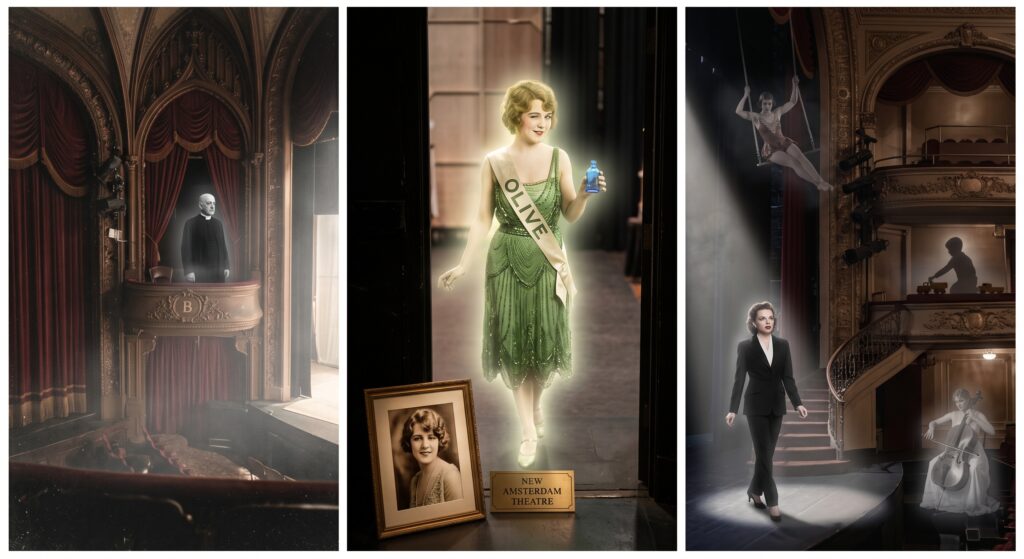
David Belasco earned the nickname “Bishop of Broadway” by dressing in clerical robes and living a near-monastic devotion to his craft. He built his namesake theater in 1907 and spent nearly every waking hour in the Gothic duplex apartment directly above the stage. He died in 1931. By most accounts, he never left.
The Bishop’s Presence
Actors describe Belasco in full clarity, still robed, watching rehearsals from the balcony or his private box. He shakes hands backstage and congratulates strong performances. Weak ones earn a colder reception: moans in the wings, dressing rooms found overturned. One eerie footnote endures. After the nude revue, oh! Calcutta! played the house; the Bishop reportedly withdrew, as though the show finally offended him into silence.
The Blue Lady
A second spirit haunts the stairways and dressing rooms, a showgirl said to have died in an elevator shaft fall. She reveals herself as an icy blue mist and a strange blue glow. Actor Laura Linney once described looking up during a final dress rehearsal and seeing a blonde woman in a blue dress in the locked balcony. When she mentioned it, the house manager reportedly asked only whether the figure wore blue. The theater’s disconnected elevator, meanwhile, still seems to travel to Belasco’s sealed penthouse on its own.
The apartment above the stage feeds its legends. Staff describe the sound of raucous 1920s parties spilling down from Belasco’s rooms, complete with dancing feet and jazz. Workers who climb to investigate find the penthouse empty and its dust undisturbed. Producers have even courted the bishop directly. When Hedwig and the Angry Inch ran at the house, the script asked each night whether anyone in Box B had spotted the ghost. Nobody claimed the sighting, yet the house manager insisted her office door still locked itself without a hand to turn it.
The New Amsterdam Theatre: The Persistence of Olive Thomas
Olive Thomas blazed through the Ziegfeld Follies and silent film before dying in Paris in 1920 at just 25, poisoned by her husband’s mercury bichloride. She became Broadway’s first notorious scandal, then came home to the stage that made her happiest.
The Girl in the Green Dress
Witnesses describe Olive in a green, beaded Follies dress, a sash reading OLIVE across it, clutching the blue glass bottle that held her poison. She is playful and flirtatious, and by long tradition she shows herself only to men. She triggers hand dryers, moves walkie-talkies, and flicks the lights before a conductor’s opening show, her mischief conveyed with a wink rather than a threat.
Goodnight, Olive
To keep her content, staff place her photograph at both the stage door and the main entrance. Cast and crew observe a strict custom before leaving each night. They say, “Goodnight, Olive.” One longtime theater manager put it best: you do not find Olive; she finds you, usually in the middle of a change, a new show, or a new office. Ritual, memory, and affection braid together here into something that feels less like a haunting and more like a family keeping a chair at the table.
Her timing sharpens the legend. Olive rarely performs on cue, especially for a Halloween crowd hunting for a thrill. She surfaces when the building shifts around her, when new productions load in and old routines dissolve. The staff read her appearances as approval rather than warning, a sign that the theater still runs on the joy she once brought to it. Disney, who restored the New Amsterdam in the 1990s, embraced her openly, framing a playful spirit as a fitting guardian for a house built on happiness.
The Palace Theatre: A Hub of a Hundred Spirits
The Palace once crowned the vaudeville circuit, and it seems to have kept every performer who ever needed it. Reports credit the house with at least a hundred resident ghosts, a crowd that rivals its living audiences.
Judy Garland Waits for Her Cue
Staff saw Judy Garland pacing stage left in heels, standing exactly where she waited during her 1950s concerts. The theatre once built her a dedicated orchestra-pit entrance and staircase. During 2018 renovations, her presence reportedly grew restless, lights flickering while a voice hummed “Over the Rainbow” from inside a sealed auditorium.
Louis Borsalino’s Fatal Encore
An acrobat named Louis Borsalino fell 18 feet during a netless tightrope act in 1935. He survived the fall and lived until 1963, yet his spirit reenacts the disaster anyway. Witnesses hear a blood-curdling shriek and glimpse a figure swinging from the rafters before it plunges, a trauma replaying itself against the will of the man who lived through it.
The Mezzanine Boy and the Cellist
Quieter spirits share the house. A small boy rolls toy trucks in the hallway behind the mezzanine. A white-gowned cellist plays a lost melody that drifts up from the orchestra pit, a fragment of music with no living hand to finish it.
More Broadway Hauntings
The New Victory Theater holds Mrs. Leslie Carter, Belasco’s original leading lady, known to hurl storage bins and once to flip one in midair to reveal a missing bow tie. Cast members of Billy Elliot at the Imperial Theatre blamed a mischievous door-opening entity they named Fred. At the Lyceum, choreographer Bob Fosse watches from his favorite balcony seats, and the drifting smell of cigarette smoke announces his presence.
The Living and the Lingering
Broadway’s ghosts endure because Broadway wants them to. The district builds a tradition around its deceased, saving seats, photographs, and holding nightly farewells. That care may prove multiple spirits real. It does prove something about the people who work these stages. They refuse to let a beloved performer become a stranger, even after death empties the dressing room. So the lights flicker, the elevator climbs, and somewhere a voice says goodnight to Olive one more time.
References & Further Reading
Wikipedia, Belasco Theatre. https://en.wikipedia.org/wiki/Belasco_Theatre
Playbill, The Real-Life Ghost Stories Behind Broadway’s Haunted Theatres. https://playbill.com/article/the-real-life-ghost-stories-behind-broadways-9-haunted-theatres
Beyond Haunted, Belasco Theatre Haunted History. https://beyondhaunted.com/new-york/belasco-theatre
Ron Fassler (Medium), Ghosts of Broadway. https://ronfassler.medium.com/ghosts-of-broadway-861701fbb1df
NYC Ghosts, Haunted Belasco Theater. https://nyghosts.com/belasco-theatre/
Broadway Scene, The Ghost of David Belasco. https://broadwayscene.com/broadway-ghosts-and-myths-the-ghost-of-david-belasco/

[…] theatre ghost is not a London or New York invention. It is a global species, and its stories shift shape to fit local history, local grief, […]