Picture a small grove of pine and oak along a Virginia creek. Fifty acres, salt fog, a skeletal canopy. Now fill it with pirates, drowned soldiers, and a Spanish galleon that sails above the treetops. That is Old House Woods, and every ghost here is looking for something.
The place sits in Mathews County, on Virginia’s Middle Peninsula. It takes its name from an abandoned colonial homestead that once stood among the trees. The house is long gone. The stories only multiplied.
Three treasures, three betrayals
Regional folklore names three distinct hoards, and each involves a killing. Pirates supposedly buried plunder near a freshwater pond called the cowhole, then murdered their own comrades to leave guardian spirits behind.
A second tale claims a British detachment buried Cornwallis’s Yorktown gold, then fell to ambush before they could return. A third describes royalist treasure hidden by British soldiers who were executed by white bondsmen afterward.
Notice the pattern. Every treasure comes with a broken promise and a violent death. The gold stays buried. The people who hid it stay dead. Neither party ever completes the deal.
The ship above the trees
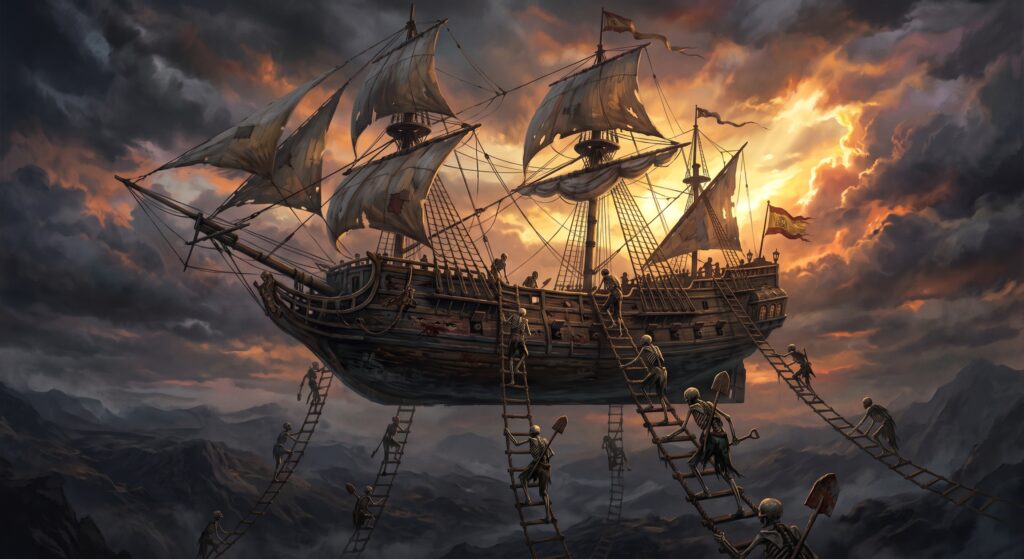
The sightings match the theme. Witnesses describe a three-masted Spanish galleon floating over the treetops, with skeleton sailors climbing down a Jacob’s ladder carrying shovels. They come, it seems, to dig for what they lost.
Then there is the Storm Woman. She appears as a pale figure in a nightgown, screaming above the canopy to warn sailors of coming shipwrecks. In the early 1900s, merchant Jesse Hudgins reported a giant man in plate armor floating along the road, carrying a fish-horn gun, who dissolved into a skeleton.
The plantation next door
The nearby Auburn Plantation carries its own haunting. Philip Tabb built it in 1824. In the 1970s, John Lennon and Yoko Ono reportedly bought it as a retreat. Yoko is said to have had the house exorcised and the basement filled completely with sand to keep the ghosts down.
True or embellished, the detail fits the region. Here the response to a haunting is not to flee but to seal something underground. The land keeps swallowing things: gold, soldiers, a basement full of sand.
Ghosts of incomplete histories
Every phantom in Old House Woods is stuck mid-task. The pirates guard loot they cannot spend. The soldiers dig for gold they cannot reach. The armored man patrols a road to nowhere.
Think of them as ghosts of incomplete transactions. A haunting like this is not really about death. It is about unfinished business, about a deal that death interrupted.
Walk the narrow evergreen roads in the bay fog. Listen to the wind screech through the skeletal branches. The woods do not want to scare you off. They want help finishing something no one living can complete.
A coast made for legends
Consider why this specific shoreline breeds ghosts. The Middle Peninsula juts into the Chesapeake, a maze of creeks, marshes, and isolated groves. Fog rolls in thick off the bay. Sound carries strangely over the water.
History layered conflict onto that geography. Colonial settlers, Revolutionary armies, and opportunistic pirates all passed through these waters. Each left behind stories of buried plunder, sudden death, and unfinished business.
Put fog, isolation, and violent history together and you get a perfect stage. Old House Woods supplies every ingredient a haunting needs, then adds a floating galleon for good measure.
The psychology of buried treasure
Think about why treasure legends attach to hauntings so often. Buried gold represents value locked away, denied to everyone, guarded by the dead. It is the ultimate unfinished transaction.
The guardian-spirit motif makes the point vivid. Pirates who murder comrades to post them as sentries turn greed into eternal duty. The dead cannot leave, and the living cannot dig. Everyone loses forever.
That deadlock is the true engine of the fear. A ghost searching for gold it can never hold is more tragic than any simple specter. It wants what death made impossible, and it will keep wanting it as long as the story is told.
Walking the haunted grove
Picture the visit itself. Narrow roads lined with evergreens lead toward the water. Salt fog clings to the branches. The wind screeches through a canopy that looks skeletal against a gray sky.
Now populate that scene with its phantoms. A galleon drifts overhead. Skeleton sailors climb down with shovels. The Storm Woman screams her warning from above the trees. An armored figure patrols the road and melts into bone.
Every one of them is still working. That is the haunting’s genius. Old House Woods is not a place where things ended. It is a place where nothing ever got to finish, and the dead keep trying.
The endless search
A death-loop ghost is frozen in trauma. A search-loop ghost is frozen in longing. It wants something specific and unreachable, and it will keep reaching for as long as the tale survives.
The buried treasures make perfect anchors for that longing. Gold hidden and never recovered is desire made permanent. The diggers cannot stop, because the object of their search still exists, somewhere, just out of reach beneath the sand.
Stand in the salt fog and let that idea settle. The galleon overhead, the skeleton crew with their shovels, the armored patroller: all of them are still working a job that death interrupted. In Old House Woods, nothing gets to rest until the search ends. And the search never ends.
That is the woods’ final gift to the visitor. It offers not a jump scare but a slow ache, the sight of the dead forever chasing what the living hid. Few hauntings capture longing so purely. Old House Woods turns simple greed into an eternity of searching.