A child stands near the ice on the shore. A low, sweet humming rises from beneath the surface, almost like a mother calling. The child steps closer. That is the moment every Qalupalik story warns against, and it is why generations of Arctic children learned to fear the edge of the water.
Most write-ups sell the Qalupalik as a slimy horror-movie hag and stop there. That framing misses what the legend is for. This is a teaching story, one that Inuit authors and animators are now actively reclaiming from the monster bin. The real subject is not a creature. It is thin ice and love.
What the stories describe
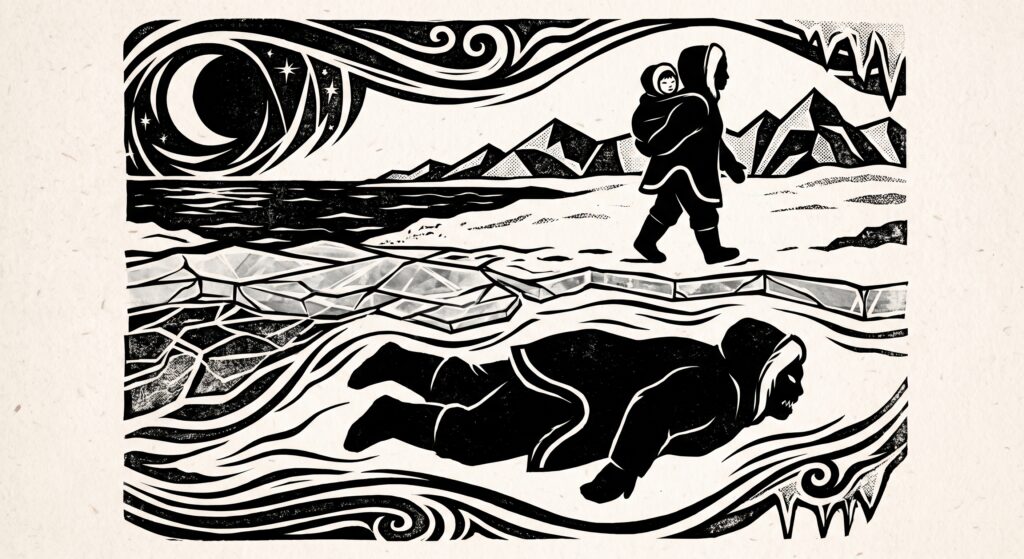
The Qalupalik, also spelled Qallupilluit, lives along Arctic shorelines near ice floes across Inuit communities in Canada, Greenland, and Alaska. Accounts describe it as having green, slimy, or scaly skin; long hair; webbed and clawed hands; and long fingernails. Some tellings add a sulfur-like smell before it appears.
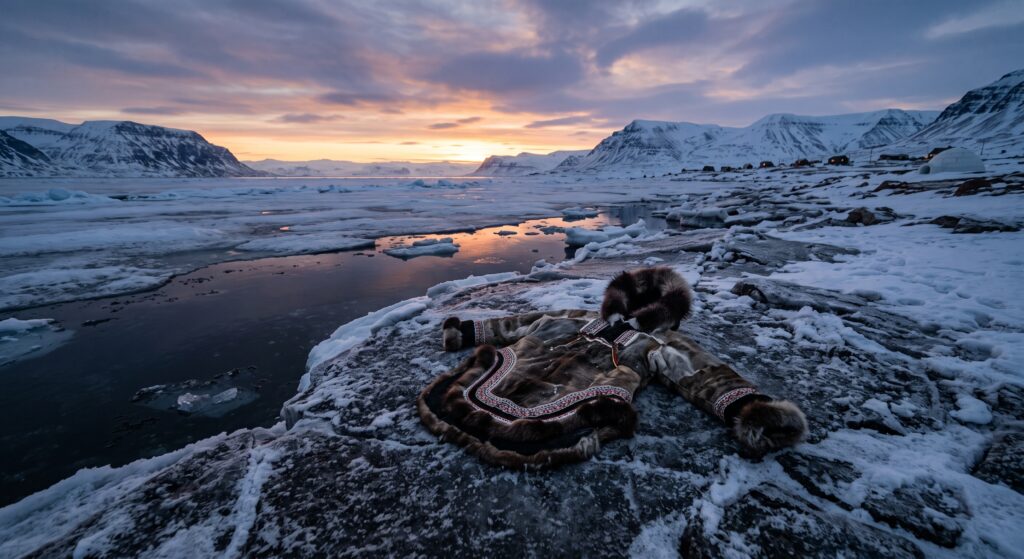
Its most haunting feature is the amautik it wears, the hooded parka Inuit women use to carry babies against their backs. The Qalupalik uses that same pouch to steal children who wander too close, then vanishes with them beneath the sea, never to be seen again.
That detail lands with particular force because it inverts an image of safety. “Amautik” means warmth and a mother’s care. On the Qalupalik, it becomes a trap for the unwary. Some tellings even add that the creature can shapeshift into a seal or whale to travel quickly. Others say it raises stolen children as its own beneath the waves.
The hum that lures children in
The creature hunts by sound, using its eerie hum to lure children in. It hums an eerie, distant tune from below the ice, sometimes tapping its fingers on the surface to draw curious children nearer. In some versions it mimics a familiar voice, even a mother’s lullaby, folding it back to coax a small child forward onto weak ice.
The parallel to sirens is obvious, but the Qalupalik is more monstrous than seductive. Where sirens tempt grown sailors, this creature preys on children specifically. That focus is the key. The story targets exactly the listeners it most wants to protect.
A warning built into the word
Consider the etymology. The Latin root of “monster,” monstrum, means “to warn”. That is precisely the Qalupalik’s job. In the harsh Arctic, children who wandered onto thin ice could fall through, drown, and disappear without a trace. The legend gave that horror a face and a rule.
Franz Boas documented the tradition as early as 1888. Scholars widely read it as a protective device. Rather than repeat “stay away from the ice” endlessly, elders gave children an unforgettable image. Fear did the work of a fence, keeping small feet away from lethal water.
The legend also explained real tragedies. When a child fell through thin ice, drowned, and vanished without a trace, the Qalupalik gave that loss a shape and a name. In a world of genuine, sudden danger, the story offered both a warning beforehand and an account afterward. It carried grief as well as caution.
More than a bogeyman
The deeper tellings resist the simple monster label. Some Inuit writers describe the Qalupalik as both feared and revered, a presence tied to the sea’s uncontrollable power and the respect it demands. The concept of “monster” does not translate cleanly into Inuktitut at all.
Origin stories vary with the teller. In some, the creature was once a woman who loved the sea too much or a child taken by a stranger’s greed. The important part, elders say, is not the reason but the result. A being lives under the ice, and children must learn the boundary of the shore.

Reclaimed by its own culture
This is the fresh angle. The Qalupalik is not fading into generic cryptid content. Inuit creators are bringing it home. It anchors children’s books from Inuit publishers, including work by Elisha Kilabuk and a graphic novel featuring the characters Putuguq and Kublu.
It also appears in the animated short Qalupalik from the Nunavut Animation Lab and in the acclaimed game Beneath Floes. These retellings keep the story where it belongs, inside the community that created it, teaching respect for the sea rather than serving up a shock for outsiders.
So approach the Qalupalik as more than a green-skinned scare. It is a piece of living Inuit knowledge, a warning stitched from love and fear. It reminds us that the oldest way to keep a child safe is a story they never forget. For more Alaskan coastal folklore, check out the Kushtaka.
How hunters were said to beat it
The old stories did not leave people entirely helpless. In its natural form, the Qalupalik supposedly resisted all weapons. But it could shapeshift, and that was its weakness. Hunters would call out and praise the creature, coaxing it to transform into a seal or a whale.
In that borrowed shape, it became vulnerable, and the hunters would strike. The detail is telling. Even the fiercest Arctic monster had a rule that could be turned against it, a logic that rewarded knowledge and nerve. The lesson cut both ways, warning children while empowering the adults who protected them.
A mirror to other water spirits
The Qalupalik sits within a global family of water beings, yet it stands apart. Compare it to Japan’s kappa, a mischievous river creature that people can placate with cucumbers and that sometimes even helps humans. The kappa’s tone is playful. The Qalupalik is a grave warning about lethal water. For more on river monster folklore, click here.
That contrast reveals something about the Arctic. In a milder climate, a water spirit can afford to be a trickster. In a place where thin ice and frigid seas kill quickly, the guardian of the water had to be genuinely frightening. The harshness of the environment shaped the harshness of the tale.
That is the final reason to treat the Qalupalik with respect rather than as cheap horror. It is a survival tool carved by people who buried children lost to the ice. Behind the green skin and the humming lies a parent’s oldest fear. The oldest answer to it is a story told with love.
For more on this topic, see our complete guide to the Cryptids of the World: A Global Guide to Hidden Monsters.
References & Further Reading
Qallupilluit, citing Boas 1888 (Wikipedia)
Beneath the Ice: Exploring the Qallupiluk (NightTide Magazine)