Water hides things. This is the fundamental truth that river and lake monster folklore processes: the surface of any large body of water is a boundary, and what lies beneath that boundary is genuinely invisible to any observer standing above it. Unlike a forest, where persistence and patience can resolve most mysteries, deep water keeps its secrets indefinitely. The largest creatures in a lake can live their entire lives without being seen by human eyes. The river’s current erases tracks. The lake’s depth swallows evidence. The creature does not need to be particularly elusive. The water does all the concealing work.
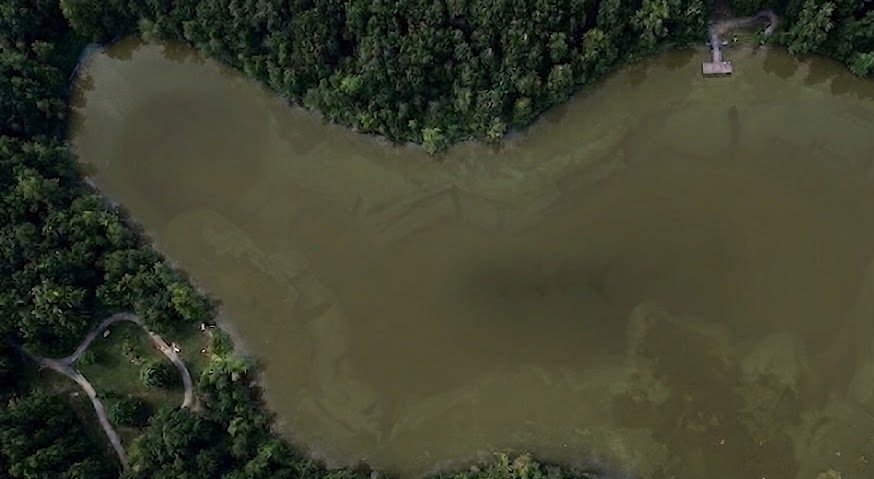
River and lake monster traditions exist on every inhabited continent, in cultures that developed their water-creature lore without contact with each other, and the structural features of those traditions are strikingly consistent. A large creature, usually serpentine or at least elongated, associated with deep water, occasionally seen at the surface during specific conditions, regarded with some combination of fear and respect, and connected to the water’s broader spiritual significance in the culture that perceives it. The consistency suggests either a common biological reality or a common psychological response to the same fundamental experience: the opacity of deep water and the human need to populate uncertainty with something recognizable.
The Deep Water Reflex
Evolutionary psychologists suggest that the human nervous system has a deep-water reflex: a heightened alert state triggered by proximity to opaque bodies of water, particularly when those bodies are large, deep, or moving. This reflex is plausibly adaptive, since large predators have used water edges as ambush sites throughout human evolutionary history. The reflex predisposes humans to perceive threats at water boundaries and to interpret ambiguous stimuli, a distant ripple, an unusual current, or a briefly visible dark shape, as potentially predatory.
This doesn’t mean lake monsters are hallucinations. It means that human beings are specifically primed to notice and remember unusual things they see in or near deep water and to weight those observations with a significance they might not attach to the same stimulus in a forest or a field. The monster that breaches briefly at the far end of the lake is not just a curiosity. It is a threat-adjacent experience that the nervous system files away carefully.
The Sacred Water Tradition
Across Indigenous traditions worldwide, large bodies of water are consistently regarded as spiritually significant: places where the boundary between the ordinary world and the spirit world is thin, where power concentrates, and where unusual things are possible. The Syilx N’ha-a-itk of Okanagan Lake, the Ojibwe Mishipeshu of the Great Lakes, the Bunyip of Australian billabongs, the Naga of Southeast Asian rivers, the Kelpie of Scottish lochs, and dozens of similar traditions all place a powerful, dangerous, semi-divine entity in the deep water of a significant body. These are not monster stories in the Western entertainment sense. They are cosmological statements about the nature of water and power.
The Western lake monster tradition, from Nessie to Champ, developed in a different cultural register: secular, biological, and cryptozoological rather than spiritual. The assumption is that the creature is an animal, a surviving plesiosaur or giant eel or unknown species, rather than a spirit or a power. This secular framing opened lake monster research to scientific methodology but also stripped the tradition of the relational complexity that made the Indigenous versions so rich. Understanding both frameworks together produces the most complete picture of what lake monster lore actually is.
What the Animals Actually Tell Us
Lake and river ecosystems regularly surprise biologists. Giant oarfish, reaching thirty-six feet, are occasionally found stranded on beaches after being assumed to be mythological by most of the populations whose fishermen reported them. The megamouth shark, now known to be a widespread species, eluded discovery by science until 1976, when one was accidentally caught off Hawaii. The coelacanth, a lobe-finned fish believed extinct for 65 million years, was found alive in 1938 in South African waters. The colossal squid was confirmed as a real species only in 2003.
These discoveries do not prove that lake monsters are real. They establish that enormous animals can remain unknown to science for extended periods and that the oceans and large lakes are sufficiently opaque to conceal significant biological surprises. The question of whether something unknown lives in Loch Ness or Lake Champlain differs from the question of whether it is scientifically plausible that something unknown could live there. The second question has a more compelling answer.

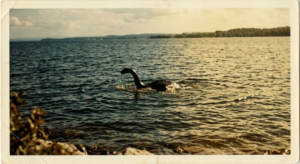

[…] The Qalupalik sits within a global family of water beings, yet it stands apart. Compare it to Japan’s kappa, a mischievous river creature that people can placate with cucumbers and that sometimes even helps humans. The kappa’s tone is playful. The Qalupalik is a grave warning about lethal water. For more on river monster folklore, click here. […]
[…] traditions warned of massive creatures ruling the continent’s deep waters. Today, these river and lake monsters remain some of our most enduring cryptids. Lake Champlain, bordering New York and Vermont, is home […]