The White River moves through the Arkansas Ozarks with a quality of ancient persistence: deep in places, opaque with limestone sediment, cutting through country that was remote when the first European settlers arrived and remains significantly rural today. In 1915, a plantation owner named Bramlett Bateman reported seeing an enormous creature in the river near Newport, Arkansas, an event that other witnesses confirmed and that generated regional newspaper coverage. Bateman described the creature as roughly twenty feet long, with grey skin and a spiny back, surfacing with enough force to create a visible disturbance in the water from the shore.
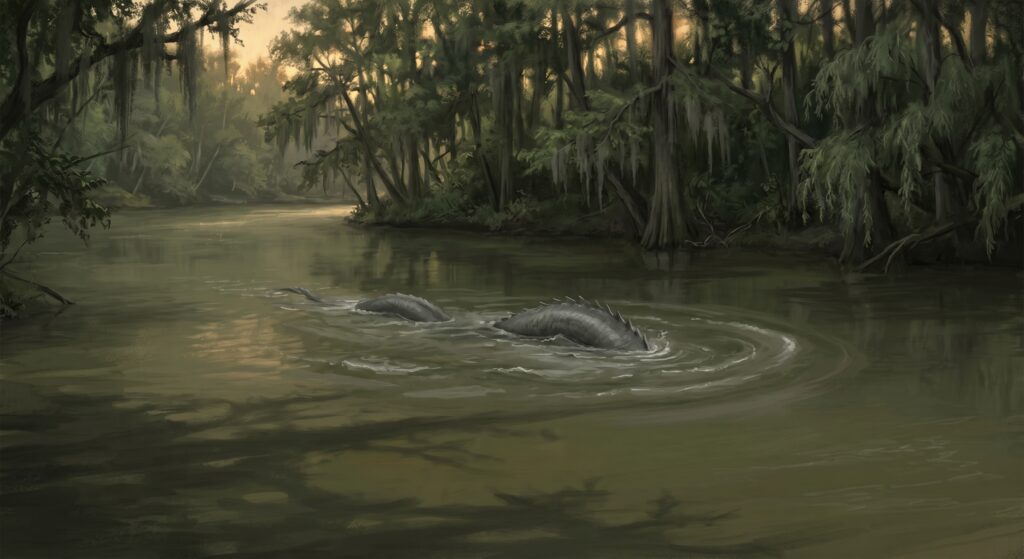
The 1915 account was not the first. Older reports from the surrounding community stretched back further, though none had attracted Bateman’s level of formal documentation. Newport sits in Jackson County on the White River’s lower course, where the river widens and slows before its eventual confluence with the Black River. Essentially every subsequent White River Monster account has cited the deep pools near the Newport bend as the creature’s preferred location.
The 1971 Sightings and the State Sanctuary
The White River Monster’s modern prominence dates to a cluster of sightings in 1971 near Jacksonport, a small town north of Newport. Multiple witnesses reported a large, grey creature surfacing in the river over several weeks. One witness, local farmer Cloyce Warren, described a creature approximately forty feet long rolling on the surface before submerging. The accounts attracted enough credibility that the Arkansas State Legislature passed a resolution in 1973 designating a stretch of the White River as the White River Monster Refuge, with explicit legal protection for the creature.
The legislative action is arguably the most significant thing about the White River Monster tradition: it represents a formal government acknowledgment of a cryptid’s existence sufficient to extend it legal protection, even if that protection is largely symbolic. Arkansas shares this distinction with New York and Vermont’s Champ legislation and British Columbia’s Ogopogo protection, reflecting a pattern in which lake and river monster traditions become institutionalized in the communities where they are most deeply rooted.
What Lives in the White River
The White River supports a substantial population of alligator gar, which can reach ten feet in length and have a prehistoric appearance with heavy scales, an elongated snout, and large size. Alligator gar surface to gulp air periodically and can create significant water disturbances. Large blue catfish in the White River reach impressive sizes, with specimens over sixty pounds documented regularly. Flathead catfish are even larger in potential, with a record for the system exceeding eighty pounds. None of these animals match the forty-foot descriptions from the most dramatic accounts, but at night, at distance, and in the White River’s characteristically murky water, a huge catfish or gar could produce an encounter that exceeds its actual dimensions in the telling.

[…] White River Monster of Arkansas: Muddy Water, Old Reports, and Local Legend […]