Somewhere in the vast, underpenetrated swamps of the Congo Basin, in the area where the borders of the Republic of Congo, the Democratic Republic of Congo, and Cameroon converge around the Likouala swamp region, there may or may not be a creature that multiple generations of Pygmy and Bantu forest peoples have described as enormous, long-necked, semi-aquatic, and extremely dangerous to approach.
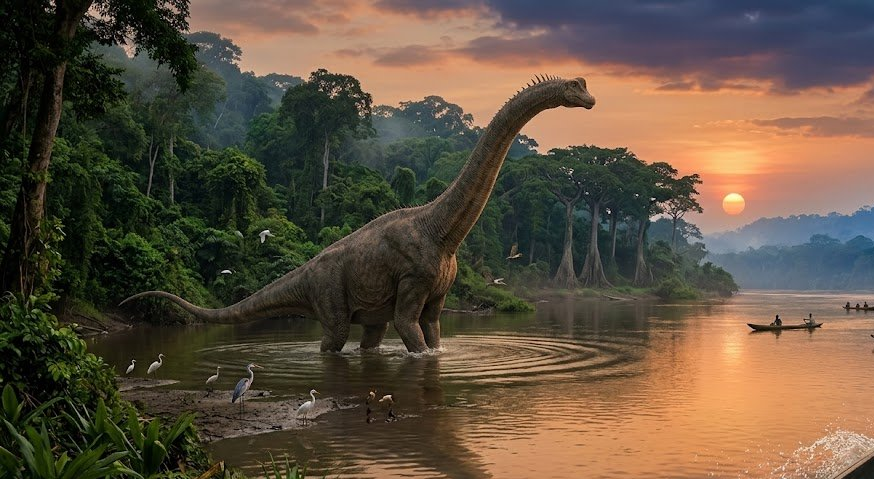
The Mokele-Mbembe, whose name translates roughly as ‘one who stops the flow of rivers’ in the Lingala language, is the most seriously investigated African cryptid and one of the most persistently intriguing in the global inventory. Its description, repeated with reasonable consistency across independent interviews with Indigenous people of the Congo Basin conducted by European and American researchers over more than a century, is what makes it genuinely compelling rather than simply entertaining: a large, long-necked herbivore with a small head, a long tail, grey or brownish skin, and the ability to kill hippopotamuses that enter its territory.
The History of Investigation
The first sustained Western investigation of Mokele-Mbembe accounts was conducted by Carl Hagenbeck, a German animal trader who included a description of a supposed giant aquatic saurian in his 1909 memoirs, based on reports from Central African informants. Subsequent expeditions by Colonel Percy Fawcett (1907), Leo von Boxberger (1914), and Willy Ley (1940s) collected additional accounts and elevated the creature from curiosity to a genuine cryptozoological subject.
James Powell, Roy Mackal, and their colleagues conducted the most systematic modern investigations in the 1970s and 1980s. Their expeditions into the Likouala swamp region produced extensive interviews with local people but no physical evidence of the creature. Mackal’s 1987 book A Living Dinosaur? is the most detailed treatment of the fieldwork. The expedition teams were consistently told by local informants that the creature was known to inhabit specific deep-water lakes and river sections, but none produced a direct sighting.
The Sauropod Hypothesis
Western researchers have proposed that Mokele-Mbembe, if real, might represent a surviving population of sauropod dinosaurs, specifically small relatives of the large long-necked sauropods of the Mesozoic. This hypothesis is paleontologically implausible: sauropods disappeared globally at the Cretaceous-Paleogene extinction event 66 million years ago, and no mechanism has been proposed that would allow them to survive in isolation while leaving no fossil or physical evidence from the intervening period.
The more credible biological candidates for the creature described in Indigenous accounts include huge Nile monitor lizards (which can reach eight feet), large African softshell turtles, and possibly a surviving population of rhinoceroses (whose horn could create a long-neck silhouette in murky water seen from a distance). None of these fully matches the detailed descriptions produced by consistent Indigenous eyewitness accounts.
References & Further Reading
• Roy Mackal: A Living Dinosaur? In Search of Mokele-Mbemb
For cryptids beyond North America, see our guide to the Cryptids of the World: A Global Guide to Hidden Monsters.
[…] 1980s, biologist Roy Mackal led two expeditions into the Congo while searching for the better known Mokele-mbembe. Local informants told him about the elephant-killing horn instead, and he took detailed notes. […]
[…] rests on remarkably little testimony compared to related Congo cryptids like the Mokele-mbembe or the Emela-ntouka. A handful of villagers near two neighboring settlements make up nearly the […]
[…] of the Congo River basin have long been rumored to harbor prehistoric survivors. The most famous is Mokele-Mbembe, a sauropod-like creature said to dwell in the deep rivers. But it is not […]