She appears without warning at the edge of the road, in a white dress that is wrong for the weather, standing still in the dark. Drivers who see her report the same sensation: the wrongness arrives before any specific detail. Something about the stillness, the pale clothing, and the way she does not react to headlights feels wrong. Then she is gone, on the road, or in the back seat, and the driver does not stop.
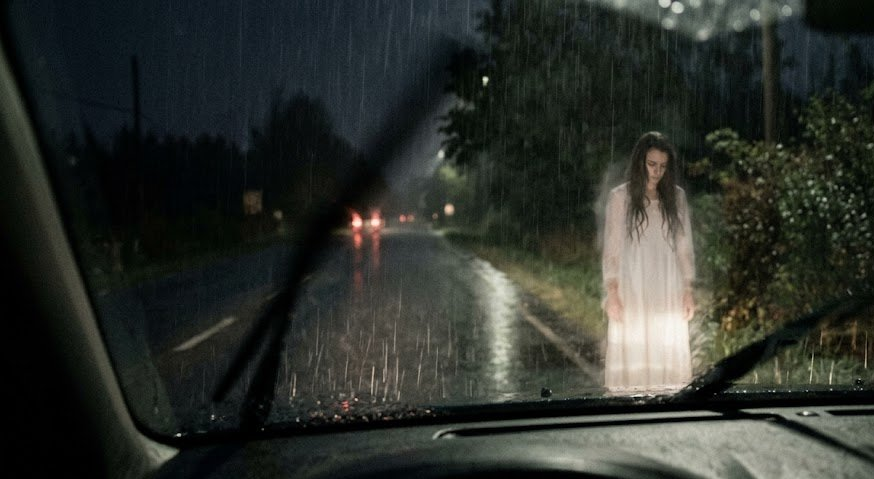
The Woman in White is one of the most globally distributed ghost archetypes in the world. She appears on roads, near rivers, outside castles, and in hospital corridors. She crosses cultures and centuries with a consistency that makes her impossible to dismiss as regional folklore. Understanding what she represents and why she keeps appearing in the same form across traditions that developed independently reveals something genuine about grief, gender, loss, and the landscapes where tragedies accumulate.
The Global Template
The White Lady, as she is known in British and European traditions, appears in the folklore of virtually every country with a ghost tradition. In England she is associated with castles and great houses, typically a noblewoman or servant who died through betrayal or violence. In the Philippines, the White Lady of Balete Drive in Quezon City is reported by drivers on a specific road: a young woman who was raped and murdered, now appearing to lone motorists. In Brazil the Dama Branca is described as a young woman who died in childbirth or by violence, appearing in a white dress or sleeping gown. In Scotland, White Ladies guard castle walls, often connected to imprisonment or betrayal.
In Mexican and Southwestern American folklore, the archetype reaches its most developed and emotionally complex form as La Llorona, the Weeping Woman. La Llorona is described as a woman in white who wanders near bodies of water, wailing for her lost children, whom she drowned in a jealous rage after her husband’s infidelity. Her origins connect to Aztec goddesses, including Cihuacoatl and Chalchiuhtlicue, both associated with water and violent loss. Mentions of her can be traced back more than four centuries. The legend has been used as a warning story, a representation of Mexican colonial grief, and a genuine folkloric ghost who people report encountering near rivers and canals to this day.
What the White Color Means
The color white operates differently in ghost folklore than its connotations in Western bridal tradition might suggest. In many cultures, white is the color of mourning and death rather than purity. Ancient Romans wore white to funerals. Asian cultures use white burial garments. The white dress of the Woman in White places her immediately in the category of the dead, marking her visually as someone who has crossed the boundary she is still haunting. The pale quality of the apparition reinforces the point: the lack of color is the lack of life.
Paranormal investigators who catalog Woman in White sightings note three distinct behavioral modes across the reports. In residual-style encounters, she appears like a replay, showing up in the same location doing the same thing and ignoring anyone who witnesses her. In interactive encounters, she reacts to witnesses, follows them, or appears closer than she should. In the rarer threatening mode, associated particularly with La Llorona and some road variants, the apparition is actively dangerous, luring drivers toward water or off-road edges. Most reports fall into the first category. The threatening mode tends to cluster around accounts that serve a specific warning function within the community, alerting them to danger.
Roads and Water: The Specific Landscape
The Woman in White appears disproportionately in two specific landscapes: roads at night and the edges of bodies of water. Both are liminal environments in the folklore sense. Roads are transitional spaces, places you pass through rather than inhabit. Water is the universal symbol of the boundary between life and death across virtually every mythology. A woman in white standing at a river’s edge at night has placed herself at the intersection of two of the most symbolically charged environments in human spiritual geography.
Resurrection Mary, Chicago’s most famous Woman in White, appears on Archer Avenue near Resurrection Cemetery, asking for rides to a dance hall and vanishing before arrival. She is categorized as a phantom hitchhiker, but she is also unmistakably a Woman in White: pale, dressed in white, associated with a cemetery, and appearing on a road at night. The case has generated independent sighting accounts across nearly a century, with the location and description remaining remarkably consistent.
Why the Story Keeps Being Told
The Woman in White archetype persists because it processes something that every culture needs to process: the violent or tragic death of a young woman and the guilt, grief, and unresolved feelings that such a death generates in a community. She appears where injustice happened and was not fully addressed. She appears where grief was suppressed rather than acknowledged. She appears where something was left unfinished. This function, in which the ghost embodies unresolved community feeling, explains why the story keeps emerging independently in cultures that could not have borrowed it from each other. The Woman in White is not a genre. She is a symptom.
References & Further Reading
• All That’s Interesting: La Llorona Legend
• Haunted Traverse: What Is a White Lady Ghost?
• Ghostly Activities: The Woman in White Ghost Type


[…] belongs to a global family of stories. Folklorists call it the vanishing hitchhiker, or the woman in white, and versions appear across many cultures. Chicago alone claims several ethnic variants of the […]