Most night demons in this series are terrifying but harmless. For a deeper dive into sleep paralysis experiences across cultures, click here. The Filipino tradition is different. Here the folklore attached itself to something that genuinely kills young, healthy men in their sleep. The demon is called the Batibat. This death is called bangungot.
Please Note: This article is provided for informational and educational purposes only. It does not constitute medical advice and should not be treated as a substitute for professional diagnosis or care. If you regularly experience sleep paralysis, or if your episodes are frequent, distressing, or accompanied by other symptoms, please consult a qualified doctor or sleep specialist.
The demon in the bedpost
The Batibat is an ancient, enormous, tree-dwelling female demon of Ilocano tradition. She lives inside her tree, and she is territorial.
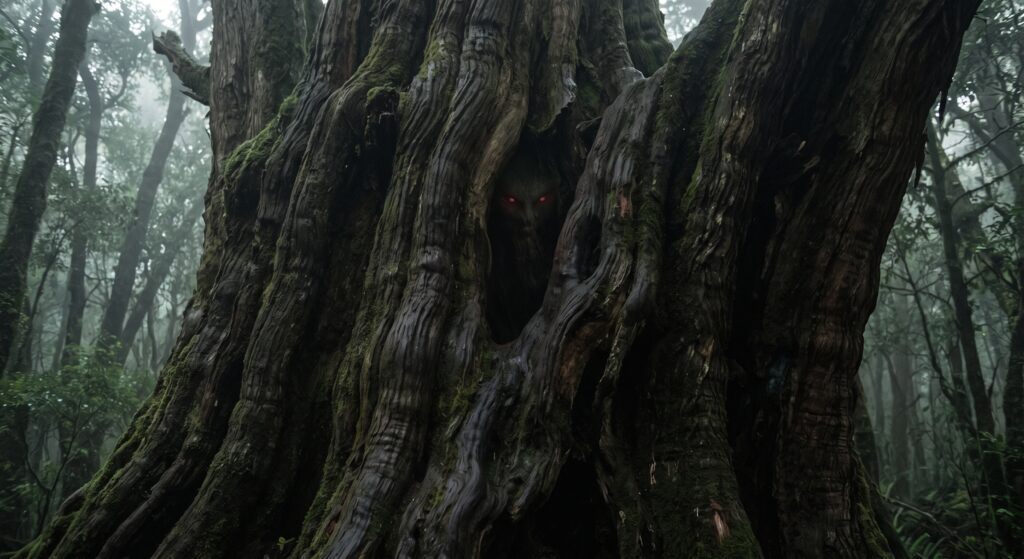
The danger begins when humans cut down her tree and use the trunk as a support post for a house. The Batibat migrates into the post. And she turns vengeful toward anyone who dares sleep near her new home. At night she assumes her true, massive form, settles onto the sleeper’s chest, and suffocates them while flooding their dreams with horror. Victims groan and moan, struggling for breath under her weight.
The tree-post detail grounds the demon in daily life. Homes were built from felled timber. A support post was ordinary, load-bearing, and everywhere. The lore placed a furious spirit inside the most mundane part of the house.
When the nightmare is fatal
Here, the folklore diverges from all others in this collection. In the tradition, if the sleeper cannot wake, they die. And disturbingly, that reflects a real phenomenon.
Bangungot is the folk name for a pattern doctors call “sudden unexplained nocturnal death syndrome,” or SUNDS. It strikes a recognizable profile: young men, roughly ages 20 to 40, apparently healthy, dying suddenly in their sleep, often after a large meal.
The folklore reflects a real pattern. In the lore, failing to wake means death. In the clinic, a fatal arrhythmia can end a life mid-sleep. The story wrapped a true danger in a demon’s shape.
The genetic culprit, and an honest caveat
Research points to a strong link between the folklore-matching cases and Brugada syndrome, a genetic disorder of the heart’s electrical system. Brugada can trigger fatal arrhythmias during sleep and disproportionately affects young men in Southeast Asia.
Under extreme panic, such as a perceived spiritual attack, a surge in the body’s stress response could tip a vulnerable heart into a deadly rhythm. That fits the Batibat lore all too well.
But honesty requires a caveat that the scary version usually skips. “Bangungot” is an umbrella term. Autopsy studies show it also captures other causes, including acute hemorrhagic pancreatitis. Not every bangungot death is Brugada, and researchers are careful to say the two are closely related rather than identical. The folklore names a real danger, but the medicine is more layered than a single gene.
The profile is consistent. Young men, often after a large meal, dying suddenly in their sleep. Brugada syndrome disrupts the heart’s electrical rhythm and strikes this group hardest in the region.
The wisdom in the toe-wiggle
Traditional Ilocano advice for a Batibat attack is precise. Bite your thumb hard, or forcefully wiggle your big toe, to jolt the body awake and break her spell.
This is not mere superstition. Focusing intense effort on a single small muscle is a recognized way to interrupt REM atonia and end an episode. In the folk frame, the goal is to survive the demon by waking before she finishes. Neuroscience says the same small movement can break the paralysis.
The urgency in the folk advice reflects the stakes. In most traditions, waking is a relief. Here, waking is survival. The instruction to move a toe carries the weight of life and death.
The curse carried in lumber
The vengeful-tree-post lore has a haunting logic. A family fells a tree, builds a home, and unknowingly brings a furious spirit into the wood they sleep beside. A piece of ordinary lumber carries a fatal curse into the house.
Read through the medical lens, the story becomes a cultural container for a genuine tragedy. When a healthy young man died overnight for no visible reason, the Batibat gave grief a name and a shape. She explained the unexplainable.
When to take the story seriously
This series treats night demons as folklore, not fact. The Batibat is the one case where the underlying danger deserves genuine caution.
Sudden nocturnal death in young men is real. Its link to Brugada syndrome is well documented, even as researchers stress that bangungot covers more than one condition. The demon is a story wrapped around a true tragedy.
That is why the practical takeaway matters more here than anywhere else. Charms cannot address an inherited heart-rhythm disorder. A cardiologist can.
If sudden, unexplained nocturnal death runs in a family, that is a medical fact worth investigating. The Batibat gave grief a name. Modern medicine can sometimes give it a warning in time.
Where folklore meets the cardiologist
Bangungot is the rare case where taking the science seriously is not just compelling but potentially lifesaving. The demon is a story. The sudden cardiac death behind some of these cases is not.
That is why this post carries a real recommendation, not just a spooky one. The Batibat cannot be fought with charms. But a family history of sudden nocturnal death is something a cardiologist can actually evaluate. Sometimes the most useful response to an old demon is a modern checkup.
References & Further Reading
Unraveling the enigma of bangungut: is SUNDS allelic to Brugada syndrome? (PMC, 2012)
Batibat and bangungot lore (The Aswang Project)
Dying from sleep or bangungut may run in the family (Philippine Heart Association)


[…] translates as “a dead body climbed on top of me.” In the Philippines, “bangungot” describes a deadly nightmare caused by spirits. In Egypt, the “kabus” is a heavy […]