Seventy years ago, someone quietly moved and rebuilt the most haunted house in Salem.
A Panic That Consumed a Colony
In 1692, religious hysteria swept through Salem and the surrounding villages. Fear, rivalry, and a legal system willing to accept spectral evidence as proof of guilt fueled it. Nineteen people were hanged, one man was pressed to death, and five more died in prison awaiting trial.
Judge Jonathan Corwin sat on the Court of Oyer and Terminer that sent most of those nineteen to the gallows. He conducted early interrogations from his home, working alongside his brother-in-law and fellow magistrate John Hathorne, a man remembered even more harshly for his zeal.
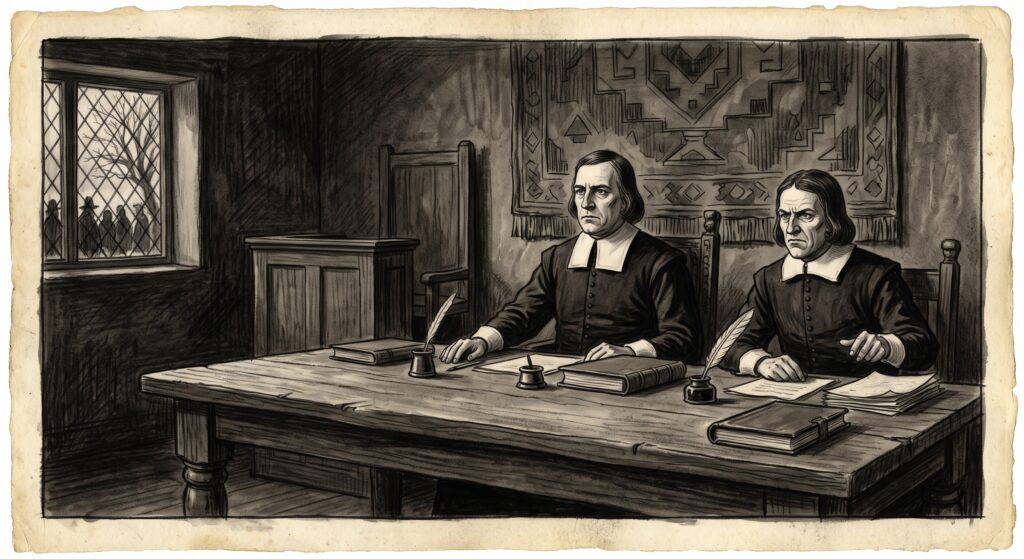
Corwin never publicly expressed remorse for his role, a silence historians still find striking given how many other participants eventually apologized. He went on to serve as a judge on the Superior Court and as a judge of probate. He died in 1718, wealthy and respected within Salem society.
His accuser-turned-victim, Bridget Bishop, had been hanged twenty-six years earlier as the first person executed in the entire ordeal.
The House That Was Never What It Looks Like
Corwin’s home, now known as the Witch House, stands as the only structure in Salem with a direct, documented tie to the trials. That distinction has made it the centerpiece of the town’s haunted reputation for generations.
The The building visitors walk through today is not located where Corwin’s house originally stood. In the 1940s, the city of Salem planned to widen North Street, a project that would have demolished the historic home entirely.
Local preservationists raised enough money to save the building. Saving it meant physically moving it roughly thirty-five feet back from the road. Architects then restored the structure to its presumed seventeenth-century appearance in 1945. That reconstruction relied on documentary research, architectural archaeology, and a fair amount of educated guesswork.
That restoration effort helped launch Historic Salem, Inc., the preservation group still active in the city today. The Witch House reopened as a museum in 1948 and now consists largely of twentieth-century material dressed to look four hundred years old.
None of these changes makes the house less historically important. Corwin genuinely lived there, genuinely questioned accused witches within its walls, and genuinely never repented for the role he played. The frame is newer than most visitors assume, but the weight of what happened on that property remains entirely real.
The Corwin Curse
Family lore holds that eight members of the Corwin family died prematurely in the years following the trials, a pattern descendants eventually called the Corwin Curse. One of Corwin’s own grandsons reportedly wrote of an unrelenting run of loss that devastated what remained of the family estate.
The trials themselves are documented with unusual precision for the era. The curse story survives mainly through descendants’ own accounts, passed down rather than confirmed by outside sources.
It is easy to see why the story took hold. A family that profited from a wave of judicial killings, then suffered its own string of early deaths, fits a moral pattern audiences find satisfying. Satisfying does not mean documented, though, and the two should not be confused when weighing what actually happened on Essex Street.
Whatever its origins, the curse narrative has become inseparable from the house’s haunted reputation. It gives visitors a second layer of tragedy to consider beyond the executions themselves.
Who Still Walks the Property
Visitors and paranormal investigators describe the presence of Bridget Bishop lingering near the property where she was examined before her hanging. Some report an unexplained child’s voice recorded inside the house, with no living child present at the time.
Others describe Sarah Good’s spirit as walking the grounds, searching endlessly for the judge who condemned her. Local tradition claims that stepping onto the property on Halloween night invites an unusually strong response from the spirits tied to the trials.
The Witch House survived demolition, relocation, and a near-total architectural rebuild. It still draws visitors captivated by the weight of what happened inside its walls, whichever exact patch of ground those walls now occupy.
Salem eventually built a tourism industry around the very hysteria its founders once tried to bury. The Witch House anchors that industry today, standing as both a genuine artifact and a careful reconstruction. It is a fitting contradiction for a town that has spent three centuries deciding how to remember its worst year.
A Trial by Neighbors
What made the Salem trials especially devastating was their intimacy. The accusers and the accused had known each other for years, worshipped in the same meetinghouse, and often worked the same fields together. Fear turned lifelong relationships into evidence against a defendant almost overnight.
One juror and twelve of his fellow jurors eventually signed a public statement of regret, admitting the evidence used against the condemned had been insufficient. Corwin’s silence stands out precisely because so many of his peers eventually broke theirs. That contrast has become part of his legacy, a judge remembered as much for what he refused to say as for what he did in 1692.
The Massachusetts colony itself later passed a bill restoring the good names of several victims. It also offered compensation to their families, though the process took years and never touched everyone affected. Some families waited generations for any form of official acknowledgment at all.
Salem’s modern identity as a witch-friendly tourist town would have been unrecognizable to the Puritans who lived through 1692. They saw the trials as a source of shame, not spectacle. It took nearly three centuries for the town to fully reclaim the story on its terms, and even longer for it to profit from the telling.
The Witch House sits at the center of that long reclamation. It is a genuine seventeenth-century home, moved and rebuilt but still standing, still holding the memory of a judge who never once looked back.
Visitors leave with a fuller picture than the gift shop plaques usually offer. There is a real magistrate, a real curse story of uncertain origin, and a real building that survived through relocation rather than pure luck. All three threads matter to the haunting, and none of them cancels the others out.
For a deeper dive into the moral panic of the Salem Witch Trials, see our post here.
For the full story of America’s paranormal political history, see our guide to the Ghosts of the Founding Fathers and the Haunted White House.
References & Further Reading
Jonathan Corwin House in Salem, MA, Salem Witch Museum
Salem’s Haunted History: Judge Corwin’s Haunted Witch House, Wandering Educators

[…] darker moments also survive; in Massachusetts, the legacy of the witch trials is bound up in the Corwin Curse of Salem, while Virginia’s Colonial Williamsburg hides the ghosts of pirate executioners and tragedy […]