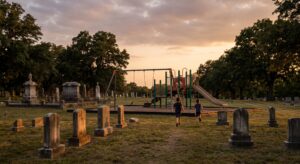
Two other people confessed to the murder on their deathbeds. The man Alabama hanged for it never got to hear either one.
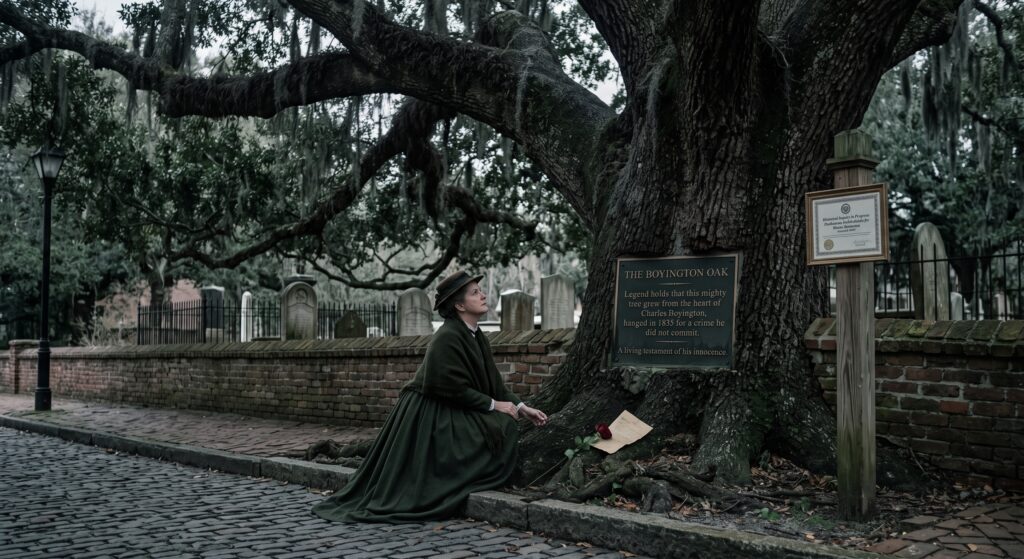
From the gallows in 1835, Charles Boyington made one final claim before he died: a mighty oak tree would grow directly from his heart, proof to the world that Alabama had just executed an innocent man. Today, a massive Southern live oak stands exactly where his grave was dug. Nearly two centuries later, historians are still trying to get him a pardon he will never see.
The Boyington Oak stands on Bayou Street in Mobile, just outside the wall of the historic Church Street Graveyard, a living monument to one of Alabama’s most persistent claims of wrongful execution.
A Gambling Debt, a Body, and a Rushed Verdict
Charles R.S. Boyington arrived in Mobile from Connecticut in 1833, a young printer known around town for his gambling habits. On May 11, 1834, witnesses saw him walking toward Church Street Graveyard with his friend and roommate, Nathaniel Frost, a man Boyington reportedly owed money. Frost was later found stabbed to death near the cemetery, robbed of his belongings.
Boyington became the immediate and, to investigators at the time, obvious suspect. He was tried, convicted, and sentenced to death, maintaining his innocence throughout the process and right up to his execution on February 20, 1835. Because of his murder conviction, cemetery officials denied him burial inside the consecrated grounds of Church Street Graveyard. He was buried instead in the unmarked potter’s field just outside the wall.
The Oak That Kept His Promise
True to his final words, a live oak eventually grew directly from Boyington’s grave site, a detail that struck nineteenth-century Mobile as either coincidence or confirmation, depending on who was telling the story. The tree has stood for nearly two centuries, its size and age now well beyond what a typical grave-site sapling would reach naturally, feeding the legend that something more than chance planted it there.
Visitors and passersby have long reported hearing whispers, sighs, and low groans coming from the oak’s branches after dark, along with occasional sightings of a man sitting quietly beneath the tree, staring silently toward the cemetery wall that once refused to hold his body.
The Confessions That Came Too Late
Here is the detail most retellings of the Boyington Oak skip entirely: two separate people reportedly confessed to Frost’s murder on their deathbeds, decades after Boyington’s execution, each independently claiming responsibility for a crime he died denying. Neither confession arrived in time to change anything for Boyington, but both have fueled a modern effort to secure him a formal posthumous pardon, an unusual and difficult undertaking for a case this old.
That effort matters beyond Boyington’s individual case. Wrongful execution claims from the 1830s rarely come with this much corroborating detail, and the Boyington Oak stands as a rare example of a ghost story where the underlying legal question, guilty or innocent, remains genuinely open rather than settled by history.
A Tree That Outgrew Its Own Legend
Botanists who have examined the Boyington Oak note that its size is unusual, though not impossible, for a tree grown from a single grave site over roughly 190 years. What makes the tree remarkable is less its biology than its symbolism: a living thing that Mobile residents have chosen, generation after generation, to interpret as a message rather than simply a tree that happened to take root in fertile, undisturbed ground outside a cemetery wall. The city’s decision to name an annual festival after it reflects how deeply that interpretation has settled into local identity.
Wrongful Conviction Claims Rarely Age This Well
Most wrongful conviction stories from the 1830s have no path forward, no surviving evidence, no modern advocacy group willing to take up a case nearly two centuries old. Boyington’s case is an exception, kept alive partly by the oak itself and partly by the two later confessions that gave his claim of innocence something historians could actually investigate. Legal historians researching early Alabama capital cases point to Boyington as a rare instance where folklore and formal advocacy for a pardon have reinforced each other rather than working at cross purposes, each keeping the story relevant to the other’s audience.
Pairing the Oak With Church Street Graveyard
Most visitors combine a stop at the Boyington Oak with a walk through the adjacent Church Street Graveyard, which opened in 1820 and reflects the raised brick tomb style common to Mobile’s French and Spanish colonial influences. The cemetery holds its own collection of notable graves and local legends, giving visitors a fuller sense of the historic downtown district beyond the single tree on the corner.
The city’s annual Boyington Oak Festival, held near the anniversary of Boyington’s execution, combines historical talks, local vendors, and storytelling events centered on the case, drawing a crowd that skews toward genuine local history enthusiasts rather than pure thrill-seekers. It offers one of the more community-oriented ways to engage with an Alabama ghost story on this list.
Visiting the Boyington Oak
The Boyington Oak is publicly accessible on Bayou Street in Mobile, adjacent to Church Street Graveyard, and the city hosts an annual Boyington Oak Festival celebrating the tree’s history and local folklore. The cemetery itself remains active with visitors and is worth pairing with a stop at the oak for the fuller context of Boyington’s story.
The Bottom Line on the Boyington Oak
Most ghost stories ask visitors to accept the supernatural on faith. The Boyington Oak asks something different: to sit with a genuine, still-open legal question about whether Alabama executed an innocent man in 1835. The tree itself is beyond dispute, tall, old, and rooted exactly where the legend says it should be. What it actually proves remains as unresolved today as it was the moment Boyington made his final promise from the gallows.
Nineteenth-century Mobile executed Boyington quickly, in an era when circumstantial evidence and a defendant’s reputation as a gambler could carry as much weight as physical proof. Modern advocates pursuing his pardon face the opposite problem: a case old enough that most direct evidence has long since disappeared, leaving the oak itself as the most durable witness to a trial many historians now consider deeply flawed.
References & Further Reading
Bienville Bites: Haunted History of Mobile, The Boyington Oak