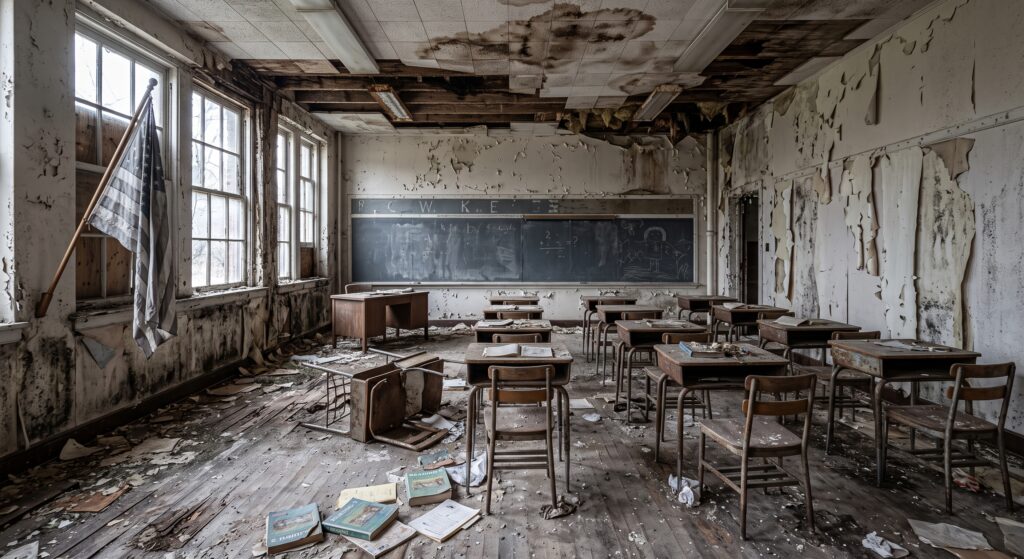
An empty school has a specific quality of wrongness that an empty office building does not. The scale of the furniture, sized for children who are no longer there, is part of this wrongness. The drawings are still taped to the walls. The row of coat hooks, set at a height of three feet, is empty. A space that was built specifically for a population that is now absent produces a kind of grief that has no clean name. And in the more extreme cases, where the school was not merely closed but abandoned, that wrongness intensifies into something oppressive.
Abandoned schools are among the most reported haunting locations in urban exploration and paranormal investigation communities. Understanding why requires a look at both the psychology of these spaces and the histories carried by the most famous cases.
The Liminal School
Schools sit at an unusual intersection of psychological categories. They are places of intense social and emotional experience, often the site of formative memories, traumas, friendships, and significant personal events. They are also highly institutional, built for a specific purpose that is clear in their design. When that function is removed, the design remains and becomes strange. The small desks, now without children. The blackboard still has writing on it. The clock stopped at a specific time.
Researchers who have studied liminal space psychology note that abandoned schools produce a particularly intense version of the uncanny valley effect in built environments. In this space, everything is familiar, yet everything feels wrong at the same time. Your nervous system knows what a school should contain. The absence of that content registers as a threat signal, producing the physical sensation of unease that many people interpret as a supernatural presence.
Waverly Hills Sanatorium: Where School Meets Something Darker
Waverly Hills Sanatorium in Louisville, Kentucky, is not a school, but it exemplifies the category of abandoned institutional building that has accumulated the densest paranormal investigation record in America. Built in 1910 as a tuberculosis hospital, it housed thousands of patients during the early twentieth-century tuberculosis epidemic, with a documented death toll estimated to be in the thousands. The building has likely been the subject of more paranormal investigations than any other American location. Reported experiences include shadow figures, EVP captures, door slams in sealed corridors, and equipment anomalies that do not have electrical sources.
The Waverly Hills case is relevant to abandoned school discussion because it establishes a principle: the weight of genuine documented deaths in an institutional building, combined with the specific psychological atmosphere of abandonment and decay, produces a level of reported activity that resists simple dismissal. Whether the cause is paranormal or comes from very strong psychological suggestion in an environment that keeps people on high alert, the activity is real in the experiential sense.
The Preston School of Industry
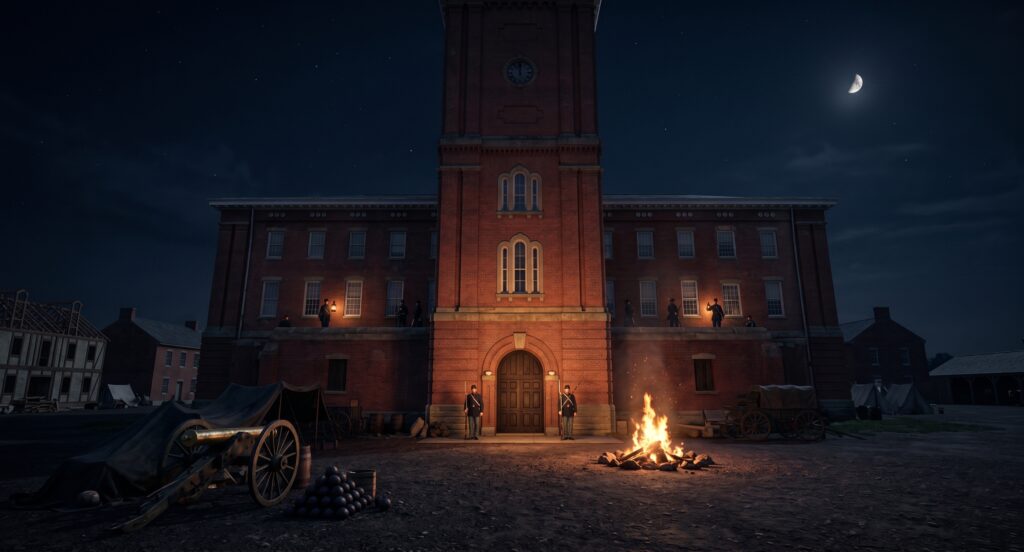
The Preston School of Industry, also known as the Preston Castle, in Ione, California, is one of the most specifically documented haunted school buildings in America. Built in 1894 as a reform school for juvenile offenders, the Romanesque Revival castle operated until 1960. Its history includes documented deaths of students and staff, including the murder of housekeeper Anna Corbin in 1950, whose case was never solved. The building has been the subject of multiple formal paranormal investigations, with investigators reporting consistent temperature anomalies in the basement area associated with Corbin’s death, audio anomalies in the upper floors, and a visual apparition in the second-floor dormitory that has been reported by multiple independent investigators across different visits.
The Psychology of the Empty Classroom
Even without genuine paranormal phenomena, the abandoned school deserves attention as a psychological environment. The chalk dust smell. The institutional green paint is at precisely the height where generations of children’s hands have brushed it. The accumulated traces of thousands of lives, all of them younger and more vulnerable than the adult standing in the empty room, produce a form of emotional resonance that is not easily classified. Grief without a specific object. Nostalgia for a time and people you never knew. A sense of obligation to those who were there, whose presence has left marks in the space that no renovation has quite erased.
When investigators report a sense of sadness or heaviness in abandoned schools, they are not necessarily reporting paranormal phenomena. They may simply be responding, with unusual sensitivity, to an environment saturated with the emotional residue of ordinary human life. Whether that saturation ever becomes something more, something that registers on a thermometer or a recorder, is the question the investigations are there to answer.