You found the photograph in a box of family papers; it was sepia, formal, and a Victorian interior with three people arranged stiffly before a wall. You have been told who the three people are. But there is a fourth shape in the upper right corner, just visible at the edge of what appears to be a doorway. It is face-shaped. It is pale. It does not match any family member you have been shown. And no one has an explanation for it.
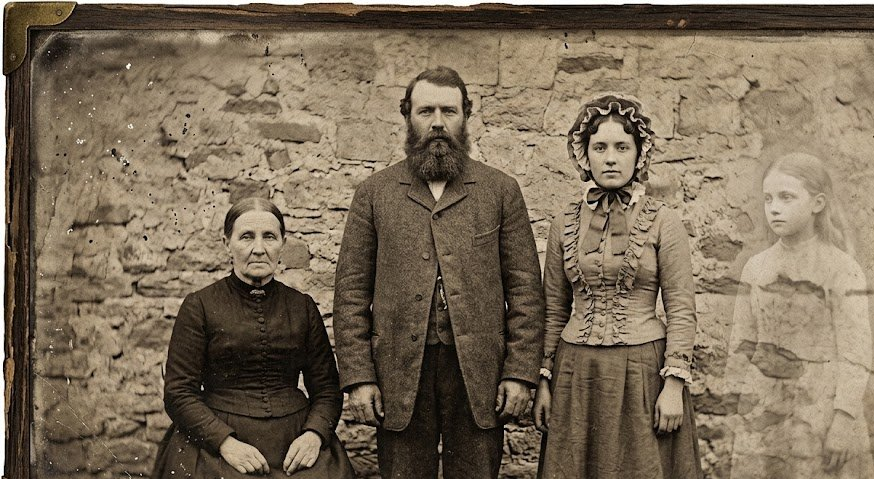
Antique photographs generate a particular category of ghost sighting for reasons that are partly technical, partly psychological, and, in the specific case of the Victorian spirit photography movement, partly deliberate. Understanding all three layers gives you the tools to evaluate any old photograph that appears to contain something extra.
The Technical Origins: Long Exposure and Accident
The earliest practical photography processes required exposure times of several seconds to several minutes. During these long exposures, any person who moved through the frame would register as a partial, semi-transparent figure, ghostly not through any supernatural process but because they were present for only part of the exposure. In a busy street scene from the 1860s, the only people who appear solidly are those who stood still. Everyone else is a blur or a ghost. This mechanism produced genuine unexplained figures in early photographs that confused and disturbed viewers and provided the technical foundation for deliberate spirit photography manipulation.
William Mumler and the Birth of Spirit Photography
In 1861, Boston photographer William Mumler produced what he claimed was a spirit photograph, a portrait of a living subject accompanied by the translucent image of a deceased person. The technique was double exposure: exposing the same photographic plate twice, with the second exposure producing the ghostly figure. Mumler sold these photographs to grieving Civil War families desperate to see their dead. His business was profitable until skeptics exposed his methods in 1869, and he faced a fraud trial, which he escaped on a legal technicality rather than an acquittal. The spirit photography tradition he launched continued through the 1920s, with a second surge during and after World War I when another generation of bereaved families sought visual connection with their dead.
The Full Toolkit for Photographic Ghosts
When evaluating any antique photograph that appears to contain an anomalous figure, the following technical causes account for the vast majority of cases:
- Double exposure: semi-transparent overlay of one image on another, either deliberate or caused by a plate being exposed twice accidentally.
- Long exposure with a moving subject: a person who entered or left the frame during exposure registers as partial or transparent.
- Reflection: Light from a mirror, window, or polished surface within the frame can produce a face or figure shape.
- Photographic damage: deterioration of old negatives, emulsion damage, moisture, and mold can produce face-shaped marks that are entirely chemical in origin.
- Lens artifacts: certain early lenses produced internal reflections that created ghost-like shapes, particularly in bright or high-contrast scenes.
- Pareidolia: the brain’s face-detection system generates face percepts from coincidental arrangements of light, shadow, and pattern, particularly in high-contrast black-and-white images where contextual information is reduced.
How to Evaluate a Specific Photograph
- Examine the full frame carefully for other anomalies, unusual light sources, reflective surfaces, and anything that could produce a secondary image.
- Compare the sharpness of the anomalous figure against the rest of the image. A solid, sharp ghost-figure is more anomalous than a blurred partial shape, which is consistent with movement during long exposure.
- Research the photographic process used and the era of the image. This information tells you which technical artifacts are possible.
- Consult a photographic historian or conservator for old images; they can often identify specific types of damage or artifacts with precision that general paranormal investigation cannot provide.
The Case That Still Has Not Been Fully Resolved
The Brown Lady of Raynham Hall, photographed in 1936 on the staircase of a Norfolk country house and published in Country Life magazine, was initially pronounced genuine by photographic experts and subsequently analyzed as a possible double exposure or in-camera reflection. The analysis has never been fully resolved. It remains, depending on your standard of evidence, either the most important ghost photograph in the English-speaking world or a not-quite-explained camera artifact from ninety years ago. What makes it interesting is not that it proves ghosts but that it still has not been fully explained and that the best available explanation involves a physical process that would be remarkable in itself. Sometimes the rational explanation is only slightly less strange than the supernatural one.
References & Further Reading
• Skeptical Inquirer: So You Have a Ghost in Your Photo
• Big Think: Spirit Photography, A Tale of Love, Loss, and Longing
• Wikipedia: Spirit Photography
• Cultura Colectiva: The Creepy Yet Fascinating Art of Victorian Spirit Photography
• Rare Historical Photos: Stereoscopic Ghost Photos That Spooked the Victorian Public, 1865
[…] Antique Photo Ghost Faces Explained: Pareidolia, Exposure, and Spirit Photography Lore […]