Most presidents scatter across the map. They are born in one town, govern from Washington, and rest in another state entirely. Richard Nixon collapsed his whole arc into nine acres.
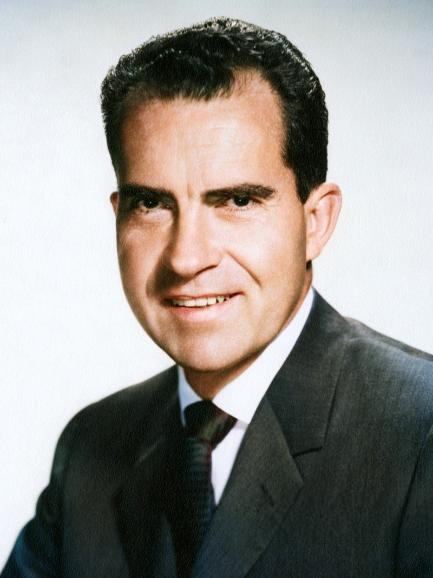
His birthplace, his grave, and his life’s story all sit on the same California ground. A visitor can stand between the humble farmhouse where he was born and the stone that marks where he lies and cover the distance in under a minute.
That rare closeness may explain the strangest reports at the Nixon Library. Witnesses describe a presence that seems torn between two versions of the same man.
One version finds peace. The other cannot rest.
The Quaker Boy and the Presidential Fall
Nixon’s father built the family’s modest farmhouse from a mail-order kit in Yorba Linda. Richard was born there in 1913 and grew up under the strict Quaker values his mother prized. The house still stands on the library grounds, small and plain among the gardens and the reflecting pool.
His career climbed at astonishing speed. He rose through Congress, served as vice president, and won the White House in 1968. Four years later, he captured a historic landslide reelection.
Then everything crashed. The Watergate scandal engulfed his second term and forced his resignation in 1974, the only such resignation in American history. He left the White House in disgrace, boarding a helicopter on the South Lawn as the nation watched.
He spent his final decades rebuilding his reputation as an author and elder statesman. He died in 1994 and was buried on the property, next to his wife Pat and only steps from the cottage where his life began.
The distance between his birth and his grave is a short walk. The distance between his triumphs and his disgrace is the whole story, and it seems to have followed him into the afterlife.
Green Mist and Malfunctioning Machines
The reports began almost immediately after his burial. A night watchman described a luminous green mist hovering over the president’s grave, glowing in the dark before dissolving. The account reached print in an LA Weekly story that fall.
Another guard saw a figure matching Nixon’s outline walk straight through the front door of the locked birthplace cottage. When he moved to confront the intruder, he found the door sealed tight. No living person could have entered, and none was found inside.
The Watergate exhibit draws the most disturbances by far. Guards have heard tapping and rapping noises echo from the darkened gallery late at night. Visitors report sudden cold drafts (see more on cold spots here), unexplained buzzing, and unpleasant odors near the displays.
The technology itself seems to resist the room. Docents from the early years recalled recording equipment glitching when they spoke certain family names. After a renovation, the old tape players fell silent, yet the newer screens in the Watergate wing began failing at random, going dark for no traceable reason.
Some visitors describe even stranger encounters. A few report a fleeting figure glimpsed from the corner of the eye, gone the moment they turn. One claimed the touch of a cold, clammy hand near the grave.
A Psychology You Can Almost Diagnose
Here is the detail that makes this haunting so peculiar. The disturbances cluster around Watergate, and only around Watergate. Mediums who have visited the site claim Nixon’s spirit grows agitated near the scandal that ended him.
In the rooms that hold his school essays and his love letters to Pat, the same visitors report something entirely different. They sense calm. They sense a man at ease with the story being told about his early life.
You do not need to believe in mediums to notice how neatly that split mirrors the living Nixon. He craved vindication for his real accomplishments, from the opening to China to the moon landing on his watch. He also burned with bitterness over the fall that overshadowed all of it.
The legend simply extends that inner conflict past the grave. It imagines a man still fighting to be remembered for his best moments while chained to his worst.
The Only President Buried on His Own Battlefield
There is a reason Yorba Linda feels so charged. Nixon planned much of it himself. He wanted his library on the land where he was born, and he chose to be buried there rather than in a distant national cemetery.
That decision fused his beginning and his end into a single place. The kit house his father built stands a short walk from his grave. The reflecting pool, the gardens, and the museum all wrap around that intimate core.
For a man whose public life ended in exile from Washington, the choice reads like a homecoming. He returned to the humble ground where the story started, far from the capital that had cast him out.
Ghost stories thrive on exactly this kind of emotional geography. When a man’s entire arc collapses into nine acres, the place seems to hold more than its share of unfinished feeling.
History Still Arguing With Itself
The Watergate exhibit at the center of the hauntings has its own turbulent history. For years, the private foundation’s version downplayed the scandal, insisting Nixon bore little responsibility for the break-in.
When the National Archives took over the library in 2007, it replaced that account with a far more critical exhibit. The change sparked real conflict between federal historians and Nixon loyalists, a fight over how they should tell the story.
In a sense, the room where visitors report the most paranormal activity is also the room where the living argued hardest about Nixon’s legacy. The tension in the Watergate wing is not only spectral.
Maybe that is why the legend clings to this gallery. The Watergate hall is where Nixon’s reputation remains contested, and the ghost story gives that ongoing struggle a supernatural face.
Walking Through a Divided Soul
Yorba Linda offers a strange kind of tour. You move from a proud boyhood, through a soaring career, into a national disgrace, and out again to a quiet grave, all within a few hundred feet.
If the stories hold any truth, the haunting maps onto that journey precisely. The boy from the kit house rests easy in the early galleries. The president who lost everything still paces the Watergate hall.
It is worth treating the man’s complexity with honesty. Nixon achieved real things and destroyed his legacy, and history keeps arguing about the balance. His ghost, the legend says, keeps arguing too.
Stand in that dim Watergate corridor and feel the air shift. Whatever you believe, the space carries a genuine tension, the weight of a reputation that never found peace. Some cases, it seems, stay open long after the courtroom empties.
References & Further Reading
• Richard Nixon Presidential Library (Wikipedia)

[…] California’s hauntings range from the desert ruins of Calico to the disrupted foundations of San Francisco. The Bay Area alone claims the Phantom Cow of Goat Island, the Golden Gate ghost ship, the White Lady of Golden Gate Park, and the cursed mansions of Pacific Heights. In Southern California, Richard Nixon’s spirit is said to linger in Yorba Linda. […]