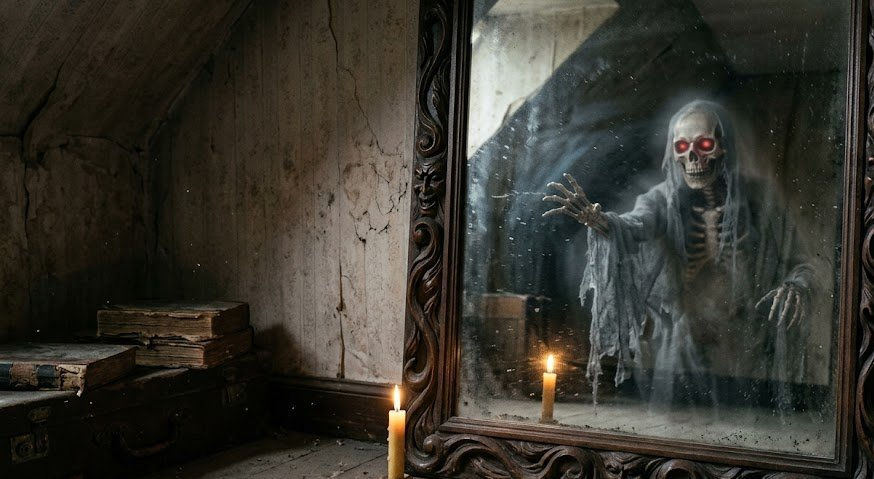
You inherited it from your grandmother. A tall, dark-framed Victorian dressing mirror that lived in her bedroom for sixty years. It came with no specific warning, just a vague sense in the family that it was an unusual piece. Three weeks after you hung it in your bedroom, you began sleeping poorly. The reflection feels wrong in ways you cannot articulate. And last Tuesday, for a few seconds, you could have sworn you saw a shape behind your own shoulder that was not there when you turned around.
Haunted mirror reports are among the most emotionally specific paranormal accounts because mirrors are so intimate. You see yourself in them. When something feels wrong about a mirror, the wrongness touches something very close to the core of your sense of self. This article walks through the reported signs, the folklore, and the rational framework you should apply before drawing any conclusions.
The Reported Signs
People who report a haunted mirror describe a recognizable set of experiences. The reflection feels wrong in ways that precede any specific observation. This is the most commonly reported initial sign and is genuinely interesting from a neurological standpoint: the sense of wrongness arrives before the conscious identification of what is wrong. It is the body’s pattern-recognition system flagging an anomaly before the conscious mind has processed it.
Seeing faces or shapes in the reflection that are not present in the room is the second most common report. Paranormal investigators call these intrusive reflections, and they need to be distinguished carefully from the mundane sources of unexpected imagery: reflections of objects outside the mirror’s direct field, light sources that cast unexpected shadows, and the documented strange-face effect produced by extended gazing at one’s own reflection in reduced light.
Cold spots in the immediate vicinity of the mirror, electronic disturbances near it, and consistent sleep disruption since the mirror was placed are also reported regularly. Sleep disruption specifically is worth taking seriously as a potential indicator because it is measurable and because several mundane explanations connect directly to mirror placement: light reflection at night, a sense of being observed that reduces relaxation, and the feng shui concern about a mirror directly facing the bed, which sleep researchers have noted can disrupt sleep independently of any supernatural cause.
The Folklore Framework
In folk tradition across multiple cultures, a mirror that belonged to someone who died carries a specific risk: the spirit of the deceased may have become confused by or attached to their own reflection, remaining near it rather than moving on. The practice of covering mirrors after a death in the home is specifically designed to prevent this. A mirror inherited from a deceased person without being formally cleared, in this framework, may carry the presence of the person who last used it habitually.
Mirrors are also considered portals in Slavic, Celtic, and East Asian traditions. A mirror that faces a door is said in some feng shui traditions to reflect away positive energy and attract negative presences. A mirror that shows a reflection of a staircase is considered particularly significant in several European folk traditions, associated with the movement of spirits between floors. Whether these specific beliefs have evidential support is a separate question from whether the emotional logic they contain is coherent, which it largely is.
How to Assess Your Specific Mirror
Before drawing any paranormal conclusion about an inherited or antique mirror, work through this systematically:
- Research the mirror’s provenance. Who owned it previously, and under what circumstances? Deaths associated with an object are relevant context.
- Check the placement in your room. Does it face the bed, a door, or a staircase? Does it catch any external light sources at night? These are practical issues that affect sleep and perception independently of anything paranormal.
- Note whether the experiences are localized to the mirror’s vicinity or distributed throughout the room.
- Check whether the experiences began immediately after the mirror was introduced or developed gradually.
- If you decide to remove the mirror, note whether the experiences resolve. A change correlated with the mirror’s removal is the most useful piece of evidence you can collect.
If you decide you do not want the mirror regardless of whether the explanation is paranormal or mundane, you are under no obligation to keep it. Inheritance does not require you to maintain proximity to an object that consistently disrupts your wellbeing.
References & Further Reading
• Ancient Origins: Mirror Mythology and the Supernatural
• J.A. Hernandez: Mirrors, Superstition, and Psychology