In January 1692, two girls in Salem Village, Massachusetts, began having fits. They screamed, they contorted, they claimed to see invisible figures attacking them. A local doctor examined them and, finding no physical cause, offered the community the only diagnosis his framework provided: witchcraft.
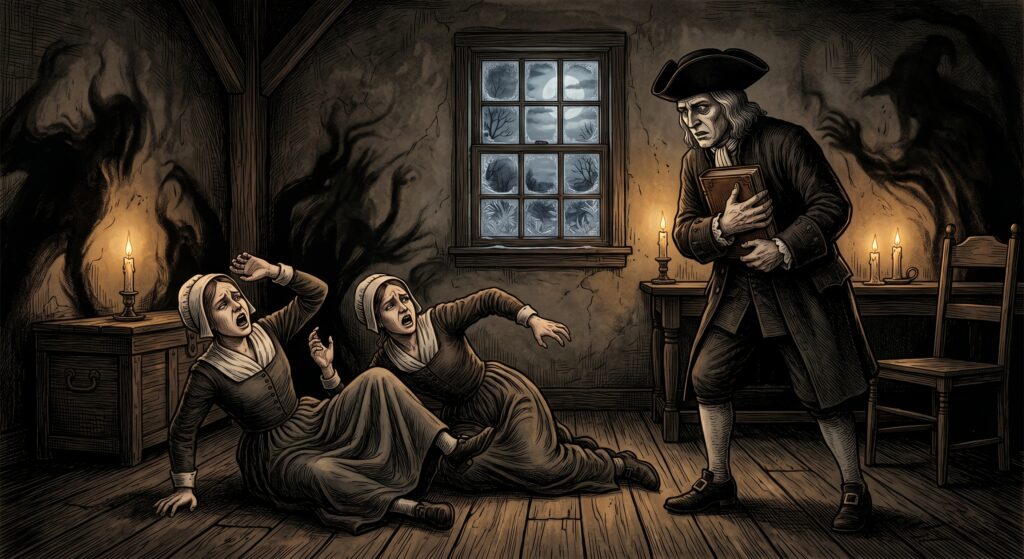
What followed across the next several months was not a supernatural event but a social one. By the time the courts finally disbanded, they had hanged 19 people, pressed one man to death beneath heavy stones, and accused more than 200 others. The youngest of the accused was four years old.
The Salem witch trials are the defining example in American history of how fear becomes accusation, accusation becomes evidence, and evidence becomes execution. For paranormal readers, the trials offer a case study in how communities under pressure process the inexplicable and how quickly the need for an explanation can override the need for a true one.
What Salem Village Looked Like Before the Trials
Salem Village in 1692 was not a peaceful community. It was a town split by political and personal conflict. Tensions between the established Porter family faction and the politically active Putnam family had divided the village over its new minister, Samuel Parris, for years. The community had recently survived a smallpox epidemic and was still processing losses from King William’s War on the northern frontier. Several of the young accusers were war orphans who had witnessed violence and displacement before arriving in Salem.
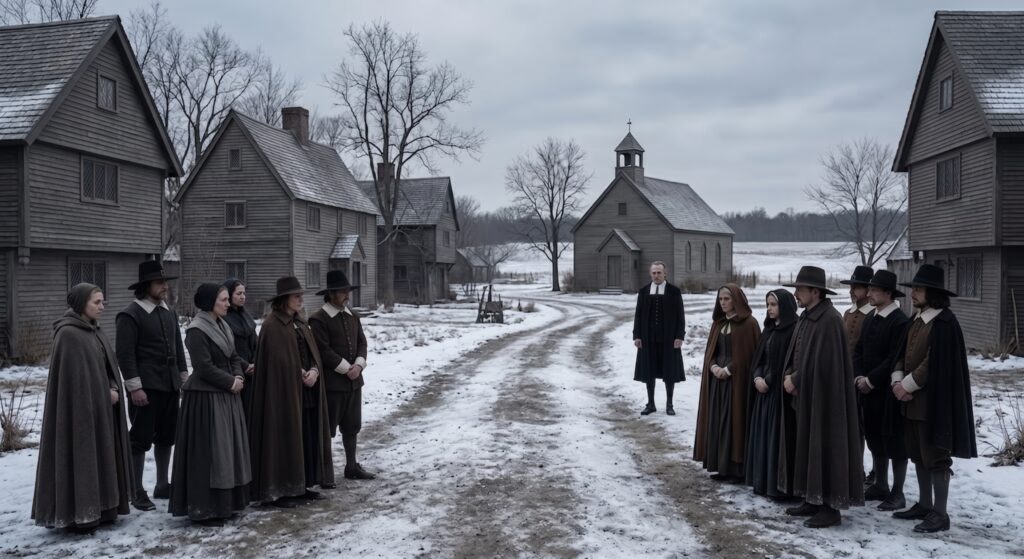
Historians who have studied the trials in detail consistently observe that the accusation pattern followed existing social fault lines. The accused tended to be people already on the margins of community acceptance, whether through age, behavior, economic status, or prior conflict with influential families. The supernatural explanation provided a framework for pre-existing hostilities.
This conclusion does not mean the accusers were simply lying. Many of the initial accusers appear to have been genuinely distressed. Among the theories for the initial outbreak are ergotism, a condition caused by a fungus that grows on rye and can produce hallucinations and convulsions, and an encephalitis epidemic. Whether or not these physical explanations are correct, the community’s response to the distress, reaching for a supernatural cause and a social remedy, followed patterns common to moral panics.
How Spectral Evidence Made Accusation Irrefutable
The legal framework that allowed the trials to proceed at the speed they did rested on a specific category of evidence: spectral evidence. Under this doctrine, a witness’s testimony that the spirit of an accused person had appeared to them in a dream or vision was considered legally valid. The accused could be executed on the basis of what someone else dreamed.
The problem with spectral evidence, recognized by some contemporary critics even in 1692, is that it cannot be refuted. If a witness claims to have seen your spirit, you cannot prove that it is absent. Defense is structurally impossible. Once spectral evidence was accepted as legitimate, any accusation became self-validating.
Governor William Phips eventually convened a special court to handle the growing number of cases. The court accepted spectral evidence as primary testimony. Condemnations accelerated. When a respected minister, Cotton Mather, publicly supported the trials and their methods, the institutional endorsement removed the last significant check on the process.
The Confession Trap
One of the most disorienting aspects of the Salem trials, for modern readers, is the pattern of confessions. Many people who were accused and confessed were spared execution. Many who refused to confess were hanged. This created a brutal incentive: confess to something you did not do and live, or maintain your innocence and die.
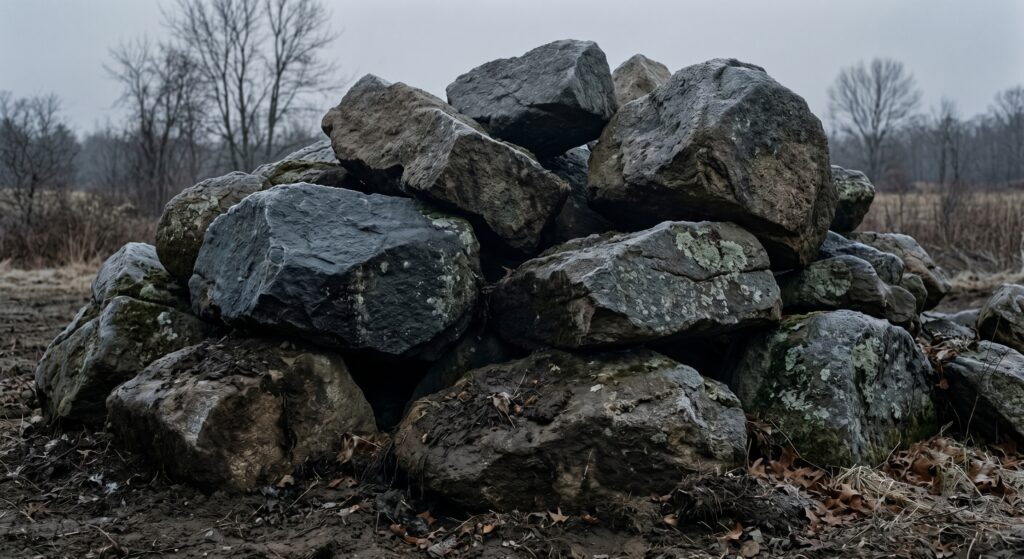
Giles Corey, an 81-year-old farmer, refused to enter any plea at all. Entering a plea would have subjected him to trial, which would have meant the confiscation of his property upon conviction. By refusing to plead, he preserved his estate for his heirs. The court responded by pressing him beneath heavy stones over the course of two days. He died without confessing.
The confessions that were given often included elaborate details about meetings with the devil, rituals, and confederates named by the confessor. These details did not come from independent experience; they came from the leading questions of interrogators who had a framework of Satanic conspiracy and asked questions that filled that framework in. The mechanism is identical to the one that produced false testimony in the Satanic Panic 300 years later.
The Turning Point and Its Aftermath
By the fall of 1692, the accusations had spread beyond Salem Village to surrounding communities and had begun to reach people of significant social standing, including the wife of the governor himself. This expansion exposed the mechanism of the accusation network in a way that earlier accusations had not. When the accusers reached too far, the community’s willingness to accept spectral evidence collapsed.
Governor Phips disbanded the special court in October 1692. The remaining prisoners were released. In the years that followed, several of the judges publicly repented. Samuel Sewall, one of the judges, stood in church while his statement of guilt was read aloud and bowed in silence. Ann Putnam, one of the primary accusers, later confessed in a public statement that she had been deceived by Satan, using a formula that acknowledged harm done without entirely abandoning the framework that had produced it.
The Massachusetts legislature eventually issued a declaration of innocence for the accused and established a day of fasting to mark the error. Indemnities were paid to surviving families. The money did not address what had been lost.
Salem as Folklore Laboratory
From a folklore perspective, the Salem trials demonstrate several mechanisms that paranormal researchers encounter in smaller-scale community events today.
Pattern-seeking in ambiguous symptoms. The afflicted girls’ behavior was real; what was disputed was its cause. A community that lacks alternative frameworks for an unexplained experience will reach for the available one; in 1692, in a Puritan village, that was witchcraft. Today, communities sometimes do the same thing with paranormal frameworks when they encounter experiences that resist ordinary explanation. Understanding what science says about common paranormal experiences helps investigators apply the same critical lens the Salem community lacked.
Social contagion in accusation. Once the community took the first accusations seriously, others followed. The act of accusing became socially reinforced, and the pattern of the accusations followed the social structure of the community. This dynamic, where a social crisis generates its evidence through the behavior it provokes, appears in paranormal rumor cycles when a building develops a reputation and residents begin reporting experiences that match the established narrative.
The limits of spectral evidence. In paranormal investigation, spectral evidence takes contemporary form as subjective testimony, EVP recordings that require interpretation, and photographs with ambiguous content. All of these are true by definition. But they share the structure of spectral evidence in that they cannot be refuted. A credible investigator applies the same scrutiny to this kind of evidence that it took the Salem community three hundred years to learn to apply.
The Question Worth Carrying
The Salem trials ended because the accusation network finally threatened people with enough institutional power to dismantle it. The lesson is not that supernatural claims are always false. It is that human communities under stress produce explanatory frameworks that serve social needs as much as truth needs and that those frameworks can survive contradicting evidence for a very long time when they are institutionally endorsed and emotionally charged.
Paranormal research operates at the intersection of these dynamics. The most rigorous investigators in the field are those who apply the same skepticism to compelling experiences that a good historian applies to compelling documents: asking not only what it shows but also what pressures shaped it, who stands to benefit from its acceptance, and what evidence would look like if the explanation were wrong.
Salem is not ancient history. The structure it demonstrates is available at any time, in any community, when fear outpaces the mechanisms designed to slow it down. The same pattern of community fear generating self-reinforcing evidence appears in modern cases, from the spread of urban legends like the Black-Eyed Children to the way a haunted building’s reputation shapes every subsequent report made about it.
References & Further Reading
History.com: Salem Witch Trials Events, Facts & Victims
Britannica: Salem Witch Trials
Smithsonian Magazine: A Brief History of the Salem Witch Trials
JSTOR Daily: What Caused the Salem Witch Trials?

[…] For a deeper dive into the moral panic of the Salem Witch Trials, see our post here. […]
[…] production to Salem, Massachusetts. That choice was pure marketing. Salem’s history included witch trials, and its economy relied on tourism, making the association easy to […]