You already know how this goes. A car pulls down a dark, unpaved road, engine cutting low under the tree cover. The radio plays something soft. Two people forget, for a moment, where they are. And then something comes for them.
The “young couple in peril” is one of horror’s oldest and most durable setups. Most audiences assume it is just lazy screenwriting, a shortcut to generate tension before the real plot begins. But the pattern runs much deeper than genre convention. It is woven into American folklore, anthropological theory, and a long tradition of supernatural belief that predates the slasher film by decades. When you strip away the jump scares and the synthesizer score, what remains is something that looks less like entertainment and more like a ritual warning.
Where did this trope come from? Why does it keep working? And what does it mean, on a deeper level, that our folklore consistently frames intimacy as an invitation for something dark to arrive?
The answer starts not with Hollywood, but with a masked killer in 1946 Texarkana, Texas.
The Real Crime That Started a Legend
In the spring of 1946, a masked attacker began targeting young couples on the quiet country roads outside Texarkana. The killings happened at night, on weekends, at the edge of town. Five people died across ten weeks. Three survivors described an attacker wearing a white sack over his face with holes cut for eyes. Local media named him the Phantom Killer. The name stuck.
The murders sent Texarkana into a state of siege. Residents armed themselves and refused to leave their homes after dark. The Texas Rangers arrived. National press descended on the city. No one was ever charged. The Texarkana Moonlight Murders remain officially unsolved.
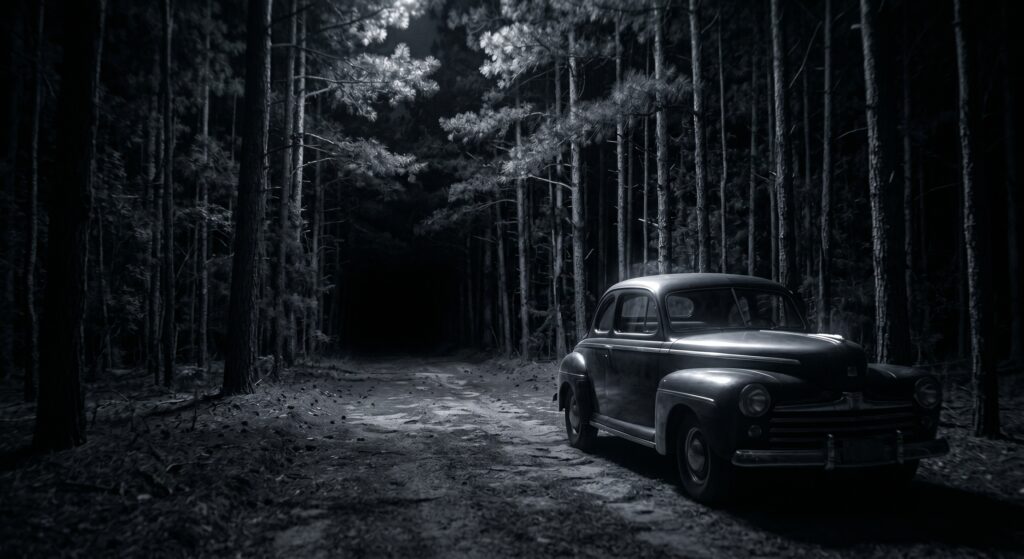
What is less often noted is what the killings produced beyond grief: they generated a template. A masked figure. Isolated roads. Young people parked in the dark. A town that could not explain what had hunted them. These elements did not fade when the headlines stopped. They mutated.
Folklorists have noted the possible connection between the Texarkana killings and the urban legend that would become The Hook, the story of a young couple parked on a lovers’ lane who hear a radio warning about an escaped convict with a hook for a hand and then drive away in fear, only to discover the hook embedded in the door handle behind them. The legend had already spread through American high schools by 1959 and received its first known print publication in the Dear Abby advice column on November 8, 1960, when a teenage reader submitted it as a cautionary true story.
The geographical and structural echoes between the Texarkana crimes and the Hook narrative are difficult to dismiss. Real violence at the edge of town became a story teenagers told each other to explain why going too far, in every sense of the word, carries a price.
The Supernatural Anatomy of The Hookman
The Hook legend has been analyzed extensively by folklorists, and most of those analyses converge on one conclusion: the tale is not just a scary story. It is a moral system.
Folklorist Alan Dundes proposed a Freudian reading of the legend in which the hook represents phallic aggression and its amputation is a symbolic castration. The escaped lunatic, in this reading, is not simply a criminal. He is an externalized moral force, the embodiment of a culture’s anxiety about adolescent sexuality. The girl who insists on leaving escapes. The couple who might have stayed would not.
Swedish folklorist Bengt af Klintberg identified the Hookman as a figure who enforces the boundary between “normal people who follow the rules of society and those who are not normal, who deviate.” Folklorist Bill Ellis pushed further still, framing the Hookman as what he called a moral custodian, an entity who disrupts youthful transgression not out of madness but out of a kind of terrible purpose.
Here is where the legend’s supernatural dimension comes into focus. The hook, in multiple versions of the story, is described as a prosthetic that replaced a hand severed in a slaughterhouse or meat-processing plant. Under the anthropological framework of Sir James George Frazer’s Law of Contagion, objects that have been in contact with death retain a corrupting essence. The hook is not a neutral tool. It is saturated with slaughter’s residue, and when it fuses with its human host, it infects him. It makes him treat the living like raw meat.
Under this reading, the Hookman is not a person who went insane. Something made him. The object did. And when the couple drives away and finds that hook on the door handle, they have not simply escaped a dangerous man. They have narrowly avoided being claimed by something contaminated, something that carries death on its surface and transfers it through contact.
That is not a punchline to a campfire story. That is sympathetic magic.
How the Slasher Film Codified the Covenant
By the late 1970s, what had been an oral tradition became a cinematic formula. John Carpenter’s Halloween (1978), Friday the 13th (1980), and A Nightmare on Elm Street (1984) each established a rule that audiences absorbed so thoroughly it became a cultural reflex: characters who engaged in premarital sex, drinking, or drug use died first, and they died badly.
Researchers studying slasher film content found a striking statistical correlation between on-screen sexual activity and subsequent on-screen death. The pattern was consistent enough across dozens of films to be called a formula. Scream (1996) made the formula explicit when a character recited the “rules” of horror movies as literal survival instructions: if you have sex, you die.
Most critics treat the film as conservative moralizing wrapped in fake blood. And at the surface level, that reading is accurate. But there is a folkloric layer underneath it that the purely political analysis misses.
Gillian Bennett, writing on the body as a symbolic system in folklore, noted that cultures have long treated the human body as a fortress. Every aperture is a potential breach. Every act of radical vulnerability, physical or emotional, is a moment when the fortress walls come down. The slasher film is not simply punishing characters for their moral choices. It is encoding an older belief: that intimacy lowers a spiritual defense.
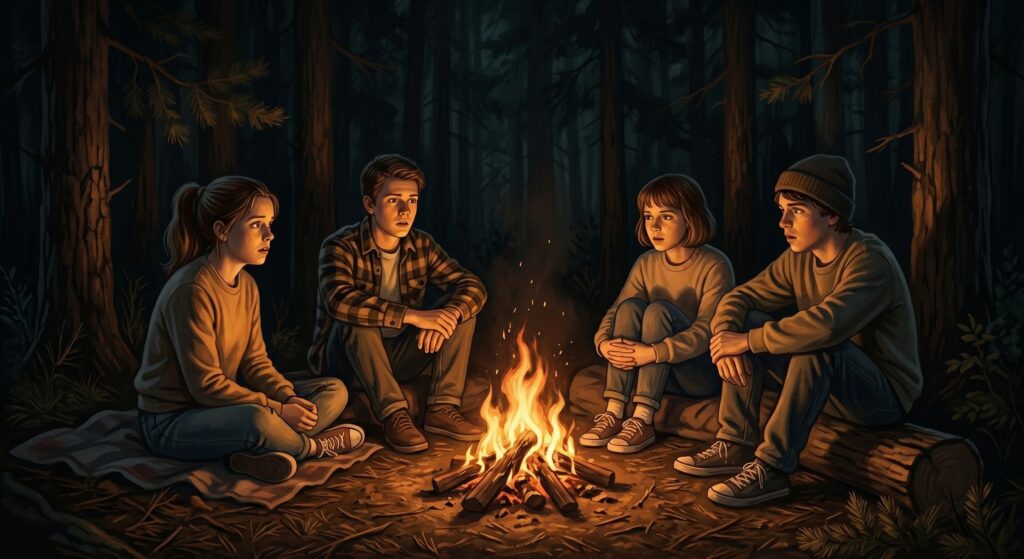
When the couple in the woods stops watching, stops listening, and surrenders entirely to the moment, something outside the circle of firelight notices. That is the logic. The monster does not choose its victims randomly. It finds the ones who have stopped paying attention to the dark.
The Final Girl and the Talisman of Vigilance
If the young couple’s vulnerability is the wound, the Final Girl is the antidote. The term was coined by scholar Carol Clover in her 1992 book Men, Women, and Chain Saws, and it describes a recurring figure in slasher films: the sole survivor, typically female, who rejects alcohol, drugs, and casual sex and who is also the first to sense that something is wrong.
The Final Girl watches. She investigates. She does not dissolve into the moment, and that alertness is what keeps her alive. Classic examples include Laurie Strode in Halloween and Jess Bradford in Black Christmas (1974). Both abstain. Both survive, at least partly.
Read through a supernatural lens, the Final Girl’s purity is not a social value. It is a functional shield. Because she has not breached her own defenses, the monster cannot find its way through. Her peers are accessible in a way she is not.
But defense alone is not enough to win. Clover observed that the Final Girl does not survive by hiding. At some point, she seizes the killer’s own weapon and turns it back on him. She takes the chainsaw, the knife, and the axe. In folkloric terms, this is a counter-spell: using the source of corruption against itself. She does not overcome evil by being good. She overcomes it by temporarily becoming what she has been running from and then surviving that transformation.
This is, structurally, the same logic as a protective ritual. You take the threatening force. You contain it. You redirect it. You expel it.
It Follows: When the Subtext Becomes Explicit
For seventy years, the supernatural threat embedded in the young couple trope operated as subtext. Then, in 2014, director David Robert Mitchell made it the text.
It Follows features Jay, a college student who sleeps with a man who has been carrying a curse. After they have sex, he tells her an entity will now follow her at a walking pace, relentlessly, until it kills her. She can pass the curse to someone else by sleeping with them, which will redirect the entity’s attention. If that person dies, the entity returns to her. It never stops. It never tires. Only those who carry the curse can see it.
Director David Robert Mitchell has described the creature as a representation of mortality, the slow inevitability that no one ultimately escapes. But the mechanism of transmission, sex as the vector, makes the supernatural logic of the older folklore explicit.
In It Follows, intimacy is not just metaphorically dangerous. It is the literal mechanism through which a malevolent force transfers itself between human hosts. The breach of one’s spiritual boundary, the moment of complete vulnerability, creates a tear in one’s defenses that the entity exploits. It does not attack randomly. It tracks the chain of intimacy backward.
That structure mirrors the folkloric belief precisely. The threat follows vulnerability. The opened gate stays open.
What makes the film unsettling beyond its premise is the entity’s patience. It walks. It does not run. It does not rage. It arrives. And it arrives because it was invited, even without the host’s knowledge, the moment the boundary came down.
From Campfire to Cursor: The Legend Lives Online
In June 2012, a post appeared on internet forums that retold the Hook legend in the most stripped-down, grammatically fractured way imaginable. Known as Man Door Hand Hook Car Door, it began as a parody, a “trollpasta” mocking the earnestness of traditional creepypastas. The text was barely coherent. But it spread across Tumblr and YouTube with extraordinary speed, generating hundreds of thousands of shares and imitations.
The absurdity was the point of it all. But the absurdity did not kill the legend. It transformed it. A story that had once relied on darkness, the right voice, the right night, and the right clearing in the woods now traveled in fragments, in screenshots, and in joke formats that mocked the original and simultaneously kept it alive.
Theorist Richard Dawkins coined the word meme to describe cultural units that replicate and adapt the way genes do. Folklorist Bill Ellis extended the frame, arguing that certain legends behave like mind viruses, actively colonizing consciousness and driving behavioral change in people who encounter them. The Hookman legend has never stopped replicating itself, evolving from a campfire warning to a newspaper column to a slasher film to an internet meme. Each new form finds a new host population.
In esoteric traditions, a thoughtform that accumulates enough collective belief can develop its own momentum. The Tibetan concept of the tulpa describes precisely this: a form conjured by concentrated attention that, over time, develops an existence independent of its original creator. Whether one takes that literally or metaphorically, the Hookman fits the pattern. Millions of people have held this story in their minds, passed it forward, modified it, and kept it running. Whatever it is, it has not stopped.
Why the Formula Still Works
Horror fans have spent decades debating whether the young couple trope is a relic worth preserving or a conservative cliche that punishes desire. That debate is real and worth having. But it misses something.
The trope endures not because audiences are puritanical but because it encodes a fear that does not belong to any era. It is the fear that openness is dangerous. That being fully present with another person requires lowering defenses that exist for a reason. That the woods, the dark water, and the road that runs past the edge of the known world are not neutral spaces. Something waits there. And the moment you stop watching for it is the moment it moves.
The Phantom Killer wore a sack over his face so no one could see him coming. The Hookman carried corruption on his body and transferred it through contact. The slasher arrived the moment attention collapsed inward. The entity in It Follows walked, unhurried, through the same space as ordinary people, invisible to everyone who had not already been touched.
Each version of the story tells the same thing differently: there is a cost to leaving the circle of safety. There is a risk in the open door. And the thing on the other side of it is patient.
The young couple always parks at the edge of something. The road ends. The trees close in. The radio plays. And somewhere out in that darkness, an old legend, waits for the moment when no one is looking.
References and Further Reading
Texarkana Moonlight Murders, Encyclopedia of Arkansas
Texarkana Moonlight Murders, Wikipedia
The Phantom Killer: Texarkana’s Chilling True Crime Legend, Experience Texarkana
Texarkana Murder Mystery, Texas Monthly
James George Frazer and the Law of Sympathetic Magic, The Golden Bough, Wikipedia
Carol Clover, Men, Women, and Chain Saws, Wikipedia
Friday the 13th (1980), Wikipedia
A Nightmare on Elm Street (1984), Wikipedia
Black Christmas (1974), Wikipedia
It Follows Offers a Sobering Meditation on Death, Horror Obsessive
Man Door Hand Hook Car Door, Know Your Meme

[…] The confessions that were given often included elaborate details about meetings with the devil, rituals, and confederates named by the confessor. These details did not come from independent experience; they came from the leading questions of interrogators who had a framework of Satanic conspiracy and asked questions that filled that framework in. The mechanism is identical to the one that produced false testimony in the Satanic Panic 300 years later. […]