The most refined haunting in a house full of stomping and grief
Wander past the Yellow Oval Room late enough, and the lore says you might catch a violin. Not a wail, not a scream, just a few faint bars of music drifting from an empty room. The player, supposedly, is Thomas Jefferson, still practicing two centuries on.
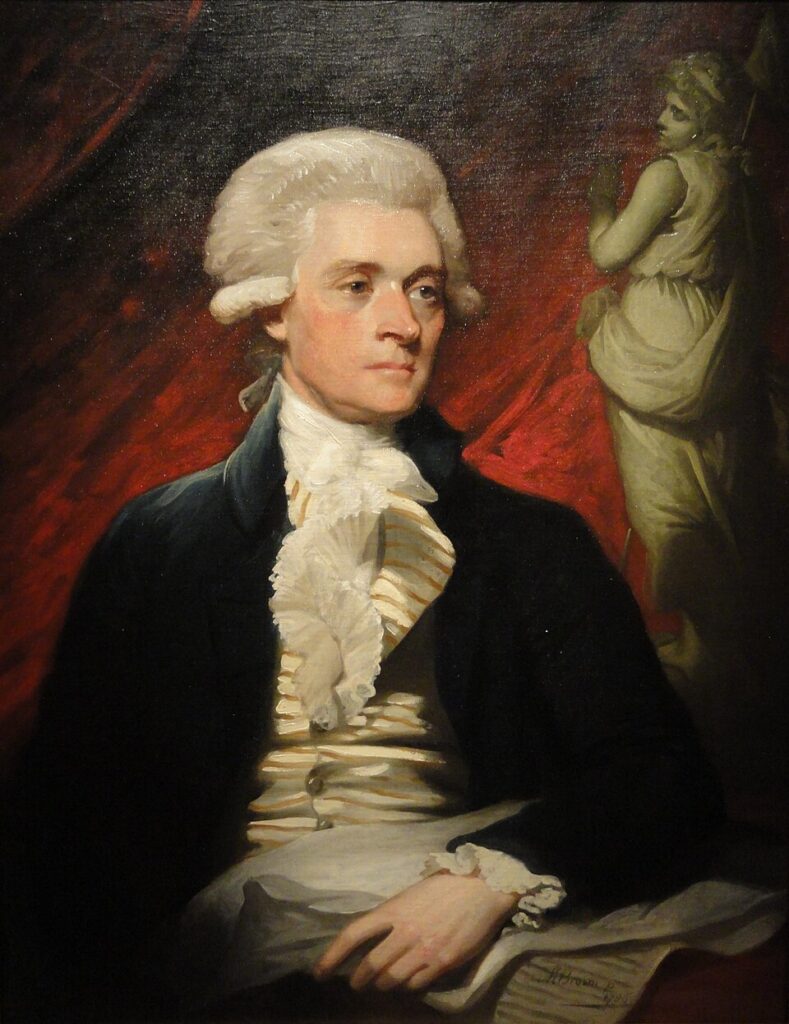
In a house where Jackson swears and Lincoln broods, Jefferson’s ghost stands apart. It does the most civilized thing imaginable. It makes music.
The scholar returns
Jefferson played the violin throughout his life and prized it among his many pursuits. He was a scientist, an architect, an inventor, and an amateur astronomer, a man who organized his days around ideas. A haunting built on music fits that temperament perfectly.
His reported presence is almost entirely auditory and gentle. It carries none of Jackson’s rage or Lincoln’s heaviness. The third president returns the way he lived, quietly absorbed in something he loved.
The angry voice next door
Jefferson shares this acoustic space with a far less polished spirit. David Burns owned the land the government took to build the White House, and he resented losing it. His disembodied voice reportedly booms from the Yellow Oval Room and the attic above, declaring, “I’m Mr. Burns.”
In 1953 a guard heard the voice and assumed Secretary of State James Byrnes was nearby. The names sound nearly identical. He went looking and found that Byrnes was not in the building at all. The territorial grievance of the original landowner, it seems, still echoes through the mansion’s private rooms.
The angle most accounts miss
Stack these two voices side by side, and you reveal the whole story of the property in miniature. Burns represents the land taken by force, still bitter. Jefferson represents the Enlightenment ideals the new government meant to build on that land, still playing them.
One room, two ghosts, two opposing claims on the same ground. The violin and the shout are not unrelated hauntings. They are the founding tension of the place, preserved in sound.
Why a violin fits the man
Jefferson’s musical haunting is not an arbitrary detail. Music threaded through his entire life. He took up the violin as a young man and reportedly practiced for hours, even during his courtship of Martha Wayles, with whom he played duets. He called music “the favorite passion of my soul.” An instrument, for Jefferson, was not a pastime. It was central to who he was.
That fits a wider pattern in these legends. The strongest hauntings preserve the trait that defined the person. Jackson kept his temper. Abigail kept her industry. Jefferson kept his music. The lore, intentionally or not, functions as a kind of folk biography, distilling each figure down to a single essential characteristic and replaying it forever. For the architect of Monticello and the Declaration, the surviving signature is a melody.
The land remembers too
David Burns provides the Yellow Oval Room its harsher half. Burns owned a substantial tract of the land the federal government acquired to build the new capital, and he reportedly resented the deal for the rest of his life. He died in 1799, before the mansion was even finished, and he carried his grievance with him.
The 1953 incident remains the most quoted. A guard heard the booming “I’m Mr. Burns” and naturally assumed Secretary of State James Byrnes was nearby, the names being nearly homophones. He searched and found Byrnes absent from the building entirely. The voice has been reported in both the Yellow Oval Room and the attic above it, a restless presence still announcing his claim. There is something pointed in the fact that the original landowner’s ghost haunts one of the mansion’s most refined private spaces. The house was built on land taken from him, and the legend never lets the building quite forget it.
Two founders, two unfinished arguments
The pairing of Jefferson and Burns in one room rewards a closer look, because it stages a debate the country has never fully settled. Jefferson embodies the soaring ideal: reason, art, self-government, the Enlightenment promise written into the founding documents. Burns embodies the cost: a man whose land was taken so that this ideal could have a home. The violin and the furious voice are the two halves of the American founding, still arguing in the dark.
Neither voice resolves the other. The music does not silence the grievance, nor does the grievance stop the music. They simply coexist in the same haunted space, which is precisely how the founding tension persists in the country itself. The lofty principles and the dispossession that funded them have never been reconciled, only carried forward together.
There is something fitting in placing this unresolved pair in the Yellow Oval Room, one of the mansion’s most private and elegant spaces. The house’s public face is all marble and ceremony. Its haunted interior keeps the harder conversation going. Jefferson plays on, beautiful and idealistic. Burns keeps insisting on his name.
Listen for the violin and the shout together, and you hear the founding in stereo. The country was built on extraordinary ideals and on real harm done to real people, and it has carried both ever since. The Yellow Oval Room, in this telling, is more a national conscience that never quite goes quiet than a haunted room, one voice playing beauty, the other demanding to be named.
It is no accident that the mansion placed its gentlest ghost and one of its angriest in the same elegant room. The pairing keeps the founding honest. Every time the violin drifts through the Yellow Oval Room, the voice of the dispossessed landowner is there to answer it, a reminder that the beautiful idea and its human cost were always neighbors, sharing the same address.
More in This Series: White House Hauntings
- The Cabinet of the Dead: Inside the Most Haunted House in America
- The Resident Who Never Left: The Strange Persistence of Lincoln’s Ghost
- Old Hickory’s Eternal Grudge: The Auditory Haunting of Andrew Jackson
- Laundry in the East Room: The Eternal Diligence of Abigail Adams
- The Ghost Who Stopped the Shovels: Dolley Madison’s Floral Legacy
- One Month in Office, Eternity in the Attic: The Harrison Haunting
- Proposals in the Blue Room: The Romantic Specter of John Tyler
- Echoes of Sad Things: The Haunted Weight of the Johnson Years
- Death in the Executive Mansion: The Lingering Presence of Zachary Taylor
- The Bride of the Blue Room: The Eternal Youth of Frances Cleveland
References & Further Reading
White House Historical Association: White House Ghost Stories
Theresa’s Haunted History: The Attic Ghosts of the White House
Elections Daily: Hauntings at the White House
Medium (Dora Suarez): The White House Scary and Spooky Ghosts
For more on this topic, see our complete guide to the Ghosts of the Founding Fathers and the Haunted White House.

[…] Faint Melodies in the Yellow Oval Room: Thomas Jefferson’s Spectral Violin […]
[…] Faint Melodies in the Yellow Oval Room: Thomas Jefferson’s Spectral Violin […]