The cartridge was secondhand, bought from a garage sale for two dollars. You loaded it to find a single save file already on the game. You deleted it to start fresh. When you returned to the menu, the file was back. And this time the save showed a timestamp from this morning.
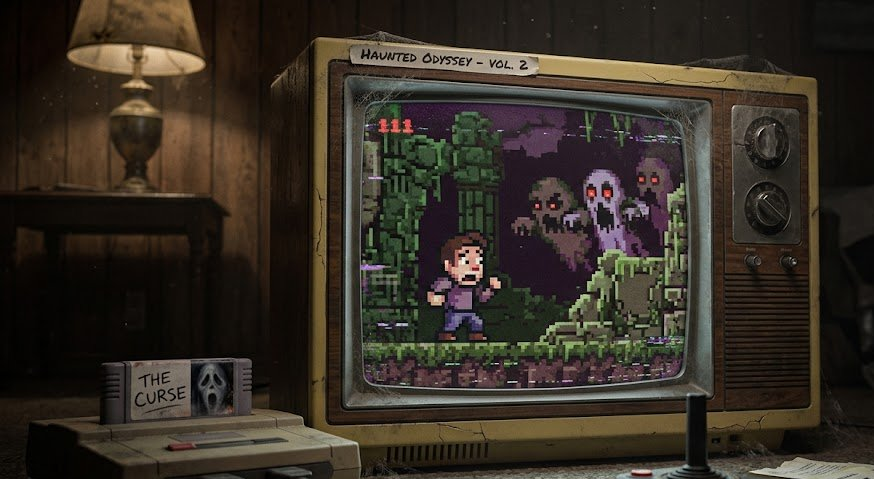
Haunted video game stories occupy a specific corner of internet horror that has proven remarkably generative. From Lavender Town Syndrome to Ben Drowned to the cursed Polybius arcade cabinet, the genre has produced some of the most technically convincing and emotionally resonant horror fiction of the digital age. Understanding why these stories work and what genuine anxieties they process tells you something important about how a generation raised on screens relates to technology, memory, and the persistence of the dead.
Ben Drowned: The Ghost in the Cartridge
Ben Drowned, created by Alexander Hall in 2010, is built around a haunted copy of The Legend of Zelda: Majora’s Mask for Nintendo 64. The story is told through a forum thread accompanied by manipulated gameplay footage showing impossible glitches, a statue that moves on its own, and game text that seems to address the player directly.
What makes Ben Drowned work is not its supernatural premise but its technical plausibility; the glitches look real because Hall understood how Majora’s Mask code actually behaves under certain corruption conditions. Researcher Emily Crawford, writing in the Transactions of the Digital Games Research Association, identified Ben Drowned as a founding text of ‘glitch horror,’ a genre that exploits anxieties about the fallibility of technology. The horror lies in the moment when the technology that is supposed to serve you begins to behave as though it has its own intentions.
Lavender Town Syndrome: The Hidden Frequency
Lavender Town in Pokémon Red and Green is already the game’s darkest location, a town built around a graveyard, with a score notably different from the rest of the game’s cheerful aesthetic. Lavender Town Syndrome is the claim that the original Japanese release’s Lavender Town music contained binaural frequencies that caused illness and suicidal ideation in child players, prompting Nintendo to alter the track before international release.
The story is false. No newspaper accounts of child deaths have been found in any archive, and the music changes were made for technical compression reasons. But researcher Eymeric Manzinali, who published a 2021 analysis of the legend, found that it worked specifically because it tapped into pre-existing parental anxieties about video game harm and combined them with the uncanny quality of Lavender Town’s actual in-game atmosphere. The creepypasta amplified something that was genuinely strange about the game into something that felt true.
The Deeper Pattern: Technology as Haunted Medium
What haunted game stories share with an older tradition is the idea of technology as a medium through which the dead can communicate or persist. This is not new; the first wave of spirit photography in the 1860s exploited exactly the same logic: the photographic plate as a surface sensitive enough to capture what the eye cannot see. Radio, film, and television each generated their own haunted technology folklore before digital games inherited the genre.
What makes the video game version particularly resonant is the save file, the persistent record of a specific person’s play, time-stamped, named, containing choices and progress that belonged to a specific consciousness. A save file from someone who is now dead is not merely data. It is the most accurate digital record that person left of their inner life. That specificity is what the haunted game story weaponizes.
Polybius: The Government Cabinet
The Polybius legend, a mysterious government-deployed arcade cabinet that appeared in Portland, Oregon in 1981, caused seizures and psychological disturbance in players and was removed by men in black suits; it has no contemporary documentation whatsoever. No news reports, no hospital records, no firsthand accounts from the period. It appears to have originated online in the late 1990s.
Yet it has become one of the most persistent gaming urban legends, generating documentaries, tribute games, and sustained community investigation. Its persistence speaks to the same anxieties that produced MKULTRA conspiracy theories: the government experimenting on unwitting citizens through technology they visited freely. The fact that MKULTRA was real makes Polybius feel possible.
What Comes After the Cartridge
The transition from physical media to digital distribution raises an interesting question for haunted game folklore: what does a haunted game look like when there is no cartridge? Contemporary legends have begun to adapt, mysterious accounts on shared servers, save files corrupted in ways that appear personalized, and AI-driven NPCs that seem to address the player by name or reference information they never shared. As AI systems become embedded in games and other media, the line between technical error and apparent intention is going to get considerably harder to draw.
References & Further Reading
• Urban Legends Mystery and Myth: Ben Drowned, The Terrifying Legend
• Untold Strange: The Lavender Town Syndrome



[…] Haunted Video Game Glitches: Why Players Turn Bugs Into Ghost Stories […]