If this has happened to you, you are not alone and you are not losing your mind. This experience has a name, a neurological explanation, and a folklore history that stretches across nearly every culture on earth.
“Bed” by Midnight Believer is marked with Public Domain Mark 1.0.
You Wake Up and Cannot Move. Something Is There.
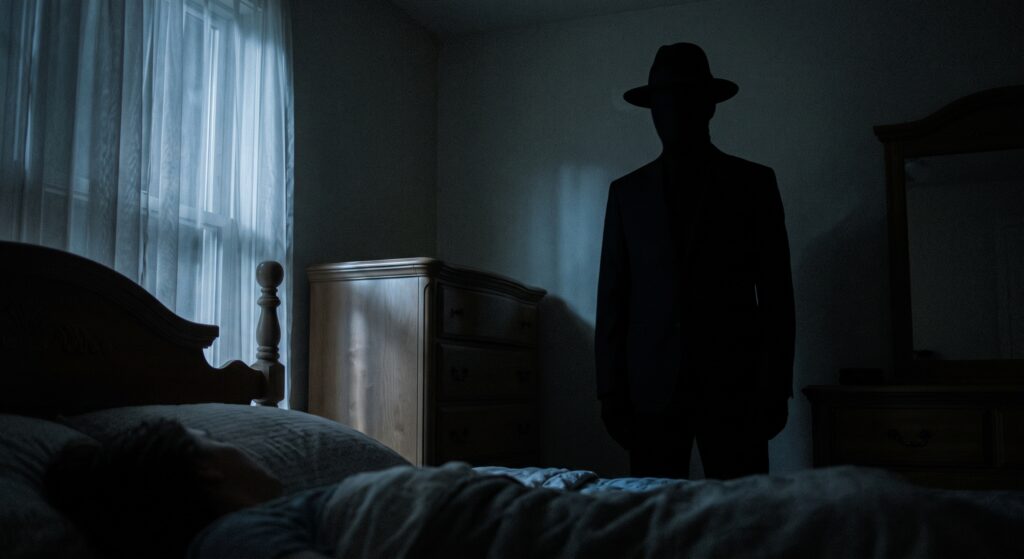
It happens in the grey zone between sleep and waking. Your eyes open but your body refuses to respond. The room looks exactly as it should, but there is weight on your chest, pressure that should not be there. And in the corner, or at the foot of the bed, or directly above you, something is present. You cannot scream. You cannot move. And then, after seconds that feel like minutes, it is over.
What Sleep Paralysis Actually Is
Sleep paralysis occurs when the brain transitions incorrectly between sleep stages, most commonly between REM sleep and waking. During REM sleep, the brain sends signals that temporarily paralyze the body’s voluntary muscles, a mechanism that prevents you from physically acting out your dreams. Sleep paralysis happens when that paralysis persists after conscious awareness returns.
The result is a state of full or near-full wakefulness in which the body cannot move, sometimes for a few seconds and sometimes for up to two minutes. It is not dangerous, but it is profoundly disorienting, and it is frequently accompanied by hallucinations.
Why There Is a Presence, and Why It Sits on Your Chest
The hallucinations that accompany sleep paralysis fall into three consistent categories, identified by researchers studying the phenomenon across cultures. The first is a sense of a presence in the room, often described as a dark figure, a shadow, or a watcher. The second is the feeling of chest pressure, as though something is sitting on or pressing down on the sternum. The third is visual or auditory hallucinations, voices, movements at the edge of vision, or figures approaching the bed.
The chest pressure specifically is thought to be caused by the brain misinterpreting the sensation of restricted breathing during REM-adjacent sleep. Breathing does become shallower during this stage, and without the normal motor feedback that explains why, the waking brain constructs a physical explanation: weight. Something pressing down. Something sitting there.
The sense of a watching presence appears to be generated by the same neural mechanisms that produce the feeling of being followed in dreams. The threat-detection regions of the brain are active; the motor regions are not. The result is perceived danger with no available physical response, which is one of the reasons the experience feels so viscerally terrifying.
The Cultural History: Every Tradition Has a Name for This
What makes sleep paralysis remarkable from an anthropological perspective is how consistently cultures have described the same experience in supernatural terms, before any neurological explanation existed.
In English folklore, the entity was called the Old Hag, a witch or crone believed to sit on the chests of sleeping victims and steal their breath. In Newfoundland the phenomenon is called the Old Hag and remains part of living folk memory. In West African and Caribbean tradition, it is called kokma, a baby ghost that jumps on the chest of sleepers. In Chinese folklore the term translates roughly to ghost pressing on body. In Turkish tradition it is a djinn. In Brazilian folk culture it is the pisadeira, a long-nailed crone. In Japanese it is kanashibari, meaning bound in metal.
Every one of these traditions describes the same three elements: paralysis, chest pressure, and a malevolent or threatening entity. The consistency is not coincidence. It is a record of how humans across time have made narrative sense of a neurological event.
Who Gets Sleep Paralysis and What Increases the Risk
Sleep paralysis affects an estimated 8 percent of the general population, with higher rates among students and people with irregular sleep schedules. It is more likely to occur when sleeping on your back, when sleep-deprived, when under significant stress, and when sleep patterns have recently shifted, such as after travel or shift changes. It is also associated with certain sleep disorders including narcolepsy, though the two conditions are separate.
Episodes tend to cluster. If you have one, you are more likely to have another within the same period of disrupted sleep. This clustering is part of why some people describe haunting patterns rather than single events.
When to See a Doctor
Isolated sleep paralysis episodes are not medically concerning on their own. However, if episodes are frequent, severely disruptive, or accompanied by other symptoms such as sudden daytime sleepiness, cataplexy, which is sudden muscle weakness triggered by emotion, or hallucinations outside of the sleep transition window, it is worth speaking with a sleep specialist. These can be signs of narcolepsy or another sleep disorder that benefits from treatment.
What This Means for the Ghost on Your Chest
The neurological explanation does not make the experience less real. The terror, the pressure, the presence: those are genuine sensory events processed by a fully conscious brain. What science clarifies is the origin, and that origin, once understood, is the single most effective tool for reducing the experience’s power. People who understand what is happening during sleep paralysis report less fear and shorter episodes than those who do not.
Whether you interpret what sits on your chest as a neurological artefact, a cultural inheritance, or something else entirely is a question this article will not answer for you. But you now know what every insomniac, folklore scholar, and sleep researcher knows: you are having one of the oldest and most widely documented human experiences there is.

[…] entity intends harm. That emotional signature is not arbitrary. As discussed in our article on sleep paralysis ghosts on your chest, the chest pressure itself is the product of the brain misinterpreting restricted REM breathing, […]
[…] Sleep Paralysis Ghost on Your Chest: The Science and Folklore Behind It […]
[…] Sleep Paralysis Ghost on Your Chest: The Science and Folklore Behind It […]