The question of whether dreams can predict death sits at the intersection of folklore, grief research, parapsychology, and cognitive science, and the honest answer is neither a simple yes nor a simple no.

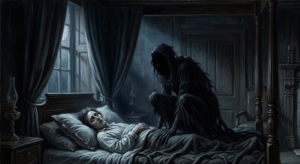
“reaper Photoshop” by Aady Aadil is marked with CC0 1.0.
She knew. That is the most consistent element in the accounts that collect around this topic, people describing not just a dream but a certainty that arrived with the dream and remained after waking. The phone call, when it came, confirmed what sleep had already told them. These accounts are not rare. They are not confined to credulous communities. They are reported by engineers, doctors, academics, parents, and children across cultures with radically different frameworks for what dreams are and what the dead do after they leave.
The Scale of the Phenomenon
Between 17 and 38 percent of people in Western populations report having experienced at least one premonition dream, a dream that appeared to predict a future event. Death-related dreams are among the most commonly reported categories. Cross-cultural research on bereavement consistently finds that between 43 and 55 percent of bereaved individuals report some form of perceived contact with the deceased, often a vivid, realistic dream that feels qualitatively different from ordinary dreaming. An Icelandic study found that 86 percent of such contact experiences constituted the first intimation that the death had occurred, meaning the person learned of the death through the dream before they learned of it through any waking communication.
The Standard Explanation and Its Limits
The rational response to premonition dream reports is selective recall: the brain generates thousands of dreams, many involving death or loss, and the ones that appear to predict real events are remembered while the thousands that did not are forgotten. This explanation is correct as far as it goes. It does not fully account for cases with unusually specific details, correct names, locations, causes, and times or for the research literature on crisis apparitions, which documents a pattern of pre-death contact experiences sufficiently consistent that the Society for Psychical Research has maintained an active case archive since 1882.
The Aberfan Premonition Study
On October 21, 1966, a coal waste landslide destroyed the Pantglas Junior School in Aberfan, Wales, killing 116 children and 28 adults. British psychiatrist John Barker collected accounts from people who reported premonitions of the disaster. He gathered 76 accounts and followed up 60 of them. Among the most specific was an account from the parents of ten-year-old Eryl Mai Jones, who had told them on the morning before the disaster that she had dreamed of going to school and finding it was not there, that something black had covered it. Eryl Mai died in the disaster later that day.
The Aberfan case generated some of the most careful contemporaneous documentation of premonition reports ever assembled and contributed to the founding of the British Premonitions Bureau in 1967. It remains the most studied cluster of premonition accounts connected to a single event, and it has not been satisfactorily explained by selective recall alone.
Folklore Death Omens in Dreams
Across folklore traditions, specific dream images are associated with impending death. British and Celtic folklore identified dreaming of a doppelganger, a crow, or a corpse candle as a death warning. Japanese tradition connected specific funeral-associated flowers with pre-death dreams. Mexican and Latin American traditions described dreams in which a deceased relative appears and beckons. Indigenous North American traditions recognized dreams in which an animal guide appears in an unusual context or in which the dreamer crosses water with a known dead person.
What is consistent across these traditions is not the specific image but the phenomenological quality: the dream is described as different, more vivid, more solid, and more real than ordinary dreaming, with a quality that some researchers call hyperrealism. This felt difference is reported consistently enough across independent cultural frameworks that it constitutes a data point in itself, separate from any question of whether the content was genuinely prophetic.
The Psychological Framework
Even without accepting any paranormal mechanism, the psychology of death-related dreams is worth taking seriously. Research published by the Sleep Foundation indicates that premonition dreams tend to occur during periods of heightened stress or when the dreamer has unconscious awareness of a person’s deteriorating condition or danger. The dreaming brain has access to an enormous amount of pre-conscious processing, bodily changes, relational patterns, and environmental signals that the waking mind filters out. A dream that appears to predict a death may, in some cases, be synthesising information the dreamer already possessed but had not consciously assembled. That is a remarkable capability in itself, independent of any further claim.
The Cases That Resist Every Explanation
The cases that remain genuinely unexplained are the ones that contain information the dreamer could not have had by any normal means. The woman documented by researcher Peter Fenwick who dreamed in accurate detail of her ex-husband’s suicide, including the method and location, on the night it occurred, before any communication reached her. The father who dreamed of the exact stretch of road where his son’s accident happened hours before it occurred and who wrote the location in a note that survived. These cases do not resolve the question of mechanism. They only establish that dismissal through selective recall alone is insufficient. Something is happening in some of these experiences that the available explanations have not yet accounted for.
References & Further Reading
• Sleep Foundation: Precognitive Dreams
• Psi Encyclopedia: Phenomena Related to Danger, Death, and Bereavement


[…] Can Dreams Predict Death? Premonition Folklore, Coincidence, and Grief […]
[…] Can Dreams Predict Death? Premonition Folklore, Coincidence, and Grief […]
[…] Can Dreams Predict Death? Premonition Folklore, Coincidence, and Grief […]
[…] Can Dreams Predict Death? Premonition Folklore, Coincidence, and Grief […]