North America is a haunted continent, but its ghosts are not all dead. From the dense pine barrens of New Jersey to the deep glacial lakes of the Pacific Northwest, the landscape is populated by creatures that biology cannot explain and folklore refuses to let go. We call them cryptids—hidden animals that exist in the space between confirmed zoology and campfire legend.
This field guide maps the most persistent monster legends across the United States and Canada. These are not merely stories; they are cultural artifacts that tell us what different regions fear, respect, and remember about the wild spaces just past the tree line.
The Forest Giants: Sasquatch and Its Kin
The hairy, bipedal hominid is the king of North American cryptids. While the Pacific Northwest claims the classic Bigfoot, nearly every heavily wooded region on the continent has its own local variant. In the Appalachian mountains of Virginia, locals speak of the Wood Booger, a localized wildman legend with deep roots in mountain culture. Further west, the dense woods of the Buckeye State hide the Ohio Grassman, while Portage County has recorded its own distinct cluster of Bigfoot sightings.
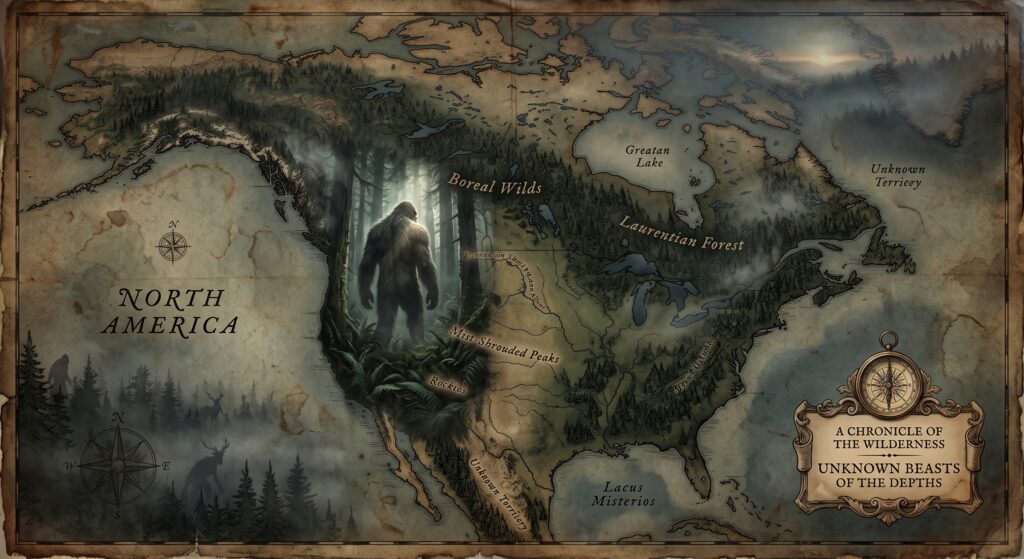
The high deserts and canyons hold their own giants. The Mogollon Monster haunts the Mogollon Rim of Arizona, described as a towering, foul-smelling creature adapted to the harsh terrain. In the deep South, the swamps of Florida hide the Skunk Ape, while the Alabama White Thang presents a terrifying, pale variant of the classic wildman archetype. Kentucky has its own entry in this category: the Hillbilly Beast, a creature that blurs the line between Bigfoot legend and Appalachian folklore.
Terrors of the Deep: Lake and River Monsters
Long before European settlement, indigenous traditions warned of massive creatures ruling the continent’s deep waters. Today, these river and lake monsters remain some of our most enduring cryptids. Lake Champlain, bordering New York and Vermont, is home to Champ, a creature often compared to a plesiosaur. In the Great Lakes, Bessie supposedly patrols the waters of Lake Erie.
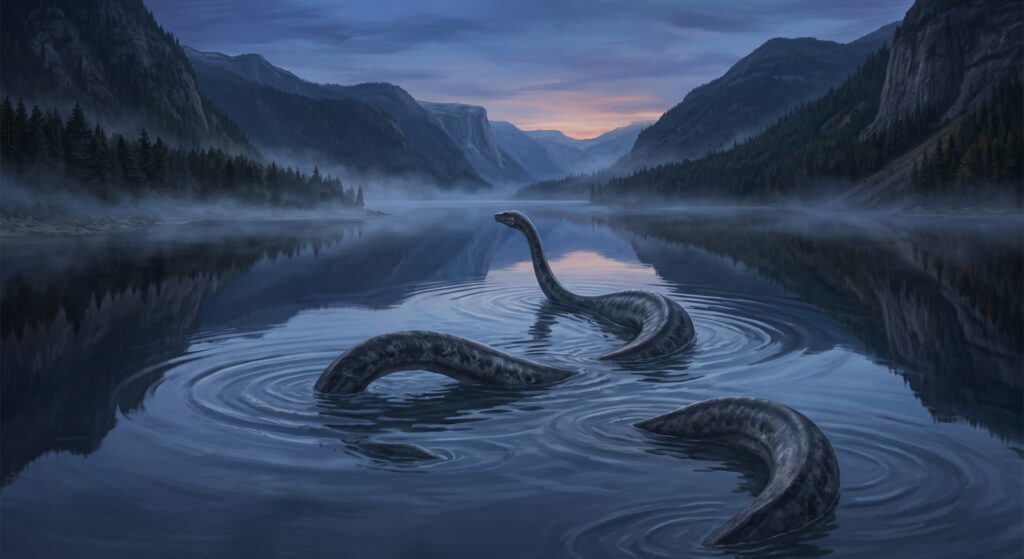
The deep, cold waters of the West hold their own leviathans. Montana’s Flathead Lake Monster has generated dozens of reports of a massive, whale-like creature. Across the border in British Columbia, Okanagan Lake is famous for the Ogopogo, a serpentine beast whose legend predates written history in the region. Further south, the muddy currents of the South hide the White River Monster of Arkansas, a creature so embedded in local identity that the state legislature created a refuge for it.
Winged Cryptids: Shadows in the Sky
The sky holds terrors that strike fast and vanish. The most famous is the Mothman, a red-eyed, winged humanoid whose sightings in Point Pleasant, West Virginia, culminated in the tragic Silver Bridge collapse. The legend has recently migrated, with a bizarre cluster of Mothman sightings in Chicago drawing national attention.
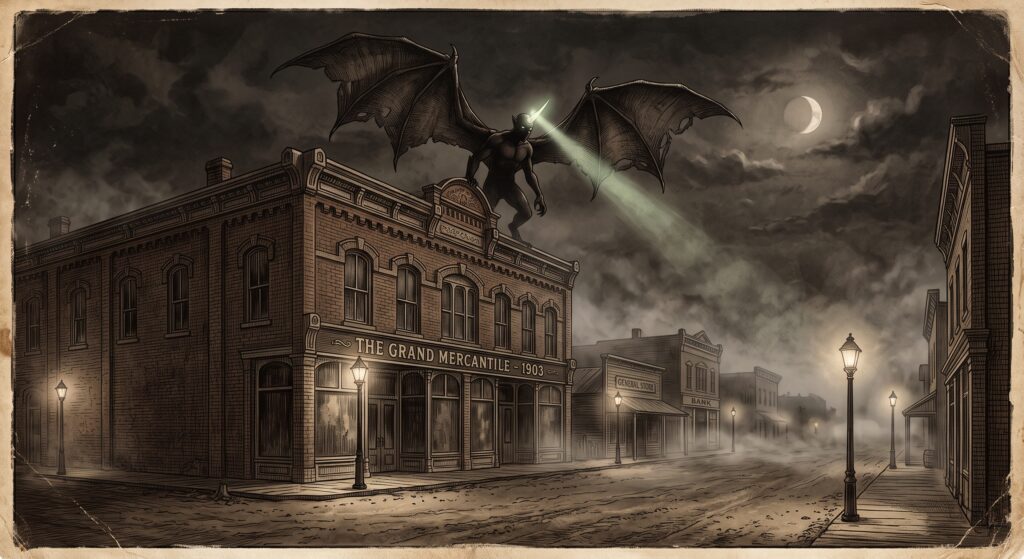
Older traditions speak of giant birds. Thunderbird sightings stretch across the continent, with particularly strong traditions surrounding the Thunderbird of the San Luis Valley in Colorado. In New Jersey, the pine barrens have been haunted for centuries by the Jersey Devil; researchers still debate why the Jersey Devil has wings and how the folklore evolved from a colonial political dispute into a literal monster. In the Midwest, the bizarre Van Meter Visitor—a winged creature with a glowing horn—terrorized an Iowa town for several nights in 1903 before vanishing into an abandoned mine. Across the Atlantic, the Owlman of Cornwall offers a striking parallel — a large, owl-like humanoid reported near a church in England, often compared to Mothman.
Canine Cryptids and Swamp Beasts
The intersection of human and wolf produces some of the most primal fears in folklore. In Wisconsin, reports of a bipedal canine known as the Beast of Bray Road have persisted since the 1980s. Down in the bayous of Louisiana, Cajun tradition warns of the Rougarou, a werewolf-like creature that enforces Catholic Lenten rules and terrifies misbehaving children.
Appalachia has its own apex predators. The Wampus Cat is a terrifying feline cryptid that blends Cherokee mythology with pioneer ghost stories. Some traditions even revere the Wampus Cat as a guardian spirit. In the swamps of South Carolina, the Lizard Man of Scape Ore Swamp made headlines in the 1980s for allegedly mauling cars. Ohio claims the bizarre Loveland Frogman, an amphibious humanoid spotted by police officers, while Massachusetts has the small, alien-like Dover Demon.
Regional Hotspots: Where Monsters Gather
Some regions seem to breed strange creatures in clusters. The Ozarks are a hotbed of cryptid activity, from giant snakes to howling wildmen. The mysterious Marfa Lights of Texas have long been linked to cryptid activity, drawing investigators who cannot explain the floating orbs in the desert night. The harsh environment of the American Southwest also produces desert monsters adapted to the heat, while the vast, unforgiving terrain of the far north gives rise to terrifying Inuit legends like the Qalupalik and the shape-shifting Kushtaka of Alaska.
When investigating these regions, it is crucial to understand the cultural context. Researchers must be careful to distinguish between a biological cryptid and a spiritual entity; as we have noted elsewhere, there are vital reasons why a Skinwalker should never be treated as a cryptid.
For those brave enough to seek these creatures out, the cryptid tourism industry is booming. You can map out road trips to cryptid museums across the country or attend one of the many cryptid festivals that celebrate these local legends. Whether these creatures represent undiscovered biology, misidentified wildlife, or the enduring power of human imagination, they remain a vital, living part of the North American wilderness.
For cryptids beyond North America, see our guide to the Cryptids of the World: A Global Guide to Hidden Monsters.


[…] This guide maps the most compelling cryptids across the globe, exploring the cultural fears they represent and the expeditions launched to find them. For monsters closer to home, see our guide to the Cryptids of North America. […]
[…] For more on this topic, see our complete guide to the Cryptids of North America: A Field Guide to Regional Monster Legends. […]
[…] For more on this topic, see our complete guide to the Cryptids of North America: A Field Guide to Regional Monster Legends. […]
[…] For more on this topic, see our complete guide to the Cryptids of North America: A Field Guide to Regional Monster Legends. […]
[…] Cryptids of North America: A Field Guide to Regional Monster Legends […]