He coined the phrase that fueled a revolution, then reportedly wished his way into one of Boston’s strangest true stories
The Man Who Coined a Slogan and Lost His Mind
James Otis Jr. never signed the Declaration of Independence, though he arguably supplied one of the Revolution’s most quoted phrases. Otis is widely credited with coining “taxation without representation is tyranny,” a line that shaped colonial resistance for more than a decade before independence was declared. He first built his reputation as a lawyer arguing against writs of assistance, a British legal tool that let officials search colonial homes and businesses without specific cause.
Otis mentored Samuel Adams and inspired John Adams’s own rhetorical style so thoroughly that Adams later called him a flame of fire in the courtroom. Everything changed in 1769, when a British customs official struck him on the head during an argument in a Boston coffeehouse. Otis won two thousand pounds in damages through the courts but refused to accept the payment. It was a strange act of pride that only added to his growing reputation for volatility.
His mental health declined sharply after the attack. Historians still debate whether the head injury caused the decline or simply accelerated a condition already present in the family. Either way, Otis spent his final years unable to practice law. His sister and brothers cared for him, moving him between several quiet towns, including Hull, Barnstable, and finally Andover, for his safety and comfort.
A Wish Granted in the Worst Possible Way
During his years of decline, Otis reportedly told his sister that he hoped God would eventually take him from this world in a flash of lightning. He apparently repeated the wish often enough that family members remembered it clearly after his death.
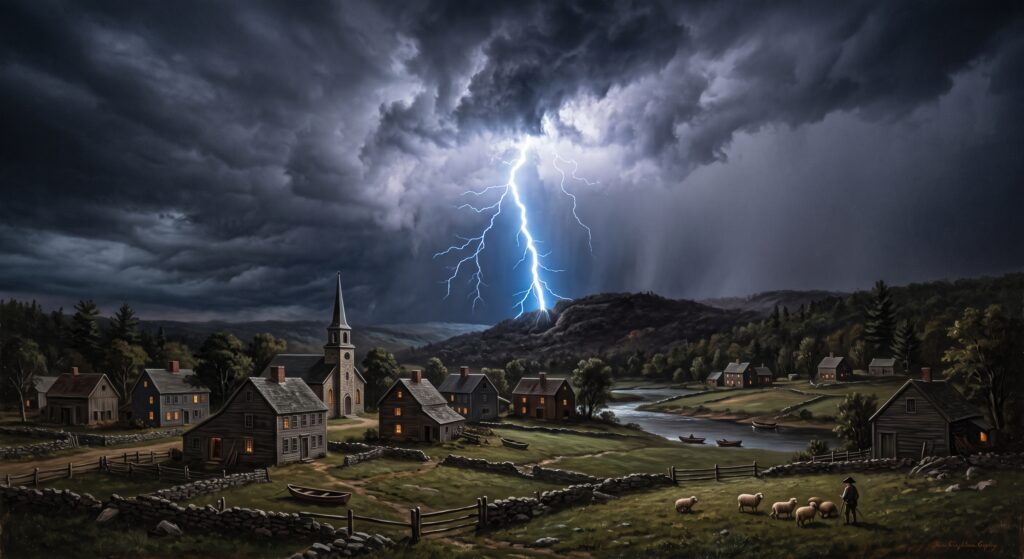
On May 23, 1783, Otis stood in the doorway of a friend’s home in Andover, Massachusetts, telling a story during a thunderstorm. A bolt of lightning struck the house and killed him instantly. Witnesses reported that his body showed no visible burns or damage, and some described his expression as strangely peaceful. The same strike also shook several members of the household inside, though none suffered serious injury.
The Elm Tree That Grew From His Skull
Otis was buried at the Granary Burying Ground in Boston, alongside Samuel Adams, John Hancock, and Paul Revere. Decades later, in the nineteenth century, workers reopening his grave for some reason found something unexpected. The roots of a large elm tree had grown directly through his skull.
Rather than treat the discovery as disturbing, nineteenth-century observers saw it as fitting. One period account described Otis’s brain as having transformed into branch and leaf and blossom, breathing itself back into the open air. In ancient Greek tradition, death by lightning was considered a mark of divine favor rather than misfortune, and Otis’s contemporaries seemed to view his death the same way.
John Adams later wrote that Otis left behind a character that would never die while memory of the Revolution remained. Given how thoroughly Otis shaped the language of the cause before losing his health, that assessment reads less like flattery and more like simple accounting.
The Pacing Spirit and the EMF Spikes
Modern visitors to the Granary describe a tall figure in colonial clothing pacing the paths near Otis’s grave before vanishing. Paranormal investigators who bring EMF meters to the cemetery frequently report unusually strong spikes concentrated specifically near his resting place.
That activity may come from restless energy, coincidental interference, or simple suggestion given the location’s reputation. Either way, Otis’s grave remains one of the most consistently mentioned stops on Boston’s ghost tours, right alongside far more famous names buried a few steps away.
A Legacy Almost Erased By His Own Hand
In a strange twist that adds to the mystery surrounding Otis, he burned most of his personal papers near the end of his life. He offered no explanation to the family members who witnessed it. Historians still do not know exactly what he destroyed, or why. A substantial record of his private thoughts vanished by his own choice, not through theft or accident.
That self erasure sits uneasily alongside his very public legacy. Otis coined language that outlived him by centuries, yet he apparently wanted at least part of his story kept from history. Otis left behind an unusually strange afterlife, marked by the burned papers, the lightning that killed him as he wished, and the elm tree that grew through his skull. That holds true for any founding figure, ghost story or not.
His sister Mercy Otis Warren, herself a noted historian of the Revolution, wrote extensively about the war but left comparatively little detail about her brother’s final years. That silence from the person who knew him best only adds another layer to a life already defined by gaps in the record.
Visiting the Granary Burying Ground
The Granary Burying Ground sits on Tremont Street in downtown Boston, open daily to visitors from roughly 9 a.m. to 4 p.m. Otis’s grave sits near the front of the cemetery, close to the entrance on Tremont Street.
Bring a bit of patience if you want a quiet moment at his grave. The Granary draws over a million visitors a year, and Otis shares his small plot of ground with some of the most photographed graves in the country.
Standing there, it is worth remembering that Otis helped give the Revolution its language before he lost the ability to keep shaping it himself. Few founding figures paid a steeper personal price for their early contributions, lightning bolt or not.
The next time someone mentions taxation without representation, consider the man who framed it that way. He spent his final years wishing openly for the exact death that eventually found him and got it in front of witnesses who never forgot what they saw.
References & Further Reading
NEW ENGLAND FOLKLORE: James Otis and the Lightning Bolt
James Otis (1725-1783) – Find a Grave Memorial
Granary Burying Ground History and Famous Graves – Ghosts and Gravestones