A picturesque town’s dark secret
Elkhorn, Wisconsin, is a small, picturesque town in Walworth County. Author Linda Godfrey once noted that it was known as the Christmas Card Town for its postcard charm. Yet a rural lane nearby, Bray Road, gave American folklore one of its most famous modern werewolf legends. Witnesses there describe a creature that should not exist.
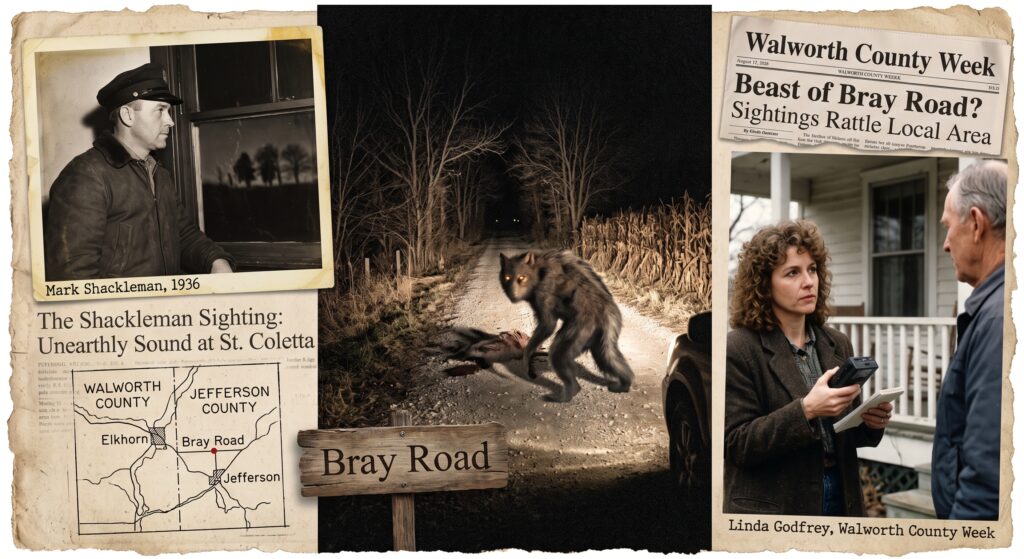
The Beast of Bray Road is described as six to seven feet tall. It is covered in brown or gray fur, with a wolf-like head, pointed ears, and glowing eyes. People have reported seeing it crossing roads; crouched over roadkill it appeared to be eating; and standing at the edge of cornfields watching them in the dark.
The creature reportedly moves in an unsettling way. Witnesses say it can run on all fours, then rise and move upright on two legs. That shifting, part-animal and part-humanoid movement is central to the terror the legend inspires. It fits no ordinary animal people know of.
The 1936 encounter
The earliest reported sighting in the region predates the modern flap by decades. In 1936, a night watchman named Mark Shackleman was working at St. Coletta, a school in Jefferson, Wisconsin. He said he saw a hairy, humanoid creature standing between six and seven feet tall, resembling a wolf or bear. He also caught the strong scent of rotting flesh.
Shackleman reportedly saw the creature on two consecutive nights. On the second night, he said it stood upright and made a strange, unearthly sound. The experience frightened him deeply and stayed with him for the rest of his life. He recounted it years later with evident conviction.
This 1936 account establishes the legend’s deep roots in the area. The Beast was not simply invented in the 1990s. Similar reports trickled out of the region for decades before the story finally exploded into the news. The consistency across such a long span is part of what makes Bray Road compelling to those who take it seriously.
The reporter who investigated
In the early 1990s, a wave of sightings around Elkhorn prompted a local newspaper, the Walworth County Week, to assign reporter Linda Godfrey to the story. Godfrey began as a firm skeptic, expecting to find a silly rumor and little else. What she found changed her approach.
As she interviewed witness after witness, she came to believe in their sincerity, even though she could not confirm what they had actually seen. The witnesses were ordinary, credible people who gained nothing from their strange accounts. Godfrey’s careful reporting turned into a series of articles and eventually several books.
Her honest, grounded approach set the standard for investigating such cases. She did not claim to know what the beast was, and she resisted leaping to a supernatural conclusion. She simply documented consistent, credible-seeming testimony and let readers weigh it for themselves. That stance is worth emulating: take witnesses seriously without abandoning sound judgment.
What it might be
Skeptics favor misidentified gray wolves, which have returned to Wisconsin and can look startling when standing upright or seen in poor light. Others suggest a large feral dog, a bear, or an outright hoax by someone in a costume. Each explanation covers some reports but not all.
Believers point to the distinct wolf-like head and the upright, bipedal gait that known animals do not easily produce. Bray Road stays genuinely unresolved. It remains a modern werewolf legend built on decades of sincere reports, careful journalism, and a rural landscape perfectly suited to a compelling scare.

[…] some of the most primal fears in folklore. In Wisconsin, reports of a bipedal canine known as the Beast of Bray Road have persisted since the 1980s. Down in the bayous of Louisiana, Cajun tradition warns of the […]
[…] sits in a lineage of Midwest dogman tales, alongside Michigan’s Dogman and Wisconsin’s Beast of Bray Road. Descriptions vary wildly, which itself suggests folklore at […]