Wood Booger is the name given to Bigfoot-type creatures in Virginia and West Virginia, and it has a register that ‘Sasquatch’ does not. The name is both frightening and slightly absurd, a vernacular coinage that suggests something that has been part of local vocabulary long enough to acquire a nickname. You don’t nickname something you’ve just started to think about. You nickname something that has been around long enough to feel familiar.
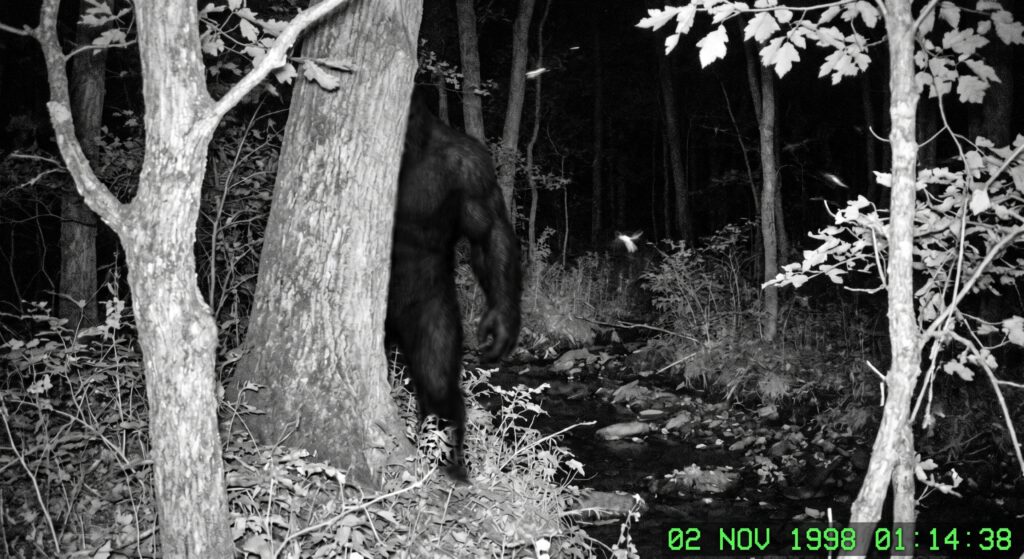
The Wood Booger tradition is centered on the Virginia Blue Ridge and its extension into the mountains of western North Carolina. Accounts cluster in the hollows and ridge-top forests of Floyd County, Carroll County, and the Washington National Forest. The terrain here is rugged enough to feel genuinely remote even in a state as populated as Virginia. Wood Booger witnesses consistently describe the creature as very large, very hairy, and extremely unwilling to show itself again. Encounters tend to be brief, often nocturnal, and accompanied by a distinctive odor that recurs in accounts across generations.
The Terminology and Its Origins
‘Booger’ in Appalachian vernacular means roughly what ‘boggart’ means in Northern English tradition: a frightening creature of uncertain nature, something lurking in a specific threatening location. A wood booger is a booger of the woods, distinct from a creek or in communities that have named fears for specific dangerous places. The word connects the Virginia tradition to a broader Scots-Irish and English linguistic heritage that Appalachian communities maintain in ways more urban regions have not.
Folklorist Bill Ellis has documented supernatural creature traditions across the Appalachian South. He noted that the Wood Booger tradition is unusually resistant to national standardization. Many local Bigfoot traditions have adopted the Pacific Northwest vocabulary over the past half-century. However, the Wood Booger name has persisted in Southwest Virginia and adjacent areas as a marker of specifically local identity. Using ‘Bigfoot’ feels borrowed. ‘Wood Booger’ feels like it belongs there.
The Sightings
Floyd County, Virginia, has produced a cluster of Wood Booger accounts that researchers have documented as among the most geographically consistent in the state. In the early 1990s, multiple independent witnesses along the Little River described the same figure in roughly the same location over a period of months. A large plaster cast was produced from a track found near a creek crossing during this period. It measured seventeen inches by eight inches and is consistent with tracks found in other Appalachian locations.
Carroll County, whose Blue Ridge terrain borders North Carolina, has a longer documented tradition. An 1890s newspaper account from Galax describes a local farmer’s experience. He tracked a large upright figure through fresh snow for nearly two miles before the tracks simply ended at a rocky outcrop above a creek. The farmer, described as one of the most reliable men in the county, reported the incident to neighbors and the county newspaper.
The Cultural Function
The Wood Booger tradition is active. The creature functions as something more than a cryptid. It is a reason to respect the forest, to stay on the trail after dark, and not to go into the deeper hollows alone. It functions as a cultural boundary marker. While the forest is a place with its own rules, its inhabitants are practically identical across Indigenous traditions from the same mountain range. The name may be different, but the role is ancient.

[…] continent has its own local variant. In the Appalachian mountains of Virginia, locals speak of the Wood Booger, a localized wildman legend with deep roots in mountain culture. Further west, the dense woods of […]