The long and strange history of the Ouija board includes a Chinese goddess of the latrine, a Baltimore patent attorney, and a Vatican-commissioned warning. Then there’s also a Pulitzer Prize and a demon invented on a message board in 2009.
TL;DR: The Short Version
The Ouija board is not a portal to the dead. It is a mass-produced toy, patented in Baltimore in 1891, whose real ancestor is Chinese spirit writing from roughly 1,400 years earlier. The planchette moves through the ideomotor effect, tiny unconscious muscle movements the players never notice.
This is the part that maintains the mystery. Laboratory research shows the board can answer questions the players cannot consciously answer. In a blindfolded University of British Columbia study, participants scored 65 percent on general knowledge; they were sure they were only guessing. Speaking the same answers aloud, they scored 50 percent. Eye-tracking work at a Ouija convention found that messages emerge from two minds unconsciously predicting each other, letter by letter.
So the answers are real, even though the ghost is not. A 2025 study also found that believers leave a session 25.5 percent more anxious than nonbelievers, which means the board can genuinely affect people. The voice on the other end is real. It just belongs to the unconscious mind of whoever is touching the planchette.
A Piece of Cardboard That Frightens Grown Adults
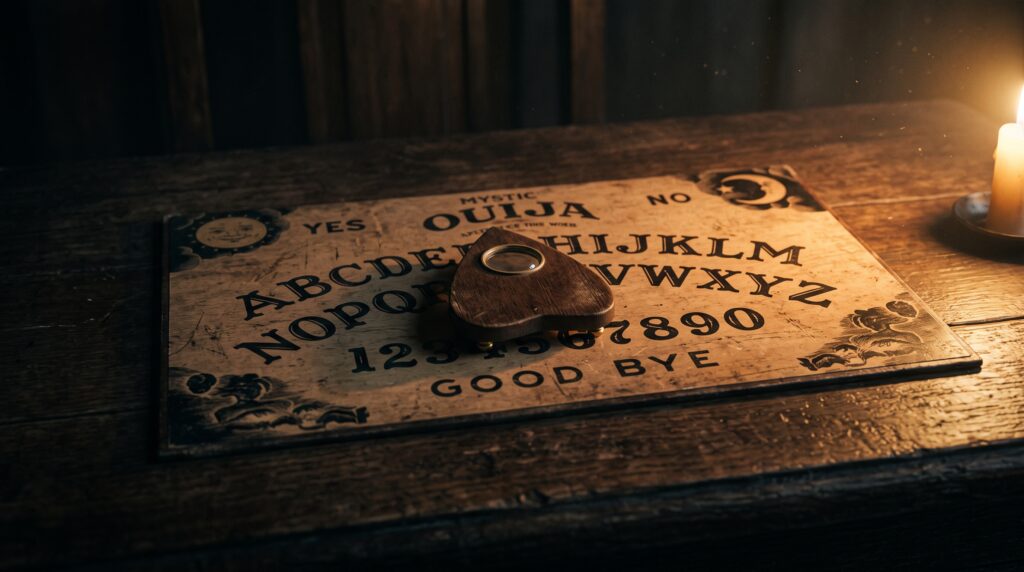
Take the object apart, and there is nothing there. A rectangle of pressed board. Twenty-six stenciled letters, ten digits, the words YES and NO, and a plastic pointer with a window in it. Manufacturing cost is measured in cents. Hasbro sells it in the toy aisle, shelved somewhere near Candy Land.
Now watch what happens when you set one on a table. People who do not believe in ghosts refuse to touch it. Churches organize burnings. Grown adults will tell you, with total sincerity, that a friend of a friend was never the same afterward. Something about this specific arrangement of ink and cardboard reaches past the rational mind and grabs something older.
Here’s the part that almost nobody mentions. Researchers have put the board in a laboratory, wired participants to eye trackers, and blindfolded volunteers to see what the planchette actually knows. The results were not what skeptics expected either. Under the right conditions, the board outperforms the people using it. The board answers questions that people cannot consciously answer.
Three groups of people have spent serious effort explaining the talking board, and each has real evidence. Historians trace it as a story of intellectual property law and family lawsuits, not spiritualism. Theologians treat it as a genuine spiritual trespass with real consequences. Cognitive scientists treat it as the cleanest window ever built into the unconscious mind.
This article takes all three seriously. It does not end where you probably expect. The scientific explanation does not make the board boring, and it does not make the fear irrational. It relocates the mystery. The planchette is not pointing outward to some other side. It is pointing straight back at the people whose fingers rest on it, and what it finds there is stranger than a ghost.
The Ancestors: Spirit Writing Before America Existed
Most Ouija histories begin in Victorian America. That start date is off by roughly fourteen centuries.
A Chinese Practice a Thousand Years Older Than Ouija

Chinese spirit writing, called “fuji,” appears in the written record during the Liu Song dynasty, between 420 and 479 CE. Early accounts describe villagers summoning Zigu, the Purple Maiden, a deified concubine who became the spirit of the latrine. Women invoked her on the fifteenth day of the first lunar month. They asked her practical questions, most often about silkworms and mulberry yields. This was not gothic horror. It was an agricultural help desk.
The practice grew sophisticated during the Song dynasty, from 960 to 1279, when scholars including Shen Kuo and Su Shi documented it. What began as folk divination among women became an elite method for conversing with deities and ancestors.
The mechanics deserve attention, because the parallel to the modern board is exact. One or two operators, called “jishou,” or “planchette hands,” supported a Y-shaped stylus of willow or peach wood over a tray of sand or incense ash. The stylus traced characters. Only one operator was supposedly possessed. The other simply held on.
A full session required a small staff. A pingsha smoothed the sand between characters. A dujizhe read and interpreted the marks. A chaojizhe copied them. Chinese practitioners understood something the Victorians would relearn painfully: raw output from a spirit device is a mess, and someone has to decide what it says.
Sacred Scripture From a Sand Tray
Fuji was not a parlor amusement. It was a devotional technology, and it produced scripture that people still read.
The Jiajing Emperor, who reigned from 1522 to 1566, built a dedicated planchette altar inside the Forbidden City. Several texts in the Daoist Canon originated through spirit writing. The Secret of the Golden Flower, a work that later fascinated Carl Jung and shaped Western understanding of Chinese meditation, likely came out of a fuji session.
The Qing legal code banned the practice. It survived anyway. Daoist temples in Taiwan, Hong Kong, and Malaysia still perform fuji today, alongside folk shrines in mainland China.
A living religious tradition invented the fundamental Ouija method centuries before Baltimore did, treated it with liturgical seriousness, and produced sacred literature with it. The American version did not descend from that tradition directly. Both arrived at nearly identical hardware because the underlying human mechanism is universal.
Grief, Rapping, and the Fox Sisters
The Western branch starts in 1848 at a farmhouse in Hydesville, New York. Two young sisters, Kate and Maggie Fox, reported knocking sounds that answered questions. The alleged spirit rapped once for yes and twice for no. A national movement grew from that farmhouse within a decade. For more on the Fox sisters, see our post here.
Then came the war. The American Civil War killed roughly seven hundred thousand people. Most were young men. Most were buried far from home, in graves their mothers would never see. Bodies did not come back. Funerals happened without a corpse. An entire generation lost the physical rituals that let grief complete itself.
Spiritualism filled that hole. It offered what no minister could: not comfort about the dead, but conversation with them. Mary Todd Lincoln held seances in the White House after losing her son Willie. She was not an eccentric outlier. She was typical.
The Problem Nobody Could Solve
Contacting the dead turned out to be tedious beyond belief.
Table-tipping worked like this. Sitters placed hands on a small table. Someone recited the alphabet aloud. When the table tilted, that letter was recorded. Then the alphabet started over for the next letter. A single sentence could consume an evening.
Consider the arithmetic. Reaching the letter S means calling out eighteen letters. A ten-word message might mean hundreds of recitations in a dark room with people who have already been sitting for two hours. The dead may have had a great deal to say. Nobody had the stamina to hear it.
The entire history of talking boards is a history of solving this bottleneck. Every innovation that follows is a bandwidth upgrade.
The Little Plank
The first real fix came from France. Around 1853, spiritist circles associated with Allan Kardec began attaching a pencil to a small basket, letting the assembled hands guide it across paper. The basket evolved into a heart-shaped wooden platform on caster wheels with a pencil through one end. The French called it a “planchette,” meaning “little plank.”
It reached America in the 1860s and sold enormously. Part of the appeal had nothing to do with the afterlife. Victorian courtship rules were suffocating, and the planchette required unmarried men and women to sit close, in dim light, hands touching, for extended periods. The dead provided excellent cover.
One problem persisted. Automatic writing produced garbage. Multiple hands pushing a wheeled pencil generate loops, scrawls, and overlapping strokes that require heavy interpretation. The sitters spent more time arguing over whether a mark was an L or a T than receiving messages.
The fix appeared in Ohio spiritualist camps around 1886. Somebody removed the pencil entirely, laid out a card printed with the alphabet, and used the planchette purely as a pointer. Interpretation vanished. The device now selected letters instead of drawing ambiguous shapes.
That change is the whole invention. Everything afterward is packaging and litigation.
The Baltimore Businessmen Who Trademarked the Afterlife
The men who created the Ouija board were not spiritualists. The Strong National Museum of Play makes this clear in its research on the artifact: the people who patented and popularized the device were capitalists.
Charles Kennard, a Baltimore businessman known for novelty products, could not raise money for a talking board. Eventually attorney Elijah Bond took interest. Bond had a specific asset the others lacked, and it was not capital. It was a sister-in-law.
The Kennard Novelty Company incorporated on October 30, 1890, the day before Halloween, with investors including William H. A. Maupin, Colonel Washington Bowie, and John F. Green. Their product plan was straightforward. Take the alphabet-card arrangement already circulating in spiritualist camps, put it on one manufactured board, trademark a mysterious name, and sell it to a grieving nation.
Where the Name Actually Came From
The official story is that they asked the board what it wanted to be called. It spelled O-U-I-J-A. Asked what that meant, it answered, “Good luck.” Some accounts add that the word was ancient Egyptian.
It is not ancient Egyptian. It is not Egyptian.
The version you will see repeated most often online is that Ouija combines the French “oui” and the German “ja,” yes plus yes. That explanation is tidy and almost certainly wrong. It appears to be a later folk etymology attached to the product after the fact.
The likeliest answer sat around Helen Peters’s neck. Peters, Bond’s sister-in-law and the medium at the session, later said she had been wearing a locket containing a woman’s portrait with a name above it. Historians have long identified that woman as Ouida, the pen name of the celebrated English novelist and animal welfare activist Maria Louise Rame.
A locket sits at chest level. A woman looking down at a board constantly looks past it. Under low light, a script capital D can easily be read as a J. Peters did not lie about the name coming through the board. She simply had no idea her own eyes had supplied it.
Hold that image, because it is the entire thesis of this article compressed into one object. A person receives information she is certain came from outside herself. It came from six inches below her chin.
The Patent Office Test
In early 1891, Bond and Peters carried the device to Washington. The chief patent officer, reasonably, refused to grant a patent for a talking board unless it talked. He demanded the board spell his name, which he had not given them.
Peters set her fingers on the planchette. According to one account of the session, the board produced the letters N-E-A-L-B. The officer was satisfied.
That detail rewards a second look. NEALB is not a clean success. It is a partial hit, close enough that a person expecting a name would round it up. It is also what you would expect from a nervous woman who had learned the name in advance. Or from ideomotor movement toward a half-remembered fragment.
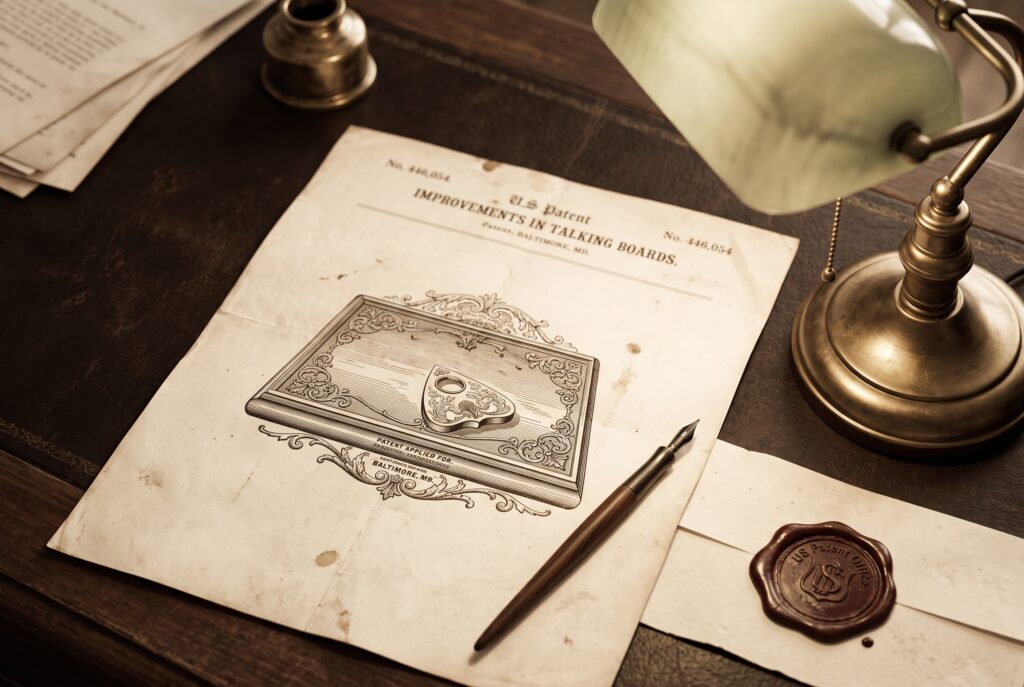
The patent issued on February 10, 1891, as US Patent 446,054. Read what it actually protects, and the mysticism evaporates. It is a utility patent covering a toy or game. The claims list the lettered board, the three-legged indicator, and the combination of the two. They also cover operating one with the other by hand. The United States government never certified that the device contacts the dead. It certified that nobody else could manufacture that particular arrangement of plywood for seventeen years.
That classification as a toy became enormously consequential later, in ways nobody in 1891 anticipated.
The Woman Erased From Her Own Invention
Helen Peters named the product, secured the patent, and then disappeared from the story for more than a century.
Her role was recovered only after Robert Murch of the Talking Board Historical Society located correspondence from Kennard and Bond published in the Baltimore Sun. On September 22, 2018, a small crowd gathered at Fairmount Cemetery in Denver. The society, along with the mayor, the Fairmount Heritage Foundation, and her descendants, attended. They dedicated a memorial at her grave.
A hundred and twenty-seven years is a long time to wait for a headstone that mentions what you did. The board that supposedly speaks for the silent dead kept one of its creators silent longer than most.
Fuld, Feuds, and a Fall From a Roof
William Fuld started as a varnisher and then a foreman at Kennard Novelty. He ended up owning the whole thing.
Kennard was pushed out of his own company in 1891 for reasons that remain unclear. By 1892 Fuld ran operations, the firm was renamed The Ouija Novelty Company, and Fuld had filed his own talking board patent. Production expanded aggressively. Additional factories opened in Baltimore, then New York, Chicago, and London. At their peak, roughly two thousand boards moved per week.
Fuld then did something instructive. He began advertising himself as the inventor and exclusive manufacturer of the Ouija board. He was neither.
Elijah Bond, who actually held the patent, was forced to buy advertising space in the trade magazine Playthings to correct the record. He devoted a third of his ad to a flat correction. William Fuld did not invent Ouija. Bond did, and the patent issued to him on February 10, 1891.
Bond had his own workaround. He waited for the original patent to expire, relocated to West Virginia, and in 1907 founded the Swastika Novelty Company to sell a competing board called Nirvana. The swastika was then read as an Indian religious symbol, decades before its appropriation by the Nazis.
The family war was uglier. Fuld licensed the Ouija name to a venture he shared with his brother Isaac in 1899. The brothers split in 1901, and William kept the name. Isaac defied an injunction and marketed a nearly identical board called Oriole. The brothers fought in court until 1919.
Fuld also told a story about the board directing his business decisions. He claimed it instructed him to prepare for big business, which he took as a signal to build the Harford Road factory. In 1927 he fell from the roof of that building and died.
Salem, Monopoly, and a Pink Board
Parker Brothers acquired the Ouija trademark from the Fuld family in 1966 and moved production to Salem, Massachusetts. That choice was pure marketing. Salem’s history included witch trials, and its economy relied on tourism, making the association easy to exploit.
In 1967 the Ouija board outsold Monopoly. Sit with that. At the height of the counterculture, a device for talking to the dead moved more units than the most famous board game in America.
Hasbro acquired Parker Brothers in 1991 and inherited the strangest asset in its catalog. In 2008 it released a pastel pink version marketed to girls, decorated with cartoon suns and offering questions about which boy would text next.
The backlash was severe. Christian groups organized boycotts, arguing that Hasbro had made occult practice look like a slumber party accessory. Both sides of that fight were arguing from the same premise, which is the interesting part. Everyone agreed the board was serious. They disagreed about whether that seriousness could be sold in pink.
The Theological Case Against the Board
What the Prohibitions Actually Say
Skeptical writing on the Ouija board often treats religious objections as mere superstition dressed up in respectable language. That is lazy. The theological argument is coherent, ancient, and worth stating accurately before anyone dismisses it.
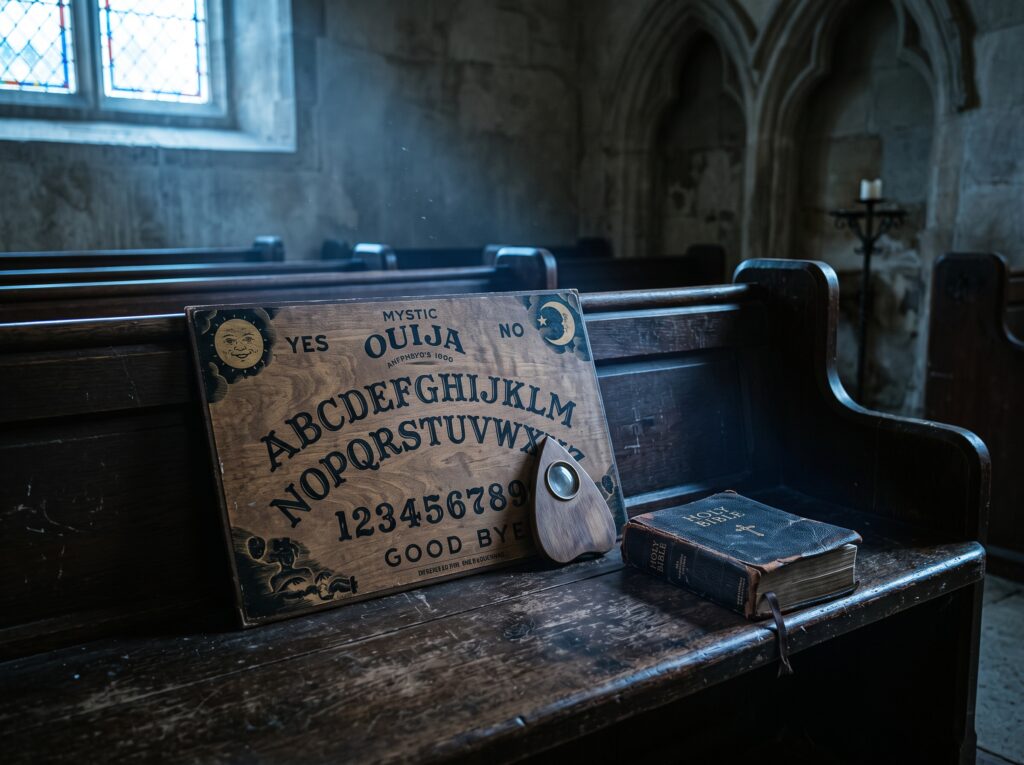
Leviticus 19:31 instructs Israelites not to turn to mediums or necromancers, warning that doing so defiles them. Deuteronomy 18:10 through 12 goes further, listing divination, sorcery, omen reading, and consulting the dead among practices called detestable.
The reasoning behind those prohibitions is that the dead can be reached. Read closely; the texts assume the opposite. The prohibition would be pointless if the practice never worked. The objection is jurisdictional. Divine communication is supposed to flow through authorized channels, and necromancy is an unauthorized back door.
Acts 19:18 through 19 supplies the template for every Ouija board bonfire since. New believers in Ephesus publicly confess their practices and burn their scrolls of magic in the street. The passage even records the price of the destroyed books, which reads as a deliberate emphasis on cost. Galatians 5:19 through 21 lists sorcery among works of the flesh.
A reader can consider this framework unpersuasive and still recognize it as internally consistent. The board is not condemned because it is fake. It is condemned because of who might answer.
The Open Wound
Contemporary Catholic writing on the board leans on a medical image. A talking board session is an open wound presented to a contaminated environment.
The mechanism, in this framing, is the deliberate suspension of will. Ouija users are told to relax, to stop steering, and to let the planchette move on its own. That instruction is the crux. Theologically, the will is a person’s protective boundary. Voluntarily setting it aside is what creates the opening. (For a related look at how folklore frames reflective surfaces as portals, see our piece on two mirrors facing each other.)
Exorcists in parish ministry describe the practice as unlocking cages at random in a zoo. Whatever comes out is not selected by the person who opened the door. Priests who work with teenagers report that youth group sessions are a common entry point. They describe cases like a college student waking with unexplained scratches.
A skeptic has straightforward responses to all of these: suggestion, group dynamics, self-inflicted marks, and retrospective attribution. Those explanations may well be correct. They do not make the pastoral concern dishonest, and the people making it are usually the ones sitting with the frightened family afterward.
A Warning Commissioned From Rome
Institutional Catholic alarm predates the horror films by half a century.
J. Godfrey Raupert, a former psychical researcher who converted to Catholicism, published The New Black Magic and the Truth About the Ouija Board in 1919. He worked with Vatican encouragement and toured American Catholic institutions, warning against talking boards.
Raupert’s specific concern was psychological rather than theatrical. He argued that the board was most dangerous to young, impressionable, unstable minds and that repeated use produced dissociation and mental disturbance.
That warning has aged remarkably well, though not in the way Raupert intended. Strip the demonology from his claim, and you will find a testable psychological hypothesis about suggestible people and altered states. A team of researchers finally tested it in 2025, and we will come to their result shortly.
How One Movie Rewrote a Toy’s Meaning
The Boy Behind The Exorcist
In January 1949, in Cottage City, Maryland, a thirteen-year-old boy began experiencing disturbances shortly after the death of his aunt. She was a spiritualist, and she had taught him to use a talking board.
Scratching sounds came from the walls. Objects moved. The mattress shifted. Over the following months, Lutheran and then Catholic clergy became involved, and a series of exorcism rites were performed in Maryland and later in St. Louis. Father Raymond Bishop kept a diary of the proceedings that ran to roughly twenty-nine pages.
The boy was known publicly for decades as Roland Doe, and sometimes Robbie Mannheim. The Skeptical Inquirer identified him in December 2021 as Ronald Edwin Hunkeler, born June 1, 1935, and died May 10, 2020.
He lived a full private life and never sought attention for any of it. That deserves noting before anyone treats him as a plot device.
What the Investigation Found
Journalist Mark Opsasnick spent years tracking the case through witnesses, neighbors, classmates, and clergy. His findings dismantled much of the popular version.
The exorcism occurred at a different address, not the Mount Rainier address repeated in nearly every retelling. The boy never lived in Mount Rainier. His home was in Cottage City.
Father Walter Halloran, who was present, told Opsasnick that he never heard the boy’s voice change pitch or tone. Halloran believed the boy was mimicking Latin he had picked up from the priests around him, rather than speaking a language he had never learned. When marks appeared on the boy’s skin, Halloran acknowledged that nobody thought to check his fingernails.
There is also a documentary problem at the foundation. Father Bishop was not involved from the beginning. He joined only after someone had already made the decision to perform an exorcism in March 1949. Everything in his diary covering January through early March is secondhand, written down by a man who was not there.
None of these accounts proves nothing unusual happened to Ronald Hunkeler. It proves the document everyone treats as primary evidence is partly a transcription of other people’s memories. A participant recorded it, and he arrived with a strong expectation about what he was witnessing.
December 1973
William Peter Blatty heard about the case as a Georgetown student and credited a 1949 Washington Post article as his inspiration. His novel appeared in 1971. The film followed in 1973.
One scene did more damage to the Ouija board’s reputation than eighty years of sermons. Regan MacNeil plays alone in the basement. She contacts a friendly presence she calls Captain Howdy. She breaks the rules that every player claims to know: she plays alone, and she never says goodbye.
Before that film, the board was a parlor game. Newspapers ran lighthearted features about it. Couples played it on dates. It outsold Monopoly six years earlier.
After that film, it was a doorway. The change was permanent, and it took about two hours to accomplish.
The Feedback Loop
Scholars of religion describe what followed as a feedback loop between horror media and lived religious experience. The sequence is worth laying out precisely, because it explains why Ouija stories all sound alike now.
A real case in 1949 generates newspaper coverage. That coverage inspires a novel in 1971 and a film in 1973. The film teaches an enormous audience what possession looks like, sounds like, and starts with. People who subsequently experience distress, dissociation, or fear then interpret and describe their experiences using the vocabulary the film supplied. Those new accounts feed the next round of films and the next generation of expectations.
This is why modern Ouija experiences are so consistent. Sudden cold. A hostile entity that lied about its identity. Figure-eight motion. Scratches. Players are not independently discovering identical phenomena. They are performing a script they absorbed before they ever touched a board, and they are performing it sincerely.
Why the Inside Job Frightens Us Most
Possession horror occupies a category of its own, and the reason is structural rather than theological.
Every other monster is external. A killer, an alien, a predator, a machine—these are all external threats. External threats permit the two responses evolution built us for. You can fight it or you can run from it. Both require a functioning body under your command.
Possession removes that. The threat is operating your nervous system. It speaks with your voice, moves your hands, and looks out through your eyes. There is nowhere to run, because the very thing you would run with is the thing that is pursuing you.
Now consider what the board physically does. It gives you the direct sensory experience of your hands moving without your permission. Possession horror did not attach itself to the Ouija board arbitrarily. The board delivers a miniature, safe, deniable rehearsal of the exact fear that possession stories exploit.
Zozo: A Demon With a Timestamp
March 24, 2009
Most folklore has murky origins. Zozo has a date.
On March 24, 2009, a man named Darren Evans from Oklahoma posted an account on the site True Ghost Tales. He described repeated encounters with a hostile entity that identified itself as Zozo through Ouija boards. He wrote that the entity was initially friendly, then turned threatening, and that it made threats against people close to him.
The post spread. Others came forward with matching accounts. Within a few years Zozo had a book, a film, and a permanent place in Ouija culture.
The reported signature is remarkably uniform. The planchette races in figure-eight patterns. It spells Z-O-Z-O repeatedly. The room turns cold. Anxiety spikes. Scratches appear afterward.
The 1818 Citation, Read Properly
Zozo’s claimed pedigree runs through the Dictionnaire Infernal, an encyclopedia of demons by Jacques Collin de Plancy, first published in 1818. The entry concerns a girl in the village of Teilly in Picardy who was said in 1816 to be possessed by three demons named Mimi, Crapoulet, and Zozo. She reportedly walked the streets on all fours and sometimes on her hands.
Nearly every article citing this passage stops there. The next line is the one that matters.
Collin de Plancy wrote that the girl wanted to pass herself off as possessed. His account, in the very source used to prove Zozo’s ancient malevolence, frames the case as a young woman staging a possession. He was not documenting a demon. He was documenting a performance.
The entry itself is also two sentences long, tucked between an entry on an enchanted castle and one on a serpent. There is no description of Zozo’s nature, powers, or appearance. There is a name in a list.
Pazuzu, Zoso, and the Manufacture of Depth
Two additional pedigrees circulate, and both fall apart on contact.
The first links Zozo to Pazuzu, the Mesopotamian wind demon. The connection rests on nothing beyond the letter Z and the fact that Pazuzu is the demon named in The Exorcist. Pazuzu is a genuinely ancient figure with a documented iconography and a protective role in Assyrian practice. He has no relationship to a two-line French footnote from 1818.
The second links Zozo to the Zoso symbol on the fourth Led Zeppelin album. That symbol is a sigil for the planet Saturn, reproduced from a sixteenth-century source. Jimmy Page is a Capricorn. Saturn rules Capricorn. That is the entire connection, and it only reads as lettering if you decide beforehand that it spells something. To his credit, Evans has himself said Zoso and Zozo are not the same thing, a distinction the articles built on his work routinely collapse.
What we are watching is a legend acquiring a fake ancestry in real time. Weblore needs depth to feel legitimate, so contributors reach backward and grab any old text containing similar letters. The Dictionnaire Infernal supplies antiquity. Pazuzu supplies gravity. Led Zeppelin is cool. None of it was connected until people needed it to be.
Legend Tripping and the Function of Rules
Folklorists use the term “legend tripping” for a specific informal folk rite. Adolescents dare one another to enter a forbidden place and confront whatever is supposed to live there. The abandoned asylum. The cemetery at midnight.
The trip is not really about the ghost. It is about status, nerve, and the group watching. Someone has to go first, someone has to break, and everyone learns something about everyone else.
This reframes the famous rules. Never play alone. Never play in a graveyard. Light a white candle. Burn sage. Never let the planchette pass through the number eight. Always say goodbye.
These are not safety instructions in any mechanical sense. No manufacturer wrote them. They function as boundary markers, which do two jobs at once. They intensify the danger by declaring that it exists, and they contain it by guaranteeing an exit. Saying goodbye is a closing ritual, the equivalent of turning the lights back on.
That structure lets a teenager experience real fear on a schedule, with an off switch. It is remarkably well designed for its actual purpose, which is not spiritual protection.
The Board That Wrote Literature
St. Louis, July 8, 1913
The most extraordinary Ouija story is not a haunting. It is a publishing career.
Pearl Lenore Curran was a St. Louis housewife with an average education for the era and few books in the house. She had not traveled widely. She had no literary reputation and no apparent ambition to acquire one.
Her friend Emily Grant Hutchings brought a Ouija board to her home in July 1912. Curran was indifferent and had to be coaxed into participating. For a year the sessions produced banal, unconvincing messages, and Curran was ready to quit. Hutchings pushed her to continue.
On July 8, 1913, the board changed character. It produced a line that reads like the opening of a novel: Many moons ago I lived; again I come, Patience Worth my name.
Almost every retelling of this story omits Emily Hutchings, and the omission matters enormously. Two people’s hands were on that planchette. Hutchings supplied the board, the enthusiasm, and the persistence when Curran wanted to stop. Any explanation that treats the event as one woman’s solo achievement, whether spiritual or psychological, has already deleted half the apparatus.
Four Million Words
Patience Worth identified herself as a seventeenth-century Englishwoman from Dorsetshire who had emigrated and been killed by Native Americans. Over the following twenty-four years, until Curran’s death in 1937, the collaboration produced an output that would exhaust a full-time professional novelist.
The material included novels, plays, short stories, and enormous quantities of poetry, delivered in an archaic English idiom. Curran’s husband John recorded sessions in shorthand. The couple hosted biweekly Patience Worth evenings and invited friends, journalists, and celebrities.
The critical reception was not polite indulgence. The Sorry Tale ran 644 pages and roughly 325,000 words, covering the last days of Jesus. It appeared in 1917 and drew reviews treating it as a serious literary achievement. A St. Louis newspaper review carried a headline calling it the greatest story ever written. Patience Worth appeared in poetry anthologies alongside Edna St. Vincent Millay. Edgar Lee Masters, after attending a demonstration, said she was producing remarkable literature.
Psychical researcher Walter Franklin Prince considered Telka, a play of sixty to seventy thousand words, superior to comparable works. Prominent skeptics tried to break the case and failed to produce a confession or catch a fraud.
Rosa Alvaro, Entrante
In November 1919, the Saturday Evening Post published a short story under Pearl Curran’s own name, without any attribution to Patience Worth.
The plot is almost unbearably revealing. A bored department store clerk named Mayme, stuck selling hosiery, is desperate for a different life. She acquires a spirit guide, a glamorous Spanish woman named Rosa Alvaro. Mayme begins slipping into Rosa’s accent and manner. The transformation makes her friend nervous and makes her romantic prospects considerably more interesting.
Curran wrote a story about a drab woman who invents a vivid alter ego to escape a life too small for her. She published it under her own name. She did this in the middle of a career built on channeling a vivid alter ego.
Scholars have read this in different ways. Daniel Shea, professor emeritus of English at Washington University, has suggested fraud may have been involved and that the story may have functioned to relieve Curran’s guilt. Parapsychological investigator Stephen Braude reached a gentler conclusion: Curran was likely a gifted child with real writing talent whose mother pushed her toward music instead.
Braude’s reading has a certain force. Consider what the Patience Worth arrangement gave a woman in 1913. She could publish novels. She could hold court before the New York literary society. She could receive praise from Edgar Lee Masters. She could do all of it without ever claiming she was talented, ambitious, or the author, which were not acceptable things for a St. Louis housewife to claim.
Patience Worth may not have been a ghost. She may have been given a permission slip.
A Willowware Teacup in Connecticut
The second literary case involves a poet nobody could accuse of being an untrained housewife.
James Merrill and his partner David Jackson spent more than twenty years at a homemade board. They worked in their Stonington, Connecticut dining room, with its flame-colored walls, using an overturned Willowware teacup as a pointer. They began in the 1950s. Merrill’s poem Voices from the Other World, from that decade, was his first published work drawn from the sessions.
The full project became The Changing Light at Sandover, a 560-page epic poem. Three volumes appeared between 1976 and 1980, collected with a new coda in 1982.
The awards record is often reported carelessly, so here it is presented precisely. The Book of Ephraim appeared in the collection Divine Comedies, which won the 1977 Pulitzer Prize for Poetry. Mirabell: Books of Number won the 1979 National Book Award for Poetry. The complete volume won the National Book Critics Circle Award. Sandover as a whole did not win the Pulitzer. A book that includes the first section did win.
Scribe and Hand
The formal design of Sandover is where the real interest lies for anyone considering how boards work.
Merrill printed the board’s dictation in capital letters and his narrative in lowercase. Open any page and you can see exactly which voice is speaking. The spirits shout. The poet answers quietly. That typographic choice does something no explanatory framing could: it makes the reader experience the division inside the room.
The spirits called Merrill scribe and Jackson hand. Two people, two functions, one voice emerges between them.
The content rejected every convention of ghost stories. Ephraim, a first-century Greek Jew, served as a guide. A peacock named Mirabell delivered cosmology. W. H. Auden, W. B. Yeats, and Plato participated. The subjects included nuclear weapons, environmental collapse, evolution, and the function of art in a world after both religion and the atom bomb.
This is the detail that should trouble anyone confident the board produces only nonsense. Two hands on a teacup generated a work that literary critics compared to Yeats, Milton, and Blake. Whatever mechanism was operating, it cannot be dismissed as random letter selection after examining the text.
What the Laboratory Found
Carpenter Names the Effect
The scientific explanation arrived early, and it was aimed directly at spiritualism.
In 1852, physiologist William Benjamin Carpenter presented a paper to the Royal Institution. Its title was long: On the Influence of Suggestion in Modifying and Directing Muscular Movement, Independently of Volition. He proposed that ideas alone can generate muscular movement without conscious intent and that people executing these movements genuinely do not know they are doing it.
The term for this phenomenon is the ideomotor effect. Carpenter built on earlier work by Thomas Laycock in 1845, and James Braid connected the phenomenon to hypnosis, where instructions reach the muscles without conscious agreement.
The key claim is not that spiritualists were lying. It is that honest, intelligent people unconsciously produce muscular activity consistent with their expectations. Sincerity was never the issue.
Chevreul Blindfolds Himself
French chemist Michel Eugene Chevreul, one of the most respected scientists in France, ran the cleanest self-experiment in the history of the subject.
He worked with a pendulum that appeared to swing on its own over mercury. Chevreul blindfolded himself. An assistant then inserted or removed a glass plate between the pendulum and mercury, without telling him which. When he could not know the setup, nothing happened.
His conclusion is one of the most useful sentences ever written about the paranormal. As long as he believed the movement was possible, it occurred. Once he understood the cause, he could no longer reproduce it.
Belief was not incidental to the phenomenon. Belief was the power supply.
Faraday’s Two Boards
Michael Faraday settled the table-turning question in 1853 with a device so simple it is almost rude.
He built a sandwich of two small boards separated by glass rollers and held together with rubber bands. The top board could slide slightly against the bottom one under sideways pressure. A hay stalk fixed upright to the apparatus made any slippage instantly visible. Sitters placed their hands on the top board.
If spirits were pushing the table, it would move first and drag the hands. If hands were pushing, the top board would slide first, and the indicator would betray it.
The hands moved first. Every time.
Faraday reported one more result that is easy to skim past. Once sitters could see the indicator revealing their own pressure, the phenomena generally stopped altogether. Awareness of the mechanism disabled it, exactly as with Chevreul’s pendulum.
His demonstration did essentially nothing to slow the craze. Table-turning continued for decades. The most famous experimentalist alive published his answer in the London Times and the Athenaeum. It could not compete with the experience of feeling the table move.
The Blindfold Study That Changed the Question
For a century and a half, the ideomotor explanation was treated as the end of the discussion. Then a team at the University of British Columbia asked a better question.
Everyone agreed the players moved the planchette. Nobody had asked what the movement knows.
Helene Gauchou, Ronald Rensink, and Sidney Fels published their results in Consciousness and Cognition in 2012. The design was elegant. A participant sat at a Ouija board across from someone they believed was a fellow volunteer. That person was a confederate. Both placed hands on the planchette, and the participant was blindfolded.
The confederate then quietly removed their hands. The participant, blindfolded, continued believing a partner was still there. In practice they were playing entirely alone, but their conscious mind had been convinced it was not in sole control.
Participants answered yes or no general knowledge questions and separately rated each answer as either known or guessed.
Sixty-Five Percent
When participants said they knew an answer, the board and the spoken response performed about the same. No surprise there.
When participants said they were guessing, the spoken answers landed at 50 percent. That is chance, exactly what guessing should produce. The same participants, answering the same questions through the planchette, achieved 65 percent.
This was fifteen percentage points above chance on questions they were certain they could not answer.
The conclusion the researchers drew is that implicit semantic memory can be expressed through ideomotor action. In simpler terms, you know things you cannot access. The information is stored, indexed, and inaccessible to deliberate recall. The planchette reaches it because it is not asking permission.
Rensink has described the underlying system as a nonconscious intelligence, sometimes called the zombie system. His practical framing is memorable: to get results, you have to park your conscious system and let yourself act through the zombie system.
Why Solitary Play Fails
This experiment points out the single most persistent piece of Ouija folklore, and the explanation has nothing to do with danger.
Never play alone, the rule says. Something strange happens.
What actually happens is nothing at all. When you sit at a board by yourself, your conscious mind knows with certainty that every movement is yours. It refuses to release control. The nonconscious system never takes the wheel, and the planchette sits there.
The rule exists because solo play is disappointing, and folklore reinterpreted the disappointment as prohibition. Notice too what the UBC design required: they had to manufacture a fake partner to make solo play work. Belief in a second pair of hands was the necessary ingredient, not the second pair of hands themselves.
Eye Trackers at a Ouija Convention
The next major study left the laboratory entirely.
In 2015, Marc Andersen of the Interactive Minds Centre at Aarhus University packed eye-tracking equipment and a research assistant. He traveled to Baltimore for a Ouija board conference. He recruited experienced practitioners rather than undergraduates. The findings appeared in Phenomenology and the Cognitive Sciences, marking the first time researchers studied the practice outside a psychology lab.
The method exploited a quirk of motor control. When you intend to move something toward a target, your eyes arrive first. Gaze precedes action. That anticipatory glance is measurable and difficult to fake.
Andersen compared two conditions. In one, pairs were told to deliberately spell a specific word, and they were given BALTIMORE. In the other, they conducted a normal session and let the board answer.
During deliberate spelling, the partners’ eyes synchronized and ran ahead of the planchette. Both knew the destination. During genuine sessions, participants were significantly worse at visually predicting the next letter. Their eyes were not leading.
A Message Nobody Wrote
One further result reframes the entire phenomenon.
As a response unfolded, participants got progressively better at predicting the coming letters. Post-hoc analysis found that the chance of predicting the next letter rose by roughly five percent with each consecutive letter in a meaningful response.
Picture how that plays out. The planchette lands on H, then E. Both players, without discussing it, now have a much narrower field of plausible continuations. Each subsequent letter constrains the next. Two prediction engines, running on shared language and shared expectations, converge on the same completion without either person deciding anything.
Andersen and colleagues concluded that meaningful Ouija responses appear to be an emergent property of interacting predictive minds that progressively impose structure on initially random events.
Read that carefully, because it is not the standard skeptical claim. Nobody is cheating. Nobody is steering. The message genuinely does not originate in either player. This interaction between two nervous systems, each doing what nervous systems do, leads to the emergence of a guess about what comes next.
Believers in the study also reported a lower sense of agency than skeptics did. Expectation shaped not only the interpretation but also the felt experience of who was moving.
The Jumpy Ancestor
One question remains. Why does the mind assign that movement to a spirit rather than to itself?
Evolutionary psychologists point to what is often called a hyperactive agency detection device. Human threat detection is calibrated to be wrong in a specific direction. Hearing a rustle in the grass and assuming a predator costs you a wasted adrenaline surge. Hearing a rustle and assuming it is the wind when it is actually a predator costs you your genetic future.
Over enough generations, that asymmetry builds a brain that sees agents everywhere. Faces in outlets. Intent on weather. Someone behind you in an empty hallway.
Now assemble the pieces at a Ouija board. Ideomotor action produces real movement. Predictive processing is inhibited, so the sense of agency drops and the movement does not feel self-generated. The mind faces motion without an apparent mover, which is precisely the input that agency detection exists to resolve. It supplies an agent immediately and without consulting you.
Purposeful movement is happening, and you are not doing it. Something else is here. That inference is not a failure of reasoning. It is the correct output of a system that kept your ancestors alive.
The Study Nobody Cites Yet
One more piece of evidence deserves attention, and it complicates the comfortable skeptical position considerably.
In 2025, a team led by Alex Escola-Gascon published a study in Psychology of Consciousness. Neil Dagnall and Andrew Denovan joined him in examining the psychological effects of Ouija play. They ran twenty-one sessions with four participants each, eighty-four people in total, measuring anxiety, altered states of consciousness, and perceptual disturbances before and after.
The researchers framed their motivation directly. The Ouija board is sold legally as a children’s game, and its potential health impacts have never been properly assessed.
Prior belief in the paranormal turned out to be the decisive variable. Believers scored higher than nonbelievers on every post-session measure. Their anxiety levels rose by 25.5 percent relative to nonbelievers. They also reported heightened altered states and more anomalous experiences.
The authors note appropriately that environmental factors may have contributed and should be controlled in future work.
Look at what this work means alongside everything else. Raupert warned in 1919 that the board was dangerous to impressionable minds. Exorcists warned that suspending your will opens something. Skeptics answered that the board is only cardboard and unconscious muscle twitches.
A controlled study now indicates something specific. People who believe in the paranormal leave a Ouija session measurably more anxious, more dissociated, and reporting more anomalous experiences than when they arrived. The harm is documented. The mechanism is psychological rather than demonic, but a 25.5 percent anxiety increase does not become fictional because we can explain it.
That is the honest position. The board does not summon demons. It can still hurt people, and the people most likely to be hurt are precisely the ones most drawn to it.
Some readers will recognize this phenomenon. If a session has left you frightened, sleepless, or shaken in a way that has not faded, you can find that reaction documented and common. Talking to a doctor or a mental health professional is a reasonable step, not an admission of anything.
The Mirror on the Table
Three Verdicts, All Defensible
Return to the three perspectives, now with the evidence in hand.
The historian is vindicated completely. The Ouija board is a commercial product invented by businessmen to solve a bandwidth problem in a grief-stricken market. Its name came from a locket. Its patent covers a toy. Its story is one of trademark disputes, sibling lawsuits, corporate acquisition, and a pink relaunch that triggered boycotts. There is no mysticism in the corporate record, only capitalism that operates on a genuine human need.
The theologian is not refuted and is partially confirmed on the one point that can be tested. The specific warning was that suspending your will in this way harms vulnerable people, particularly young and impressionable ones. Measured anxiety increases in believers support that concern, even though the mechanism turns out to be suggestion and dissociation rather than possession.
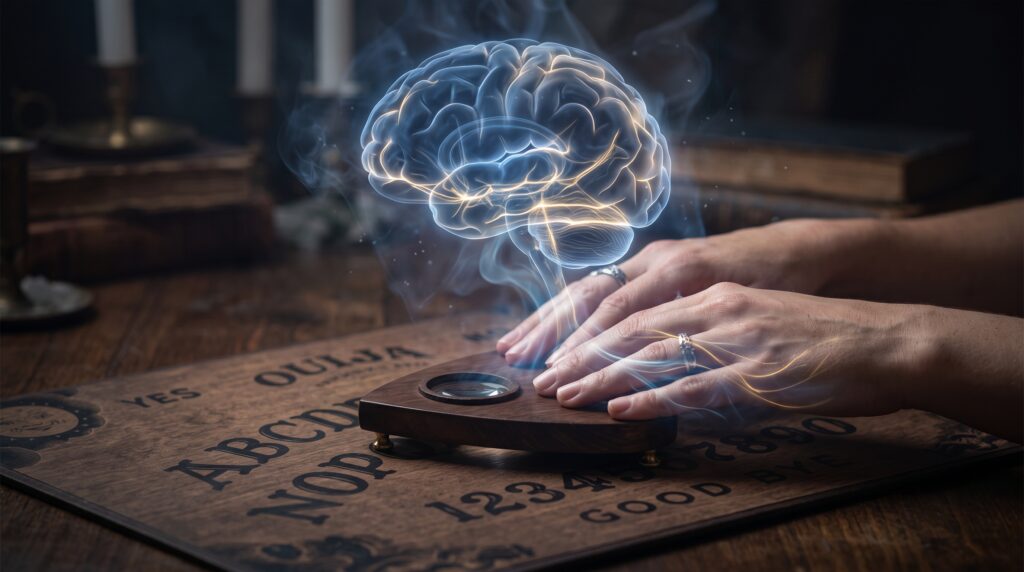
The scientist wins the mechanism and then loses the argument that it was ever simple. Yes, the players move the planchette. But those movements retrieve knowledge the players cannot consciously access. Two people’s predictions converge into messages neither one composed. A housewife with little formal education produced a 644-page novel this way. A poet produced 560 pages of cosmology.
Where the Magic Actually Lives
The standard skeptical script says it is only the ideomotor effect, so there is nothing to see here.
That script gets the emphasis exactly backward.
Consider what the debunking actually claims. Your muscles execute instructions you never issued. A hidden layer of your mind holds facts your conscious self cannot retrieve. It will hand them over if you can be tricked into thinking someone else is driving. Your sense of authorship over your own hands is not a direct readout but an inference, and it can be wrong. Two people can generate coherent language together without either one choosing the words.
None of that is reassuring. A ghost would be simpler. A ghost is an external visitor you could, in principle, refuse to invite. (The same unconscious machinery drives Old Hag Syndrome, where the brain generates a threatening presence during sleep paralysis.) The research describes a permanent tenant that operates your body, knows things you do not, and keeps secrets from you.
The talking board is a psychological mirror with a very specific design feature. It reflects the parts of yourself that ordinary mirrors cannot show, and it does it by convincing you that you are looking at somebody else.
The Direction the Planchette Points
Fourteen hundred years of this practice. A Chinese sand tray and a willow stylus. A French pencil on casters. A Baltimore patent clerk demanding proof. A blindfolded volunteer in Vancouver scored above chance. Eye trackers in a Baltimore conference room recording two people converging on a word neither one chose.
Different centuries, different cultures, different hardware, and the same result every time. Something answers.
The lasting question was never whether the answer was real. The answers are real. Patience Worth’s novel exists. Sandover exists. The 65 percent accuracy rate exists. The question has always been about the return address.
Every piece of evidence points to the same place. It does not point outward, past the wall, into whatever comes after. Downward and inward, through the floor of your attention. It points into the enormous unlit part of you that does most of the work and has never once been asked its name.
The planchette is not a pointer to the other side. It is a needle, and it swings toward the strangest thing in the room, which is the mind of whoever is touching it.
Say goodbye if it makes you feel better.
Frequently Asked Questions About Ouija Boards
Ouija boards do produce real, coherent messages, so in that sense they work. The messages do not come from spirits. They come from the ideomotor effect, unconscious muscle movements first documented by physiologist William Benjamin Carpenter in 1852. Michael Faraday proved in 1853 that the sitters, not any outside force, move the pointer. The board works. The mechanism is your mind.
It does not move on its own. The players move it without realizing they are doing it. Your muscles can act on an expectation before your conscious mind registers the intent. Because you never feel yourself pushing, your brain assigns the motion to an outside agent. Faraday demonstrated this phenomenon with a simple two-board device that showed the hands moving first, every time.
This is the strangest and best-documented part. A 2012 University of British Columbia study blindfolded participants and let them believe a partner was helping. When asked general knowledge questions that they rated as pure guesses, participants answered correctly 65 percent of the time through the board, compared to 50 percent when speaking. Your mind stores knowledge your conscious self cannot retrieve, and the planchette can reach it. Researchers call this implicit semantic memory.
Not demonic, but there is still some risk. A 2025 study in Psychology of Consciousness measured the effects directly. People who believe in the paranormal left a session 25.5 percent more anxious than nonbelievers, with more dissociation and more anomalous experiences. The danger is psychological rather than supernatural. If a session leaves you frightened or shaken for more than a short while, speaking with a doctor or mental health professional is a sensible step.
Folklore says something bad happens. What actually happens is nothing at all. Alone, your conscious mind knows every movement is yours and refuses to let go, so the pointer sits still. The unconscious system needs to believe someone else might be steering. The UBC researchers had to fake a second player to make solo play work at all. The rule exists because playing alone is disappointing, not dangerous.
Businessmen in Baltimore trademarked it in 1890 and patented it in 1891 as US Patent 446,054, classified as a toy. The men behind it were capitalists, not spiritualists. Its deeper roots run through French planchette writing of the 1850s and, much further back, Chinese fuji spirit writing recorded as early as the fifth century CE. The alphabet-card design came from Ohio spiritualist camps around 1886.
The popular claim that it combines the French oui and German ja is almost certainly a later invention. The likelier source is a locket worn by medium Helen Peters during the naming session. It held a portrait of the English novelist Ouida, and the name above it was probably misread off the board as Ouija. The company later said the board named itself and meant good luck.
Zozo is a modern internet legend with a precise birthday. A man named Darren Evans posted about the entity on March 24, 2009, and the story went viral. Its supposed ancient pedigree in an 1818 French demon encyclopedia falls apart upon inspection. That source describes a girl who, in the author’s own words, wanted to pass herself off as possessed. Zozo is folklore acquiring a fake history, not an ancient demon.
Loosely. The 1949 case behind the film involved a boy, later identified as Ronald Hunkeler, whose spiritualist aunt taught him the board before her death. Later investigation found much of the popular account unreliable, including the location and the famous voice changes. The 1973 film then permanently transformed the board’s image from a wholesome parlor game into an occult doorway.
Believers treat goodbye as a way to end the session and dismiss the spirit. Read through a psychological lens, it is a closing ritual, the mental equivalent of turning the lights back on. It marks the end of the altered, suggestible state the session creates. The rule does real work, just not the work folklore assigns it.
References
UBC Computer Science: Dr. Ronald Rensink on the Ouija board research
British Psychological Society Research Digest on the Aarhus eye-tracking study
ScienceNordic: How Ouija boards really work
Quackwatch: How People Are Fooled by Ideomotor Action (Ray Hyman)
1911 Encyclopaedia Britannica: Table-turning and the Faraday apparatus
Faraday, “Experimental Investigation of Table-Moving,” contemporary reprint
Wikipedia: Fuji (planchette writing)
FYSK Daoist Culture Centre: Planchette Writing
The Strong National Museum of Play: Investigating the History of the Ouija Board
Baltimore Magazine: The Dark and Fascinating History of the Ouija Board
SFO Museum: The Mysterious Talking Board, Ouija and Beyond
King Patent Law: Patenting the Paranormal, the History of US Patent 446,054
Wikipedia: Helen Peters Nosworthy
History Hit: The Strange History of the Ouija Board
Skeptical Inquirer: Demoniac, Who Is Roland Doe, the Boy Who Inspired The Exorcist?
Wikipedia: Exorcism of Roland Doe
Stranger Dimensions: Zozo, the Ouija Board Demon That Stumbled Into a Horror Film
New England Folklore: ZoZo the Demon in Massachusetts
Public Domain Review: Ghostwriter and Ghost, the Strange Case of Pearl Curran and Patience Worth
Psi Encyclopedia: Pearl Curran (Patience Worth)
Smithsonian Magazine: Patience Worth, Author From the Great Beyond
The Skeptic’s Dictionary: Patience Worth and Pearl Lenore Curran
Wikipedia: The Changing Light at Sandover



[…] tools of spirit communication also grew; within decades it produced mass-market devices like the Ouija board, whose origins trace directly to the spiritualist movement the Fox sisters ignited. The movement […]
[…] owners are common focal points for activity. The use of so-called divination tools, such as the Ouija board, can also invite unwanted presences into a […]
[…] No wonder the arrangement unsettles us. Both the lore and the ritual point to the same doorway. The Ouija board operates on the same principle: a tool designed to suspend conscious control and let something else […]