The infinite hallway in your hallway has haunted human imagination for a very long time.
The Corridor With No End
Stand between two mirrors hung on opposite walls. Your reflection splits, then repeats, shrinking into a tunnel that seems to run forever. Most people feel a small jolt of unease about that endless corridor.
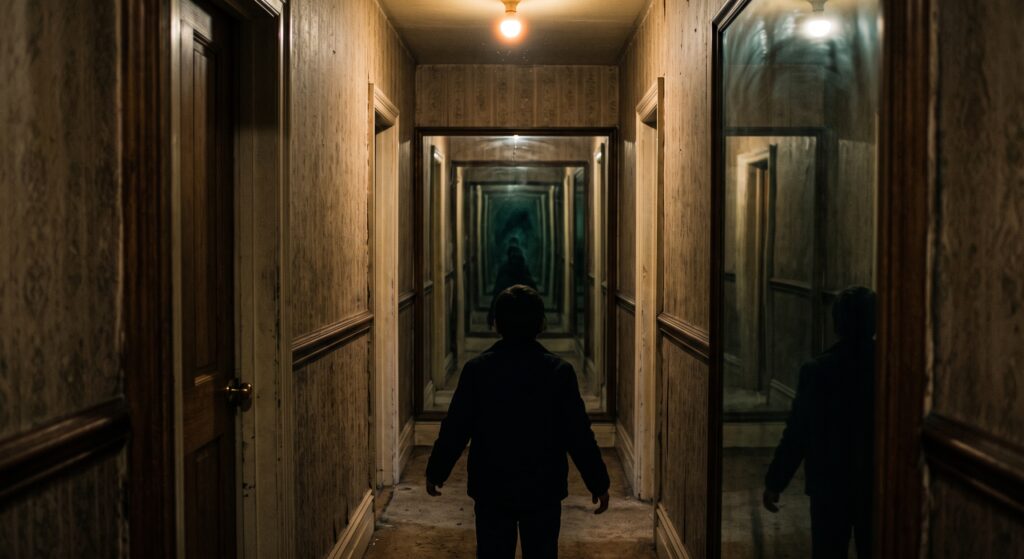
You may have noticed this arrangement in your own home. A bathroom, a narrow hall, or a bedroom where two mirrors happen to line up. And you may have heard the warning that follows: never let mirrors face each other, or you open a door. What exactly waits on the other side of that door is the question people cannot stop asking.
The unease is nearly universal, which is itself worth noticing. People who scoff at ghosts still feel it. They pause between the mirrors, sense the endless repetition, and quietly step aside. The reaction runs deeper than belief, and understanding why means separating three things: the claim, the physics, and a forgotten ritual.
What the Lore Actually Claims
The paranormal theory is specific. Two facing mirrors create an infinite reflection, and that infinity supposedly forms a vortex. Spirits use it to enter a home or, worse, become trapped inside it, pacing the endless glass.
One popular framing puts it bluntly. Place two mirrors together in a dark room, and you build a passage through which spirits slip between dimensions. Some who pass through, the story warns, never find the way back.
Occult and witchcraft circles lean on a related idea. Mirrors reflect energy, and spirits are energy, so two mirrors keep that energy flowing in an unbroken loop. The loop, they say, is what an entity climbs through.
Practical advice grows from the theory. Keep one mirror per room, some suggest, so you can cover it easily if the space ever feels wrong. Others recommend never hanging a mirror opposite a window, treating both surfaces as thresholds that should not align. The remedies vary, but the underlying worry stays fixed on that endless reflection.
Why the Fear Feels So Real
Skeptics answer with physics, and it is genuinely elegant. Light bounces between the two surfaces, losing a sliver of brightness at each pass. The images shrink below what your eye can resolve, and the corridor only seems to vanish into forever.
Here is where the dread sneaks in. Tiny movements of your head shift which faint copy you notice. Your brain hunts for a stable point of focus and never finds one. That perceptual glitch, one analysis notes, is fertile ground for superstition even when nothing paranormal occurs.
In other words, the discomfort is real even if the vortex is not. Your nervous system reacts to the endless regress before your reason can explain it away. The fear arrives first.
The Ritual Hiding in Plain Sight
Now for the twist most articles miss. The facing-mirror setup is not only a superstition. It closely resembles a deliberate practice used to contact the dead.
Researcher Raymond Moody revived an ancient technique he called the psychomanteum, a dim chamber built around a mirror and controlled reflection. The practice has deep roots: John Dee’s obsidian mirror, used by Queen Elizabeth I’s court astrologer to communicate with angels, operates on the same principle of a darkened reflective surface as a portal. Sitters gaze into the glass in low light, hoping to glimpse departed loved ones. The method depends on the same ingredients the folklore fears: a mirror, darkness, and a fixed, unbroken stare.
That overlap reframes the whole warning. People who accidentally create a facing-mirror corridor may be building, without knowing it, a crude version of a scrying chamber. No wonder the arrangement unsettles us. Both the lore and the ritual point to the same doorway. The Ouija board operates on the same principle: a tool designed to suspend conscious control and let something else steer.
Should You Rearrange Your Room?
Belief decides the answer. No controlled study has ever caught a spirit crossing a mirror. If you hold to the physics, two facing mirrors are just a lovely optical trick and nothing more.
Yet many people report a shift in the feel of a space once they turn one mirror aside. Feng Shui traditions treat facing mirrors as restless energy bouncing between amplifiers and advise against this layout for comfort rather than safety.
So if the corridor bothers you, move a mirror. You lose nothing, and you quiet the part of your mind that keeps checking the glass. If it fascinates you instead, you have a small, ancient mystery hanging on your wall.
Why Mirrors Draw the Fear at All
Facing mirrors amplifies a dread that mirrors already carry. Across cultures, reflective surfaces sit at the edge of the ordinary world. Some mirrors carry that dread as physical objects — the Bela Lugosi mirror is one of the most famous examples of a supposedly cursed reflective artifact. They show a room that looks real yet cannot be entered. That contradiction unsettles people long before any vortex enters the story.
Folklore treats mirrors, windows, and still water as thresholds, the same category as doorways. Each marks a line between here and elsewhere. Traditions that fear the dead often warn against these surfaces, because a boundary is precisely where something might cross.
Two facing mirrors take that single threshold and stack it on itself. Instead of one doorway, you seem to face an infinite hallway of them. If a lone mirror worries the superstitious, a corridor of endless mirrors worries them far more. The math of the fear simply multiplies.
This is why the warning attaches so easily. The layout hands the imagination a ready image: a passage with no visible end. The mind supplies the rest, filling that depth with whatever it already dreads.
The Practical Verdict
Strip the lore to its core and you find a choice about comfort, not safety. Nothing in the physics of two mirrors can harm you. The endless corridor is light behaving exactly as it must.
Yet comfort has real value in a home. A layout that keeps snagging your attention or leaves you feeling watched in your own bathroom earns a rearrangement on those grounds alone. You need no belief in spirits to justify turning a mirror aside.
It also helps to know that the psychomanteum connection works both ways. The same setup that unsettles a homeowner is one a researcher builds on purpose. If a controlled scrying chamber produces vivid visions in willing sitters, an accidental version in your hallway can nudge an anxious mind in the same direction. The room shapes the experience more than any ghost does.
The deeper lesson is about how legends take root. A genuine optical oddity meets an ancient fear of thresholds, and the two fuse into a warning passed from hand to hand. The corridor was always just light. The dread was always just us. For more warning signs tied to reflective surfaces, see our guide to haunted mirror signs.
References & Further Reading
The Mirror Ghost: Never Face Mirrors Together (Medium)
SpiritShack: Are Mirrors Portals?
Two Mirrors Facing Each Other: Feng Shui, Portals, and Physics
[…] The mechanism, in this framing, is the deliberate suspension of will. Ouija users are told to relax, to stop steering, and to let the planchette move on its own. That instruction is the crux. Theologically, the will is a person’s protective boundary. Voluntarily setting it aside is what creates the opening. (For a related look at how folklore frames reflective surfaces as portals, see our piece on two mirrors facing each other.) […]