In 2001, a man named Ted started a blog about a cave near his home. Post after post, he and his friends documented what they found inside: strange hieroglyphs, unidentifiable sounds, a steadily growing sense that something was wrong. Then the updates stopped. The final entry offered no explanation. Ted appeared to have simply disappeared.
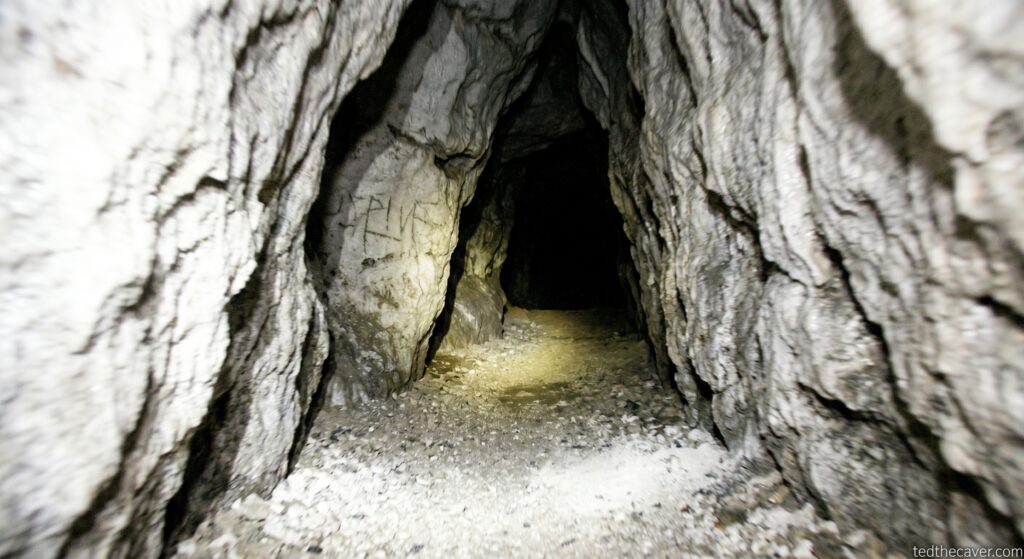
Thousands of readers who found the blog believed it was real. The site is still online. Ted the Caver, as the story became known, is widely regarded as one of the first creepypastas, a genre of horror that grew from the early internet and now functions as one of the most dynamic forms of contemporary folklore in circulation.
This is the story of how that genre works, where it came from, and why people keep copying, pasting, and believing it.
Where the Word Comes From
The term “creepypasta” derives from “copypasta,” internet slang for blocks of text copied and pasted repeatedly across forums and message boards. Horror stories began circulating through this same mechanism in the early 2000s, typically anonymous, typically formatted to look like firsthand accounts, and typically shared without attribution or source. The horror, combined with the method of transmission, produced the name.
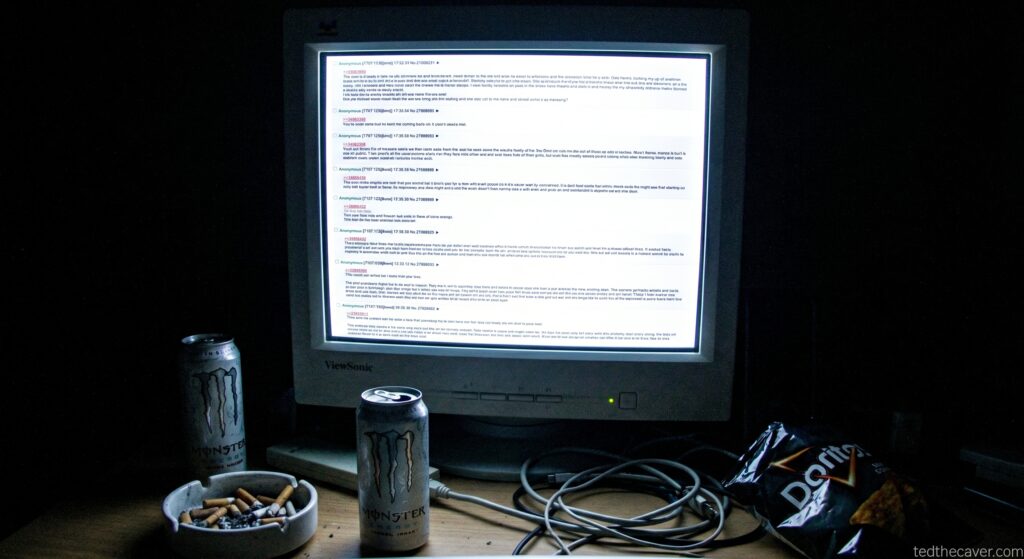
The early content lived mostly on 4chan, particularly its paranormal-themed board known as /x/. The culture of /x/ shaped the genre in important ways: stories were anonymous, attribution was rare, and the lack of a traceable origin made them feel as though they had always existed, like an old legend passed from person to person until the source was irretrievable.
The Folklore Mechanics Inside the Format
Folklorists who have studied creepypasta point out that it functions like a digital-age campfire story, but with a structural advantage over oral tradition. In oral transmission, stories mutate and simplify over generations. In digital transmission, every version can survive simultaneously, and readers can access multiple variations at once.
What the formats share is the fundamental logic of the friend-of-a-friend urban legend: claim truth, attribute the experience to a proximate source, embed the story in recognizable ordinary life, and leave enough ambiguity that the audience cannot quite disprove it. Early creepypastas were designed to be believed. They deployed details, timestamps, photographs, and follow-up posts to mimic the texture of real documentation.
Ted the Caver worked because it looked like a real blog. Its photo documentation of cave exploration gave the story a material anchor. The ambiguous ending left the closure loop open, which is precisely the mechanism that keeps a story circulating. An incomplete story is cognitively unfinished, and the brain returns to things that are unfinished.
The Explosion: Slender Man and the Shared Mythology Period
Between 2008 and 2012, creepypasta moved from forum subculture to mainstream phenomenon. The hinge point was Slender Man, created in 2009 by a user named Eric Knudsen in a Photoshop contest on the Something Awful forums. Knudsen produced two images of a tall, faceless, suited figure among groups of children, along with fabricated historical captions suggesting the entity had appeared in photographs for decades.
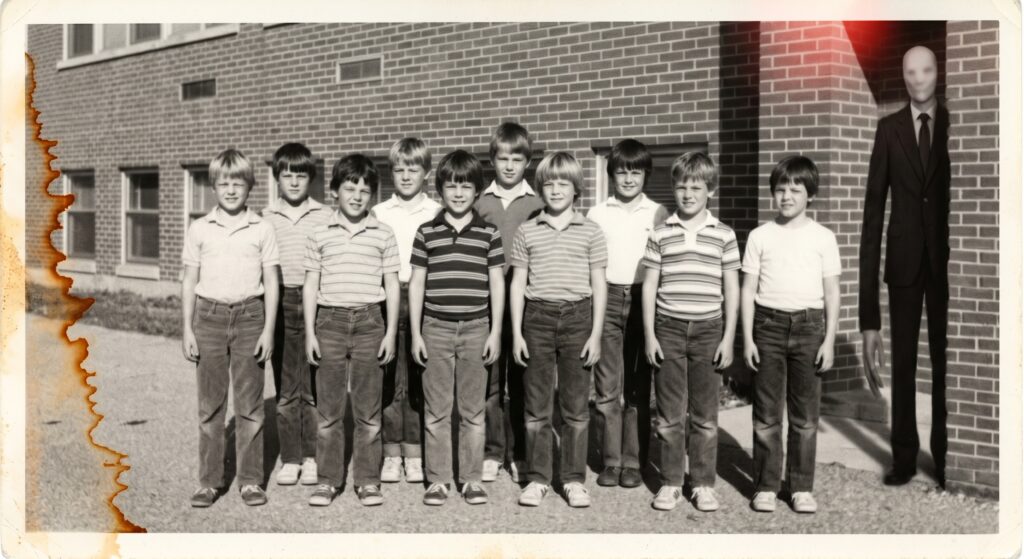
Unlike earlier creepypastas, Slender Man was immediately expandable. With no fixed canon, the character allowed every contributor to add to the mythology. Stories multiplied. Fan art spread across Tumblr and DeviantArt. The YouTube series Marble Hornets created an ongoing found-footage narrative. Video games appeared. Within three years, a figure invented for a photo contest had a mythology richer than many published fictional universes.
That scalability is creepypasta’s most distinctive quality. Traditional folklore settles into recognizable forms over generations. Creepypasta destabilizes constantly. Each repost is potentially a revision. Each adaptation adds elements. The story does not converge; it branches.
Why People Believed, and Why That Belief Had Consequences
In 2014, two 12-year-old girls in Wisconsin lured a classmate into the woods and stabbed her 19 times, claiming they wanted to prove Slender Man was real and earn his approval. The victim survived. The case forced a public reckoning with a question the creepypasta community had largely avoided: what happens when the fiction-reality boundary blurs for an audience that has not finished developing the cognitive tools to locate it?
The incident did not discredit the genre, but it exposed a genuine tension in creepypasta’s design. Stories built to feel real, spread through channels that blur authorship and provenance, and consumed by audiences without institutional context, can be mistaken for documentary evidence. The genre’s strength, its mimicry of credibility, is also its risk.
Folklorists have noted that younger audiences, who encounter creepypasta without the cultural framing that marks it as fiction, are most vulnerable to this confusion. The same quality that makes a story effective as horror makes it dangerous as misinformation.
The Evolution: SCP, Analog Horror, and What the Genre Became
After the Slender Man incident and the broader cultural reckoning that followed, creepypasta evolved. The community became more attentive to authorship. Stories began to be credited. The emphasis shifted from anonymous mimicry of reality toward openly fictional horror that used internet formats as a narrative tool.
The SCP Foundation, which began in 2008 on the 4chan /x/ board, represents the genre’s most sustained evolution. SCP entries are formatted as internal documents of a fictional organization that contains anomalous phenomena. The bureaucratic language, procedural formatting, and clinical tone produce horror through implication rather than explicit description. The project now contains thousands of entries written by hundreds of contributors, making it one of the largest collaborative fiction projects on the internet.
Analog horror represents another branch: video content formatted to resemble corrupted broadcast footage, public access television, or degraded VHS recordings. The Backrooms, originally a single-sentence post describing the experience of clipping through the walls of ordinary reality into an endless expanse of fluorescent-lit office carpet, became a franchise with found-footage films, video games, and a 2026 feature film from A24.
The campfire got bigger. The stories kept spreading.
What Creepypasta Tells Us About Fear in the Digital Age
Every generation builds horror out of its most immediate anxieties. The Satanic Panic of the 1980s showed how quickly paranormal rumors can spiral into real-world harm. Gothic fiction feared ruined aristocratic estates and the decay of old social orders. Pulp horror of the mid-20th century feared nuclear contamination and alien invasions. Creepypasta fears what the internet itself introduced: anonymity, institutional unreliability, the impossibility of verifying sources, and the sense that something is hidden just beneath the surface of ordinary documented life.
The haunted video game cartridge is a story about a familiar consumer object that turns hostile. The found footage is a story about documentation that reveals rather than reassures. The entity that appears in photographs across history is a story about the impossibility of trusting visual records. These are not arbitrary choices. They are the fears of people who grew up online and learned that information is not the same as truth.
Whether you read creepypasta as horror fiction, digital folklore, or cultural evidence, one thing is clear: it is not going away. As long as the internet exists, people will copy, paste, and add to what they find. The cave is still there. The updates have just moved to different platforms.
References & Further Reading
SCAN: Creepypastas: Horror Folklore for the Digital Age
Urban Legends Mystery and Myth: What Is Creepypasta?