The hotel’s death toll keeps climbing in retellings, but the math never quite adds up.
A Hospital Built to Survive Everything
In 1917, a copper blast beneath Jerome shifted the ground and cracked open the town’s hospital. Officials decided the next one needed to survive anything the mines could throw at it.
Workers finished the United Verde Hospital in 1927 on the steep slope of Cleopatra Hill. Engineers made it fireproof and earthquake resistant, with call lights, X-ray equipment, and a state of the art Otis elevator. By 1930, it ranked as the most modern hospital in Arizona.
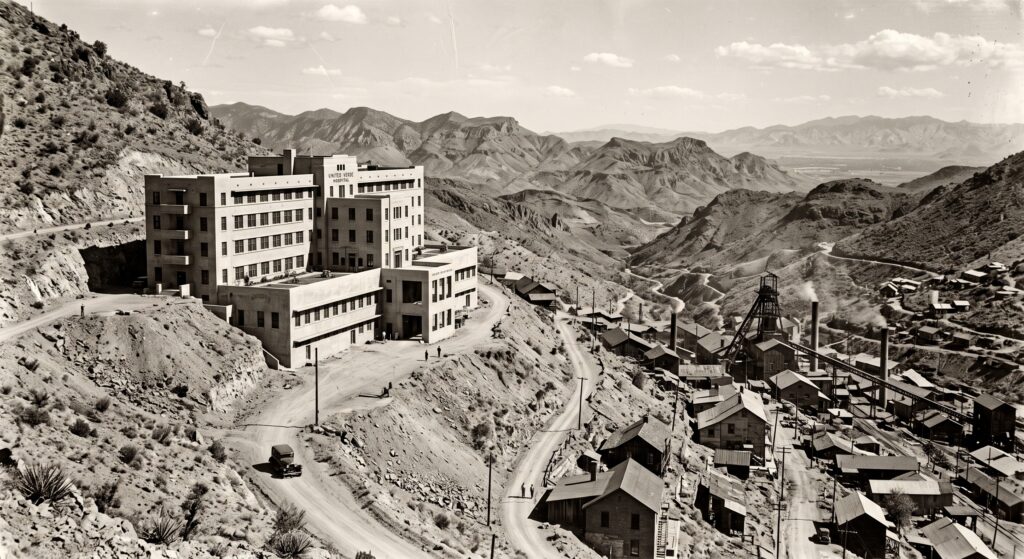
The building served over fifteen thousand miners and their families at Jerome’s peak. When copper prices collapsed during the Great Depression and land subsidence began cracking buildings across town, the population crashed too. The hospital closed in 1950, and Jerome’s population fell below one hundred within a few years.
Owned first by the United Verde Copper Company and later by the Phelps Dodge Mining Corporation, the hospital represented a massive investment for its era. It stood as the single largest civilian building the town’s dominant employer ever financed. Its scale still dwarfs most other buildings on the hillside today.
The Death Toll That Keeps Growing
Ghost tour scripts frequently claim that nine thousand people died inside the hospital during its twenty seven years of operation. That number gets repeated constantly, and it rarely gets questioned.
It should be questioned. Jerome’s peak population was roughly fifteen thousand, spread across mining families who mostly needed care for injuries, not death sentences. Even one paranormal research site that repeats the nine thousand figure admits the number seems unlikely given the town’s size and the hospital’s lifespan.
Averaged out, nine thousand deaths would mean roughly one death every single day for twenty seven straight years. That pace makes little sense in a hospital built primarily to treat mining injuries and tuberculosis. No hospital records support it, and no source has ever produced a citation for where the figure originated.
The real number is almost certainly much smaller, though still significant given the dangers of hard rock mining. Exaggeration does not erase the genuine suffering that happened here. It just makes the true story harder to find underneath the inflated one.
Mining injuries in this era commonly included crushed limbs, respiratory damage from dust, and burns from smelting accidents. A hospital treating that steady stream of trauma for nearly three decades would have seen real, sustained death. It never needed to reach nine thousand to justify its haunted reputation.
Claude Harvey and the Elevator That Never Explained Itself
One death at the hospital is thoroughly documented, if not fully explained. On April 3, 1935, maintenance man Claude Harvey was found pinned by his neck under the hospital’s Otis elevator.
An autopsy might have clarified what happened. None was performed. The United Verde Copper Company reportedly wanted to avoid liability and the controversy a full investigation might bring, so Harvey’s cause of death went undetermined.
That gap in the record is exactly what allowed the legend to grow. Ghost tours now describe Harvey as murdered, his body staged beneath the elevator to disguise foul play. The claim makes for a better story than the honest answer, which is that nobody performed the work needed to know for certain.
Staff on the graveyard shift still report a shadowy figure near the boiler room, sometimes coughing and sometimes climbing the stairs as though still on duty. Whatever happened to Harvey, his presence remains one of the hotel’s most consistently reported hauntings.
What the Hotel Actually Inherited
When Larry Altherr converted the abandoned hospital into the Jerome Grand Hotel in 1996, he kept the original elevator and boiler. Strange reports started almost immediately, even while most rooms sat unfinished.
Guests describe gurney wheels rolling down empty hallways, labored breathing near the old surgical wing, and a phantom cat that curls up on occupied beds. A woman in a nurse’s uniform reportedly glides near Suite 35, once a maternity room, though no hospital record confirms Jerome ever ran a dedicated pediatric ward.
A man in a long lab coat, apparently still carrying a clipboard, has been seen making rounds on multiple floors. Guests describe him as calm and purposeful, moving the way any doctor might move through a hallway on any ordinary night shift.
None of these details need an inflated body count to feel unsettling. A cliffside hospital treated the injuries of an entire mining boom for nearly three decades. It then sat largely forgotten for over forty years before reopening its doors, and that alone carries plenty of weight.
The real story of Jerome is not about nine thousand deaths. It is about a town that built a fortress against disaster, then watched the industry that justified it disappear almost overnight.
That fortress still stands on Cleopatra Hill today, repurposed but structurally intact, a rare survivor among the boom and bust towns that once dotted the Arizona hills.
A Town That Outlasted Its Own Industry
Jerome itself nearly vanished, along with its hospital. By the mid-1950s, the population that had once topped fifteen thousand had shrunk to under one hundred people clinging to a hillside town with no remaining industry.
A resurgence began in the late 1960s, when Jerome earned a spot on the National Register of Historic Places. Artists and shopkeepers moved into the empty buildings, and festivals began drawing visitors back to streets that had gone quiet for a generation.
The hospital took longer to find new purpose. It sat empty for over four decades before Altherr’s renovation, untouched except by vandals and the occasional curious trespasser during the building’s most desolate years.
That long emptiness may explain part of the hotel’s reputation today. A structure abandoned for four decades held the memory of thousands of genuine patients, even without the inflated number. It had plenty of time to accumulate its own kind of silence before anyone asked it to host guests again.
Visitors who arrive expecting nine thousand ghosts will not find them. What they will find is a building that spent most of the twentieth century quietly outliving the industry that built it. That history alone is worth the climb up Cleopatra Hill.
The Asylum Restaurant inside the hotel today borrows its name from the building’s medical past rather than any documented psychiatric use. It is a marketing choice that blends genuine history with a bit of dramatic license, much like the hotel’s ghost stories themselves.
For more on this topic, see our complete guide to the The Most Haunted Places in America: A State-by-State Guide.
References & Further Reading
Jerome Grand Hotel Ghost Left By Fatal Crushing, Haunted US
Jerome Grand Hotel: A Haunted Historic Landmark, Paranormal Traveler