You are falling asleep. The room is quiet and dark. And then, from somewhere inside your skull, a sound: a crack like a gunshot, a boom like a door slamming on empty air, a crash of breaking glass that leaves no broken glass. You are instantly, completely awake, your heart hammering, scanning the room for what happened. Nothing happened. Nothing is there. And somewhere between the certainty of the sound and the absence of any cause, the idea of a ghost becomes more plausible than it was before you went to bed.
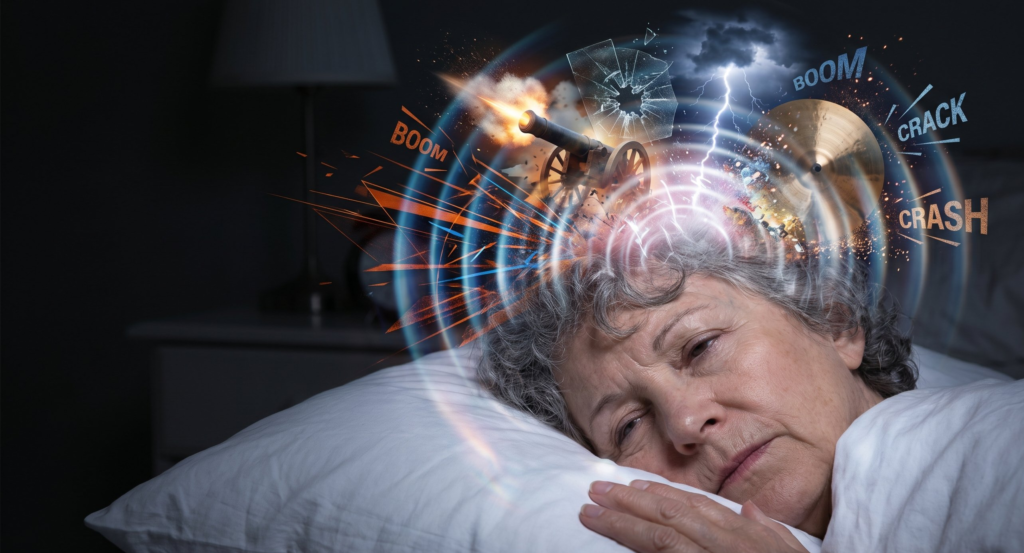
Exploding Head Syndrome, or EHS, is a sleep disorder affecting approximately one in ten people at some point in their lives. It is benign, not associated with any serious underlying condition, and genuinely strange. It also sits in an overlooked but significant relationship with paranormal experience: the sounds it produces, in the environments where they occur, create the precise perceptual conditions for haunted house belief.
What Exploding Head Syndrome Actually Is
EHS is classified as a parasomnia, a group of unusual experiences that occur during transitions between sleep and wakefulness. It consists of a sudden, very loud auditory hallucination experienced at sleep onset or awakening, typically lasting less than a second. The sound is perceived as originating inside the head rather than outside it, though many people describe it as filling the room. Common descriptions include a loud crack or bang, a gunshot, a cymbal crash, an explosion, the sound of breaking glass, a thunderclap, or crackling electricity.
Neurologist Silas Weir Mitchell first described the condition in medical literature in 1876. It was not officially classified as a sleep disorder until 2005. Current research suggests the mechanism involves the reticular activating system in the brainstem, which manages the transition between wakefulness and sleep. As the brain shifts state, there may be a brief, aberrant firing of neurons associated with auditory processing, producing the hallucinated sound without any external stimulus. The process is analogous to a hypnic jerk, the sudden muscle twitch many people experience at sleep onset, but in the auditory system.
Why EHS Sounds Paranormal
EHS occurs in the dark, in silence, in a state of reduced consciousness, in a room where you are alone or nearly alone. These are precisely the conditions that maximize the likelihood of interpreting an unexpected sensory event as supernatural. The sound is loud enough and specific enough to be fully convincing as an external event: most people who experience EHS for the first time get out of bed and check the house and may wake other people to ask whether they heard anything.
When no source is found and no other person heard the sound, the options the experiencing person faces are they imagined it (which their sensory certainty resists), something is wrong with their hearing (which will typically be ruled out), or something in the environment produced a sound that no one else perceived. That third option maps directly onto paranormal frameworks of event-specific, witness-specific auditory phenomena. EHS may be responsible for a significant but unmeasured proportion of reported paranormal sound events in supposedly haunted locations, particularly during overnight investigations where investigators are tired and at sleep onset.
What Triggers EHS
Research identifies stress, fatigue, irregular sleep patterns, caffeine consumption, and anxiety as the primary triggers for EHS episodes. Overnight paranormal investigations combine most of these factors: unfamiliar environment, physical fatigue, elevated anxiety and alertness, and frequently caffeine. An investigator who experiences a loud bang during an overnight investigation in a reportedly haunted location, finds no physical cause, and does not know about EHS, has a genuinely difficult perceptual puzzle to solve. EHS is the most parsimonious explanation for many such reports.
Distinguishing EHS from External Sounds
EHS produces a sound with no physical consequences: no objects are moved, no physical impact, no broken glass, and no door that has actually opened or closed. The sound is perceived as originating inside the head or filling the room without direction. It occurs specifically at the threshold of sleep or waking, not during a period of full alertness. If you experience what sounds like an explosion while you are fully awake, moving through a building, and engaged in normal activity, that is worth investigating. If you experience it at the moment of falling asleep, it is almost certainly EHS.
References & Further Reading
• ScienceAlert: Exploding Head Syndrome Explained
• National Geographic: Exploding Head Syndrome
• The Conversation: Exploding Head Syndrome
• NCBI/NIH: Exploding Head Syndrome, StatPearls
• Healthline: Exploding Head Syndrome