The engineer on the Louisville and Nashville Railroad line outside Bowling Green, Kentucky, heard it first: the shriek of a steam whistle on a track that carried no scheduled traffic that night. Then came the sound of wheels on rails, the groan of metal brakes, and the smell of burning coal. He waited. Nothing came. But those who lived near that stretch of line kept reporting the same sequence of sounds on the same foggy nights, always on the anniversary of the derailment that had killed the original crew decades before.
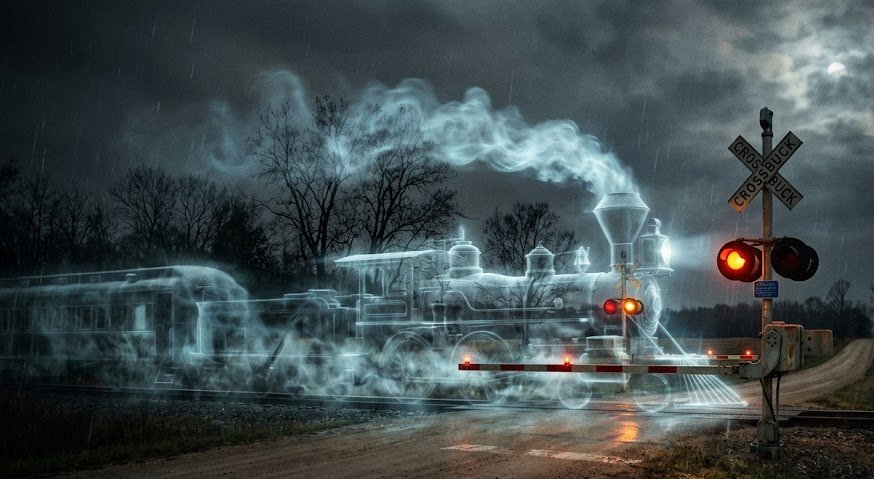
Phantom trains occupy a specific corner of American paranormal folklore that is older than the automobile, broader than any single legend, and more grounded in documented historical tragedy than most ghost story categories. The railroad era was built on catastrophe. The conditions that produced those catastrophes also produced some of the most persistently reported residual haunting accounts in the country.
Why Railroads Generate Ghost Stories
The steam railroad era, roughly 1830 to 1950, was characterized by an accident rate that would be considered catastrophic by modern standards. Track failures, bridge collapses, boiler explosions, grade crossing accidents, and derailments killed thousands of workers and passengers across the country’s expanding rail network. Each major accident left behind a location, a date, a set of circumstances, and a community of bereaved people who needed a way to process what happened. Paranormal folklore provided that framework: the train that keeps running because the crew does not know they are dead; the whistle that sounds on the anniversary of the disaster; and the light at the end of the abandoned track.
Paranormal investigator and author Matthew Swayne, whose book Haunted Rails documents accounts from 19 US states, identifies the residual haunting explanation as the dominant framework in railroad ghost lore. The theory holds that a traumatic event can imprint itself on a location, replaying like a recording under specific conditions. Railroad hauntings fit this model particularly well: the sounds are specific and repeatable, they follow the same sequence, and they do not interact with witnesses. They simply run.
The Lincoln Funeral Train
The most famous American phantom train legend involves Abraham Lincoln’s funeral train, which carried his body from Washington D.C. to Springfield, Illinois in April and May of 1865. The route covered over 1,600 miles across seven states, with stops for public viewing in major cities. According to the legend, which has been documented in newspapers since the late 19th century, a spectral version of the train makes the same journey every year around the anniversary of Lincoln’s assassination. Witnesses near the route have reported stopped clocks, paralyzed watches, and a dark train running silently through the night, its windows glowing with an otherworldly light.
No physical evidence for the phantom Lincoln train has ever been produced. The legend’s power comes not from documentation but from the emotional weight of the original journey: a nation in shock, a train carrying the body of its most beloved president, moving through hundreds of miles of grieving crowds. That kind of collective grief leaves a mark in cultural memory, and cultural memory has a way of manifesting as reported experience.
The Marshall Pass Phantom Express
One of the most specifically documented American railroad ghost accounts involves the Denver and Rio Grande Western Railroad at Marshall Pass, Colorado, which crosses at approximately 10,800 feet. In the late 19th century, engineer Nelson Edwards reported hearing a whistle and feeling his brake gong sound with no visible train ahead. He stopped and waited. Nothing came. He proceeded and shortly after passed a section of defective rail and an unsafe bridge that had been reported earlier but not yet repaired. The phantom signal, whatever its source, may have prevented a disaster. The story appears in Legends of America’s documented archive and represents a variant of railroad ghost lore in which the apparition functions as a warning rather than a residual replay.
The St. Louis Light and the Problem of Evidence
The St. Louis Light in Saskatchewan, Canada is a well-documented example of a ghost train light that attracted serious scientific investigation. Visible on a stretch of old abandoned railroad track between Prince Albert and St. Louis, the light has been reported for decades and has become a significant local attraction. Two University of Saskatchewan physics students investigated the phenomenon and determined that the light is produced by diffraction of distant vehicle headlights on Highway 355, bent and focused by atmospheric conditions toward the abandoned track. Their work won a prize. And yet, by almost all accounts, people continue to visit and continue to report the light as unsettling. The scientific explanation and the emotional experience of the place have not fully resolved each other.
Residual Haunting or Something Else
The railroad ghost category is worth taking seriously precisely because the case for residual haunting is stronger here than in most paranormal categories. The sounds are specific and reproducible. They correlate with documented historical events. They appear under consistent atmospheric conditions. They do not interact with witnesses. If you accept the theoretical framework of residual energy recording at all, the train whistle on an anniversary night is a better candidate for a genuine phenomenon than most of what ghost hunting TV produces. Whether that framework is scientifically valid is a separate question. What is not in question is that thousands of independent witnesses, over more than a century, have reported the same sounds at the same locations on the same dates.
References & Further Reading
• American Association of Railroads: All Aboard the Ghost Train
• Legends of America: The Phantom Train of Marshall Pass
• Historic Railpark: The Haunting of the L&N Line
• Wikipedia: Ghost Train Folklore
• Legends of America: Ghost Children of San Antonio’s Railroad Tracks


[…] Phantom Train Stories in America: Haunted Tracks, Lights, and Lost Passengers […]
[…] Phantom Train Stories in America: Haunted Tracks, Lights, and Lost Passengers […]