How a melancholy president read his own nightmares as maps of what was coming, and why history still argues about them
Abraham Lincoln kept a copy of Macbeth close during the war’s darkest months. He read the murder of a king aloud, late at night, to anyone who would listen. Senator Charles Sumner remembered the caverned eyes and the ghostly pallor. The president looked, one visitor said, like a man already half in another world.
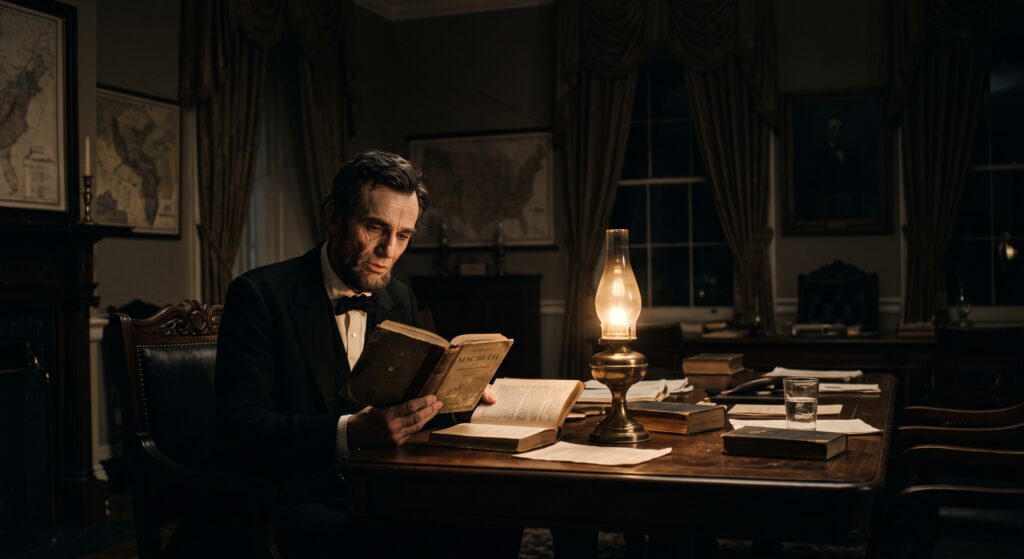
Here is the strange part. Lincoln did not treat dreams as messages from God. He treated them as natural warnings, as the mind senses a storm before the sky cracks. That distinction matters. It turns a superstitious man into something more unsettling: a rationalist who believed his sleep could forecast the future. And in the spring of 1865, his sleep grew loud.
What did the dreams show him? One promised peace. One showed a corpse in the East Room. Historians still cannot agree on which of the two was real.
The Vessel Moving Toward an Indefinite Shore
On the morning of April 14, 1865, Lincoln gathered his Cabinet. General Grant sat among them, freshly returned from Appomattox. The war was ending. Everyone waited for word from General Sherman’s army in North Carolina.
Lincoln seemed almost lighthearted. He told the room he had dreamed again, the same dream he always had before great news arrived.
Secretary of the Navy Gideon Welles recorded it three days later. Lincoln described being aboard “some indescribable vessel,” moving with great rapidity toward a dark and indefinite shore. You can read Welles’ own account in his diary of the final Cabinet meeting.
The president listed where the dream had visited him before. Fort Sumter. Bull Run. Antietam. Stones River. Gettysburg. Vicksburg. Wilmington. Each time, something enormous followed.
So Lincoln read the vessel as a promising sign. Peace was sailing in. Grant, less certain, noted that some battles on that list were defeats. The remark passed. Within hours, John Wilkes Booth reached the president in his box at Ford’s Theatre.
Welles remains the most reliable witness because he wrote his entry almost immediately. A detailed academic study of Lincoln’s dreams confirms his account predates every rival version.
The Corpse in the East Room
The second dream is darker and far more disputed.
In early April 1865, Lincoln reportedly told his wife and his bodyguard, Ward Hill Lamon, about a nightmare. He heard subdued sobbing echo through the White House. He wandered from room to room, finding no one. Every lamp burned, yet the grief had no source.
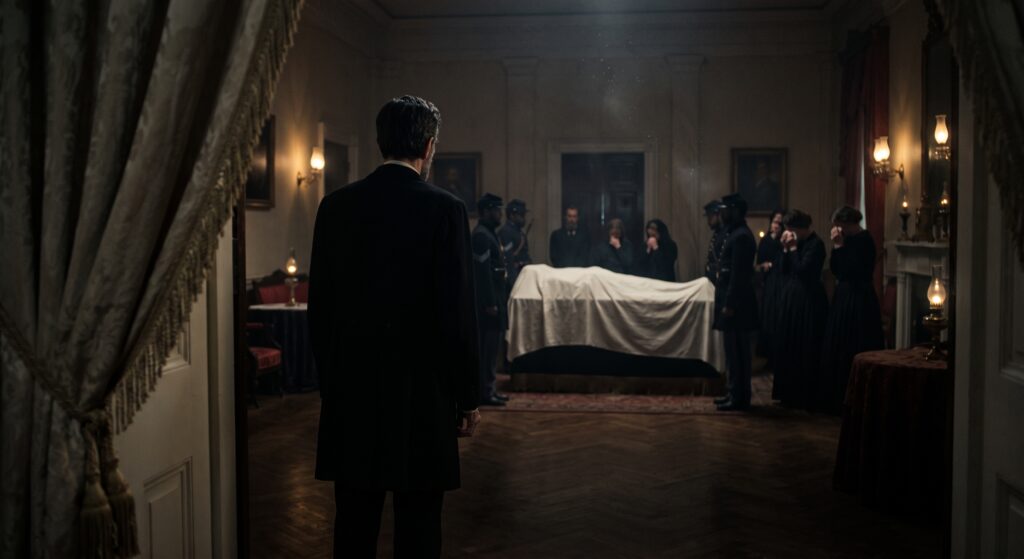
He reached the East Room. A corpse lay on a catafalque, wrapped in funeral cloth, ringed by soldiers. A crowd wept over the covered face.
“Who is dead in the White House?” Lincoln asked a guard. The soldier answered: the president was killed by an assassin. The full text survives in Lamon’s Recollections of Abraham Lincoln.
It reads like prophecy. But sound history demands a harder look, and this dream does not survive it cleanly.
Lamon published his version in 1895, two years after his death, in a book his daughter compiled and heavily edited. An anonymous and slightly different account had already appeared in Gleason’s Monthly Companion in 1880. In that earlier telling, Lincoln addressed only his family. Lamon does not appear at all.
The problems deepen. Lamon claimed Lincoln had waited up for war dispatches the night of the dream. Yet during the relevant days, Lincoln was at the front, not in the White House. And Mary Todd Lincoln told biographer William Herndon in 1866 that her husband did not dream of death in his final years.
No newspaper mentioned the funeral dream right after the assassination. The ship dream, by contrast, spread everywhere. That silence speaks loudly. The corpse in the East Room may be memory, or it may be a myth dressed as memory.
The Springfield Mirror
Trace the visions back further, to before the presidency began. Shortly after his 1860 election, Lincoln glanced into a mirror in his Springfield home. He saw two faces looking back.
One reflection was sharp and alive. The other floated pale and faint beside it, like a ghost of himself.
Mary Todd Lincoln, deeply superstitious, delivered a reading that still chills. The clear face meant he would survive his first term. The ghostly one meant he would win a second term but never finish it. For more on mirror folklore, see our other posts (post 1, post 2, post 3)
He won reelection in 1864. He died six weeks into the second term. Mary’s prophecy landed with terrible precision, though we rely on later retellings for its exact words. Lincoln himself found the double image unsettling enough to try to recreate it and reportedly could not.
The Grieving Household and Its Séances
These visions did not haunt a contented home. In February 1862, typhoid fever killed the Lincolns’ eleven-year-old son, Willie. The loss crushed Mary. It arrived inside a nation already drowning in death, with the Civil War claiming roughly 750,000 lives.
Mary turned to Spiritualism, which was sweeping the country. She hosted séances in the Red Room, hoping to reach Willie and her earlier-lost son, Eddie. Mediums came and went, among them the young Nettie Colburn Maynard.
Maynard later claimed her spirit voices even urged Lincoln toward the Emancipation Proclamation. Historians treat that boast with heavy skepticism, but the séances themselves are well documented, as this survey of the Lincoln White House séances shows.
Grief followed Mary long past the assassination. In February 1872, she entered the Boston studio of spirit photographer William H. Mumler under the alias “Mrs. Lindall.” She hid her face behind a black veil.
Mumler produced a now-famous image: a translucent Abraham Lincoln standing behind her, hands on her shoulders. Later, investigators revealed that the technique was a simple double exposure, and people now understand the story of the Mumler hoax. Mary, though, wept with joy. For her, comfort mattered more than proof.
Why the Dreams Outlived the Man
Strip away the ghost-story shine, and a real pattern remains. Lincoln was a fatalist who watched his mind for omens. He carried the war’s weight in his body and his sleep.
Some of what we retell is solid. The ship dream rests on a diary written within days. Others, like the East Room funeral, rest on shaky, edited, late-arriving sources. A careful reader can hold both truths at once.
That tension is the real story. These dreams became national mythology because they let a shattered country feel that its martyr had known, that his death carried meaning rather than mere chance. The vessel still sails toward its indefinite shore in the American imagination. We keep watching it go on. See our post on how Lincoln haunts the White House.
References & Further Reading
Mr. Lincoln’s White House, “Final Cabinet Meeting”
Western Kentucky University, “Lincoln’s Dreams: An Analysis”
TeachingHistory.org, “Premonition of Death”
HISTORY, “The Lingering Legend of Abraham Lincoln’s Ghost”
POTUS Geeks, “The Lincolns and the Séance in the White House”


[…] hard to dismiss these dreams outright when Abraham Lincoln also might have had […]