A Deep Dive into the Disembodied Splashing near the Historic Train Bridge, and the Restless Spirits of Rose Hill Cemetery
Twilight settles over Matawan Creek, and a brackish mist rolls off Raritan Bay. The tide drains slowly through the low marsh. Mud flats exhale the day’s heat. Overhead, the old train trestle waits in silence, its steel spans dark against a fading sky.
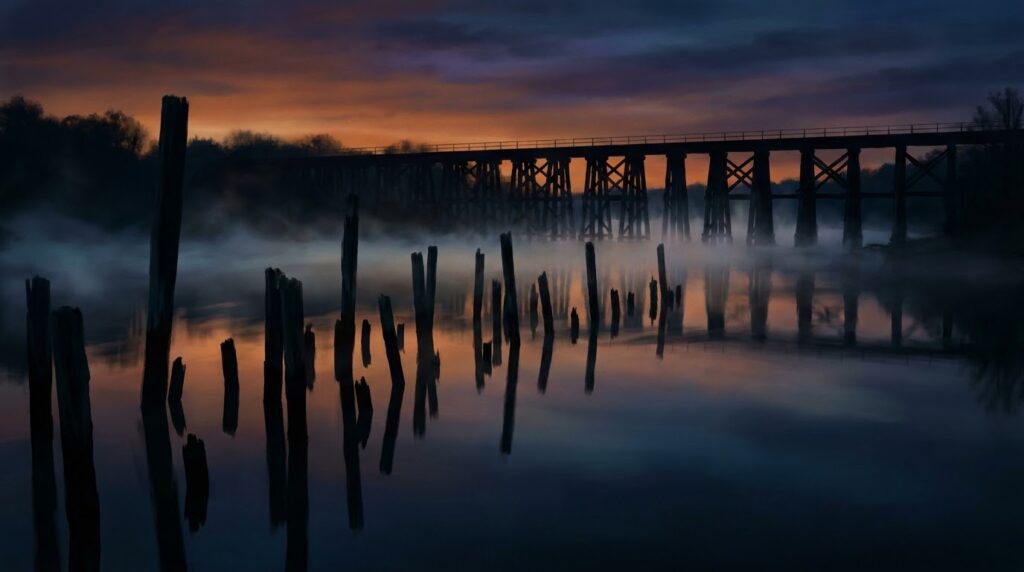
Then you hear it. Splashing. A child’s laugh, thin and far away. Someone calls out across the water, playful and delighted, near the decaying pilings of Wyckoff Dock. You turn toward the sound. Nothing breaks the surface. The creek lies flat and empty.
Locals have heard those sounds for more than a century. Children splash and laugh near the trestle at night, they say, though no children are there. This post will not wave the phenomenon away as a campfire tale or a cheap scare.
Instead, treat the haunting as something heavier. A community absorbed an unthinkable shock on one July afternoon in 1916. The creek, some believe, still holds the echo. To understand why it lingers, you have to return to the summer that shattered a town’s innocence.
The Sweltering Summer That Drew Everyone to the Water
July 1916 pressed down on New Jersey like a wet blanket. Temperatures climbed toward 96 degrees and beyond. The air hung thick and still. Families sought any relief they could find from the punishing heat.
A second terror stalked the cities that summer. Polio swept through New York and Philadelphia, and parents feared the crowded streets. Many fled toward the shore and the tidal inlets, chasing cleaner air and cool water.
Science offered false comfort. Curators at the American Museum of Natural History insisted sharks posed no real threat to swimmers in temperate northern waters. Financier Hermann Oelrichs had once dangled a public reward for proof a shark would attack a living person. No one ever collected it.
That confidence blinded a coastline. While experts argued sharks were harmless scavengers, a large predator moved north along the Jersey Shore. It had already killed at Beach Haven and Spring Lake. Then it turned toward the mouth of a narrow, muddy creek.
Eleven Miles From the Sea
Matawan sat roughly eleven miles inland from the open ocean. The town felt more Midwestern than coastal. No one there imagined a shark could reach them through the winding, brackish channel that fed the bay.
Scientists still debate which species made the journey. A great white would have pushed its biological limits by moving into freshwater. A bull shark, by contrast, tolerates both salt and fresh water, navigating by scent through murky shallows.
The bull shark theory fits the geography best. The creek runs shallow, muddy, and low in salt the farther you travel from the bay. Only one shark thrives in that exact environment, which points many researchers toward the bull shark as the likely culprit.
Whatever swam upstream that day, it arrived unseen. Retired sea captain Thomas Cottrell spotted a dark shape gliding under the trolley bridge with the incoming tide. He ran through town shouting a warning. People laughed him off. A shark in Matawan Creek sounded absurd.
July 12, 1916: Lester Stillwell’s Last Float
Around two o’clock, a group of boys slipped into the creek at Wyckoff Dock. Eleven-year-old Lester Stillwell had left his shift at the basket factory early to join them. The deep pool there drew the town’s boys on scorching afternoons.
The boys splashed and dared each other in the water. Lester floated on his back and called to his friends to watch him. One boy felt something rough graze his leg, like sandpaper. Another spotted what looked like a weathered old log drifting close.
It was no log. A dorsal fin cut the surface, and the shark seized Lester and pulled him under. His friends screamed and thrashed toward the bank. They scrambled up the mud and ran into town, some of them naked, all of them shouting the same impossible words.
“A shark got Lester!” The cry tore through Main Street. Most residents refused to believe it. Sharks did not swim into freshwater creeks eleven miles from the ocean. Yet the boys’ terror was real, and it pulled one brave man straight toward the water.
The Heroism of Stanley Fisher
Stanley Fisher, a 24-year-old local tailor, heard the boys and ran to the creek. He knew Lester suffered from epileptic seizures. Fisher assumed the boy had convulsed and drowned, not that a predator waited below the surface.
Fisher dove into the murky water again and again. Other men searched beside him, but he refused to quit. For a long stretch he probed the creek bed, determined to bring the boy home to his family no matter the cost.
At last his hand found Lester’s body along the bottom. Fisher gripped the boy and rose toward the light. Then, in waist-deep water, the shark struck again. Its jaws tore into Fisher’s right thigh, and witnesses watched the water bloom red.
Men in a boat beat the shark with an oar until it released him. They dragged Fisher ashore with a terrible wound running hip to knee. He clung to life on the train to Long Branch and died in the operating room. His last words honored the choice he made: “I did my duty.”
The Third Strike Downstream
The horror was not finished. Roughly thirty minutes later and half a mile downstream, the shark reached another group of boys near the brickyard pier. Fourteen-year-old Joseph Dunn was climbing toward safety when it clamped onto his leg.
His brother and friends refused to surrender him. They seized Joseph’s arms and pulled against the shark in a brutal, literal tug-of-war. The boy later said he felt his leg sliding into the animal’s throat and believed it would swallow him whole.
The boys won. They wrenched Joseph free and rushed him to a hospital in New Brunswick. He survived his severely injured leg after a long recovery, but he ultimately became the last victim of the Matawan attacks. In roughly ninety minutes, a shark in one creek had claimed two lives and mauled a third.
The Town’s Furious Reckoning
Grief curdled fast into rage. Residents lined the creek banks with rifles, harpoons, boat hooks, and dynamite. They strung wire nets above and below the attack site to trap whatever lurked below. The mayor posted a reward for any shark killed in the water.
The blasts and gunfire caught nothing. No shark died in Matawan Creek. Days later, a taxidermist named Michael Schleisser landed a large shark in Raritan Bay near the creek’s mouth. Reports claimed human remains were found inside it.
The panic spread far beyond one town. Newspapers fed a national frenzy, and vigilantes killed sharks up and down the coast. The attacks would later help inspire Peter Benchley’s 1974 novel Jaws, cementing Matawan’s tragedy into the roots of American pop culture.
Eternal Play: The Phenomenology of the Haunting
Paranormal researchers describe a residual haunting as a kind of recording. A location absorbs a burst of intense emotion, the theory holds, and then replays that moment across the years. The event loops, detached from any conscious spirit.
Matawan Creek fits the model with painful precision. One instant Lester floated in the sun, calling out for his friends to watch. Next, he vanished beneath the surface. That razor-thin shift may explain the imprint locals claim to hear. The creek did not merely witness a death. It witnessed the exact seam where childhood delight ripped into horror, and some believe the water never let that moment go.
The sounds carry an emotional charge that dry history books cannot hold. A biography records dates and names. A haunting, real or imagined, preserves a feeling. At Matawan, that feeling is the last carefree second before everything broke.
Why the Ghosts Laugh Instead of Scream
Here is the detail that stops you cold. Witnesses never describe screams of terror rising from the creek. They describe splashing, laughing, and playful shouts. The reported haunting sounds happy.
That choice reveals something tender about how communities grieve. Local memory could have fixed on Lester’s final agony. Instead, oral tradition returned the sounds of play to the water, an act you might call narrative sanitization.
By remembering the boys at play, the town freezes them in a gentler moment. Lester does not drown forever in the retelling. He floats forever, laughing, daring his friends to watch. The folklore refuses to leave him trapped in his worst instant.
Seen this way, the ghost story becomes an act of healing rather than fear. The community chose the version it could live beside. The splashing at night is not a curse. It is a town insisting its lost children get to stay young and joyful.
Water Ghosts of the Wider Region
Matawan’s splashing joins a broader family of water hauntings along the Jersey coast. Many center on children, and many echo the same protective instinct to soften a terrible loss into something bearable.
Visitors to the Stephen Crane House in Asbury Park report the patter of small, disembodied footsteps. Down at Barnegat Light, legend tells of ghostly parents who still call across the dunes, searching for a daughter lost to the sea.
These stories share Matawan’s emotional grammar. Water gives and water takes, and the communities beside it build gentle myths to carry the grief. The dead children are not gone in these tales. They linger, playing, just out of sight.
The Rose Hill Cemetery Connection
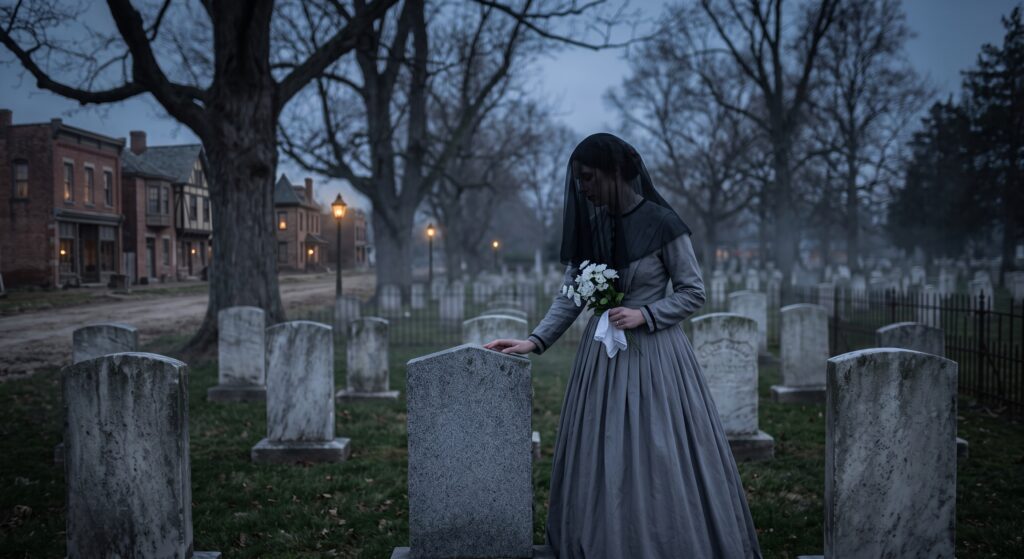
The creek’s story does not end at the water. Barely a mile away on Ravine Drive sits Rose Hill Cemetery, often called the most haunted burial ground in New Jersey. Its garden layout dates to the Victorian era, though older graves reach back generations.
Geography turns poetic here. Stanley Fisher rests on a hill that overlooks Lester Stillwell’s grave. In death, the man who died trying to recover the boy keeps a permanent watch above him. The rescuer still stands guard over the child he could not save.
Visitors to Lester’s grave report a strange, consistent anomaly. Camera batteries, phone batteries, and audio recorders drain to nothing the moment people aim them at the headstone. Paranormal enthusiasts read sudden battery loss as a spirit drawing energy to manifest.
Whether you credit that theory or not, the pattern gets repeated often enough to feel like ritual. People arrive, point a device at the boy’s grave, and watch the power vanish. Then they leave, unsettled, telling the next visitor to try it too.
A Cemetery Full of Stories
Rose Hill holds more than the shark’s victims. One headstone reads simply “Zombie,” marked 1960 to 1973, and it has fueled whispered voodoo myths for years. The truth is sweeter than the legend. Zombie was a beloved family dog, laid to rest beside his owner.
Investigators bring spirit boxes and audio recorders to the crypts after dark. Some report clear voices answering back, calling names like Ava and Margaret into the static. Near one particular crypt, a pleasant female voice reportedly repeats the name Arrowsmith as people approach.
Longtime neighbors who grew up beside the cemetery tell of a shadowy figure on the south slope and a sealed tomb they nicknamed the witch’s grave. Their childhood playground doubled as a place where, they swear, the air itself felt watched.
None of it proves anything, and honest guides admit as much. Rose Hill is haunted first by history, by shark victims and Civil War soldiers and flu-epidemic dead. Whether spirits linger beyond that record depends entirely on what you feel when you walk its quiet paths.
The Eternal Estuary
At Matawan, three forces braid together and never quite separate. Human history, natural ecology, and folklore all meet at the water’s edge. The creek carries all three at once, tide after tide, year after year.
The tragedy of 1916 offers a hard, humbling lesson. We raise towns and lay railways and throw steel bridges across the water. Yet the moment we wade off the dry land into the murky tidal channel, we become visitors in a wilderness far older than us.
The splashing at night keeps that lesson alive. It reminds a community how fast joy can turn and how fiercely people will fight to reclaim the memory of the ones they lost. Lester floats, laughing, in the town’s imagination still.
So visit the trestle at dusk. Watch the mist rise off the marsh and listen to the water settle. If you hear a child call out to be watched, you may be hearing nothing at all. Or you may be hearing a town’s oldest, gentlest act of remembrance.
References & Further Reading
- Jersey Shore shark attacks of 1916 (Wikipedia)
- 1916 Shark Attack (Matawan Historical Society)
- The Matawan Man-Eater (Weird NJ)
- We Still Don’t Understand the 1916 Shark Attacks (ExplorersWeb)
- Rose Hill Cemetery: Haunted with History (Matawan Patch)
- A Zombie Buried in Matawan, New Jersey? (Caggiano’s Corner)
- Paranormal File: Rose Hill Cemetery (Caggiano’s Corner)
- Site of the New Jersey Shark Attacks of 1916 (Atlas Obscura)