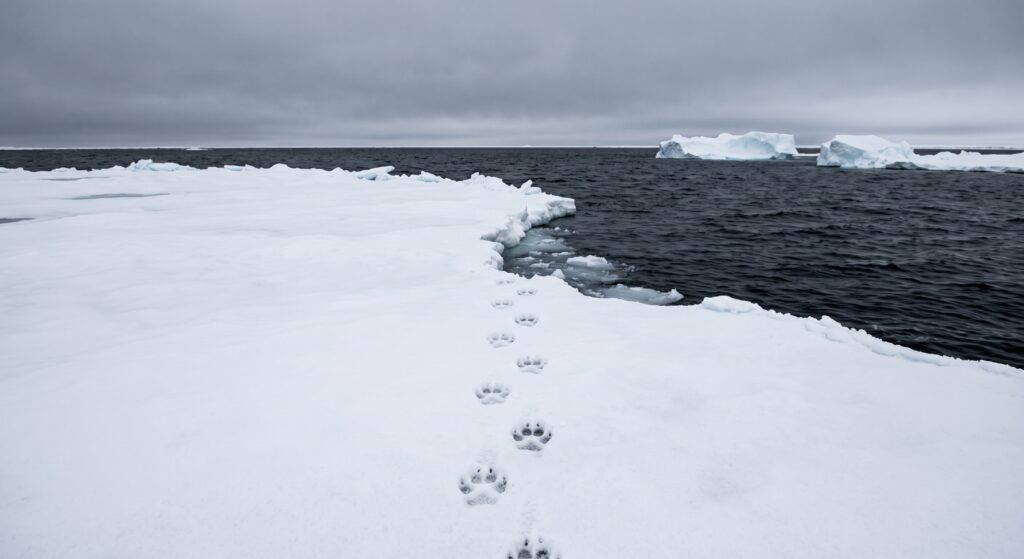
You find wolf tracks in the snow. You follow them toward the shore. Then they stop at the water’s edge and simply vanish, with no prints returning inland. To some Inuit storytellers of the Bering Sea, that was the signature of the Akhlut, a killer whale that had walked the land as a wolf.
Search the Akhlut today and you will see a fearsome wolf-orca hybrid, half fur and half fin. That image is everywhere in games and art. It is also largely a modern remix. The older tradition, recorded over a century ago, tells a quieter and more careful story.
What the early record actually says
In 1900, American naturalist Edward William Nelson documented the belief among Inuit along the Bering Sea shore. He recorded a long name, kăk-whăn’-û-ghăt kǐg-û-lu’-nǐk, for a being like a killer whale. It could change at will into a wolf, roam the land, then return to the sea and become a whale again.
Crucially, the word “akh’lut” in Nelson’s account simply meant the orca, while the wolf form carried the other name. Modern writers later borrowed “akhlut” to refer to the composite creature. So the popular name is essentially the Yup’ik word for orca, stretched to cover the whole legend.
Nelson also placed this belief in a wider pattern. He described other composite animals in the same tradition, including a white whale said to transform into a reindeer. Belief in these shifting creatures, he wrote, was common among Inuit along the Bering Sea. The orca-wolf was one figure in a whole family of shapeshifters.
The hybrid image is newer than you think
In the original tradition, the Akhlut was a shapeshifter, an orca that became a wolf and back again. Traditional art often showed it mid-transformation, carrying features of both. The now-familiar idea of a permanent, fused wolf-orca hybrid is mostly a modern interpretation, not the classic form.
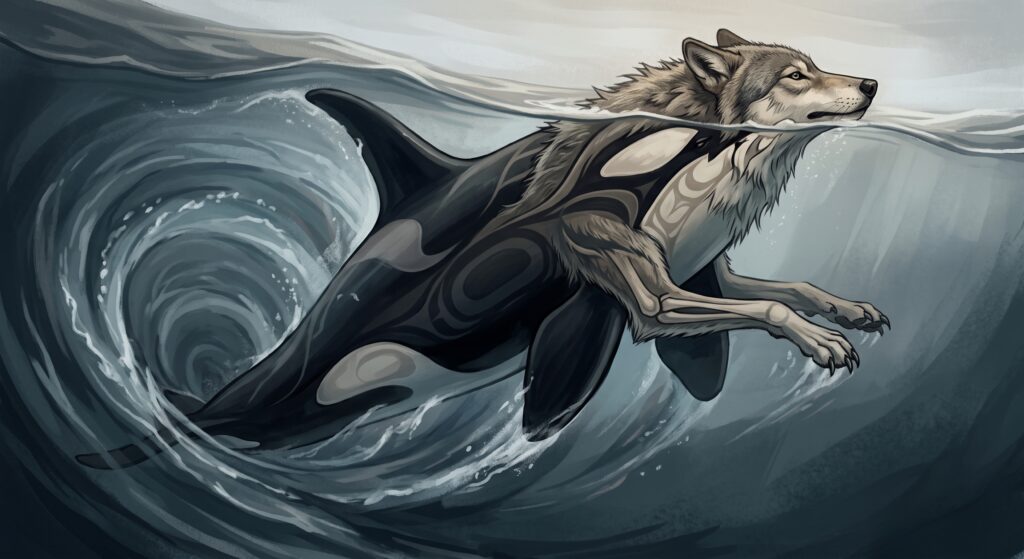
This is the correction that is worth making. When a site presents the wolf-orca hybrid as ancient fact, it collapses a fluid, shifting spirit into a fixed monster. The change is a shapeshift, not a merger. Getting that right respects how the people who told the story actually imagined it.
The language itself shows the drift. In central Yup’ik, the words for “orca” and “wolf” are “arrlug” and “kegg’luner,” distinct terms that Nelson rendered in an older romanization. Over time, English writers flattened those separate names into a single label. The tidy “Akhlut” we use today smooths over a messier, more precise original.
The tracks, and their ordinary explanation
The heart of the belief was observational. Hunters found wolf tracks leading to the sea ice and ending at open water, or beginning at the water and heading inland. That looked like a creature entering or leaving the ocean. It was eerie, concrete evidence you could see with your own eyes.
Nelson offered a grounded reading. He attributed the sightings to orcas and explained the vanishing tracks as ice breaking away from the edge, carrying prints out to sea. A wolf could walk to a floe that later drifted off. The mystery had a mechanism, even as the spirit gave it meaning.
A predator woven into a worldview
The Akhlut was feared as fierce, a hunter of seals and, in the stories, of people who wandered too close to the shore. It fit a Yup’ik worldview in which animals hold an inua, a spiritual essence that lets forms change. The boundary between species, land, and sea was never fixed.
One popular origin tale describes a man so obsessed with the sea that his village no longer recognized him and cast him out. He joined wolves, then dove into the ocean and became an orca, returning to land as a wolf when hunger or vengeance stirred. It reads as a parable about losing one’s balance between worlds.
Why the orca inspired such awe
It is no accident that the killer whale sits at the center of this legend. Orcas are apex predators of the northern seas, intelligent, coordinated, and capable of taking prey as large as other whales. To coastal hunters in small boats, an orca embodied a power that felt almost supernatural on its own.
Give that power the ability to step onto land as a wolf, and you have a creature with no safe distance. The Akhlut expresses a real respect for the orca’s dominance, stretched into myth. The half-wolf only completes the picture, extending the sea’s greatest hunter into the world of the shore.
A lesson stitched into the landscape
Beneath the fear, a lesson sits. The Akhlut warns people to respect the dangerous seam where ice meets open water. That is precisely where a hunter might slip, fall through, or drift away on breaking floes. The monster marks a genuine hazard, dressing a practical caution in unforgettable form, very similar to the Qalupalik.
Modern retellings sometimes soften the creature into a guardian that watches over those who honor the balance of nature. That gentler reading fits the deeper Inuit worldview, where animals hold spirits and respect keeps a person safe. Fierce or protective, the Akhlut always points to the same truth. Honor the boundary, or pay for crossing it carelessly.
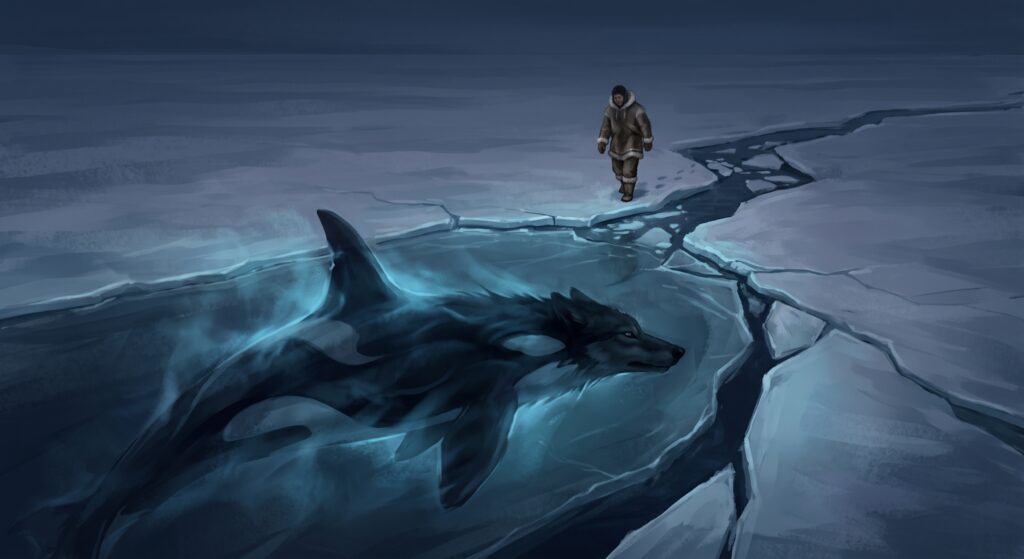
Understood this way, the Akhlut is less a creature to fear than a teacher to heed. It gathers the orca’s power, the wolf’s reach, and the sea ice’s treachery. All of it folds into one memorable warning. Strip away the game-and-comic gloss, and what remains is a careful piece of survival wisdom dressed as a monster.
References & Further Reading
Akhlut, citing Nelson 1900 (Wikipedia)


[…] Arctic, Inuit folklore warns of the Qalupalik, a sea-ice monster that snatches children, and the Akhlut, a terrifying wolf-orca hybrid that hunts the Bering Sea. Alaska’s coastlines are haunted by […]