Unexplained experiences in your home affect your sleep, your mental health, and your daily sense of safety. Whether the explanation is paranormal, structural, or psychological, you deserve to know what is going on. You also deserve a clear, calm way to figure it out.
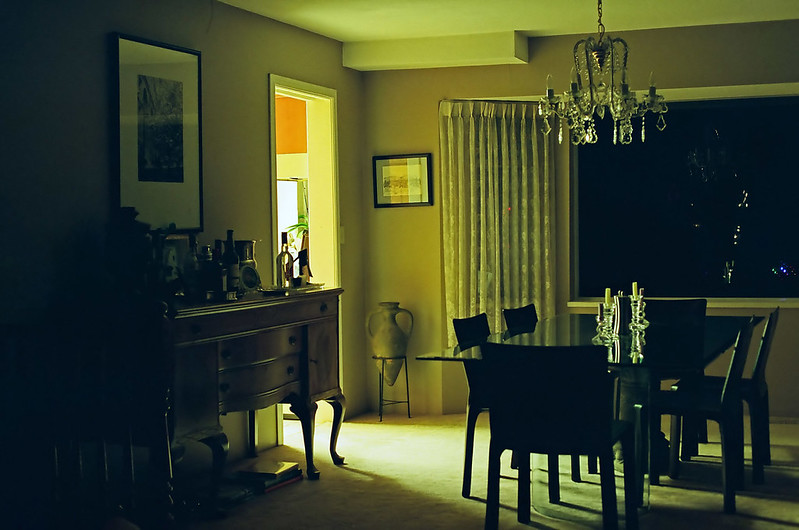
“Dark Room” by cclogg is marked with CC0 1.0.
Something Is Wrong in Your Unit, But What?
You moved in two months ago. The lease looked perfect: reasonable rent, great location, your own parking spot. But something is off. Last Tuesday you found every cabinet in the kitchen standing open. You closed them before bed. You know you did. Your cat has been sitting in the hallway for three nights straight, staring at the wall, refusing to move until sunrise. And last night you woke at 3 a.m. to the faint but unmistakable smell of pipe tobacco in a non-smoking building, from a unit that has been empty for years.
You Think You Know What a Haunting Looks Like
Most people expect a haunting to announce itself dramatically: doors slamming, objects flying, apparitions in the mirror. That is the Hollywood version. In practice, the reported signs of a haunted apartment are quieter, slower, and far more easily dismissed. You assume it must be the building settling, a neighbor upstairs, or your own sleeplessness.
But what if the pattern of events does not match any mundane explanation? What if multiple signs are stacking up, not just one strange thing but six? This guide gives you a systematic, renter-friendly checklist to document, investigate, and assess what is happening in your unit.
The Most Common Signs Are Incredibly Easy to Miss
Based on accounts from paranormal investigators and renters who have experienced activity, here are the signs most worth paying attention to and, crucially, the mundane explanations that must be ruled out first.
1. Cold Spots in Specific Areas, Not the Whole Room
Paranormal investigators frequently cite temperature drops as one of the earliest signs of haunting. What distinguishes a paranormal cold spot from a drafty window is specificity: the cold is localized to one corner, one doorway, or one section of a room, and it persists regardless of season or weather. Before attributing this to a ghost, check for gaps in insulation, vents blowing cold air, or external wall dampness. If none of those explain it, log the location, date, and temperature with a simple thermometer app.
2. Electronics Malfunctioning in One Room Consistently
Lights flickering, phones losing charge faster than usual in one area, TVs cycling on and off: these are frequently listed as signs of a haunted apartment. The first rational check is your building’s wiring. Request a maintenance inspection. If the electrician finds no fault and the issue continues in the same location, begin a log. Date, time, device, and duration of each event create a data pattern that is useful whether you are talking to a landlord, a building manager, or a paranormal investigator.
3. Your Pet Reacts to a Specific Empty Space
Animals have sensory ranges beyond human perception, particularly in the ultrasonic and infrasound spectrum. When a cat stares fixedly at one corner for extended periods or a dog refuses to enter a particular room, paranormal investigators take note. This is not definitive proof of a ghost, but it is a data point worth recording. First rule out pests: mice in walls produce ultrasonic sounds that cats respond to strongly.
4. Objects Found in Different Positions Than You Left Them
This phenomenon has an official name in parapsychology: the Disappearing Object Phenomenon (DOP). A key that was on the kitchen counter is now in the bathroom. A framed photo has been turned to face the wall. Paranormal enthusiasts sometimes attribute this to poltergeist activity. Skeptics point to absentmindedness, sleepwalking, or, in shared buildings, unauthorized access. The most important step is to rule out the latter: change your locks and check with your landlord about who has a spare key.
5. Persistent Unexplained Sounds at Consistent Times
Footsteps on the ceiling above an empty unit, knocking inside a wall where no pipes run, and a voice that sounds like it is coming from the next room when no one is there: these are classic reports. Before concluding it is paranormal, check what is above, below, and beside you. Old buildings transmit sound in unusual ways. Pipes contract as temperatures drop, producing knocking. Vermin in walls create scratching and movement sounds. If the sounds follow a pattern at the same time and in the same location, that consistency is worth documenting.
6. Feeling of Being Watched, Especially in One Location
This is harder to quantify, but it is one of the most reported signs of a haunted apartment. Paranormal investigators call it the ‘psychic staring effect’: a felt sense of being observed. One rationalist explanation is infrasound. Sound waves below 20 Hz, inaudible to the human ear but detectable by the nervous system, can produce anxiety, unease, a feeling of being watched, and even visual distortions. Some old buildings generate infrasound through HVAC systems or structural resonance. A carbon monoxide detector is also strongly recommended: CO poisoning has been documented as a cause of paranormal-style experiences, including hallucinations and dread.
7. A Persistent Unexplained Smell
The phantom smell of cigarettes, perfume, or food in an apartment where no such source exists is one of the more unnerving reported signs. It can also be structural: odor particles can be trapped in walls, floorboards, and HVAC ductwork for decades in older buildings. Before calling anyone, ask building management when the unit was last renovated and whether previous tenants had complaints.
The Renter’s Paranormal Checklist
Use this checklist before drawing any conclusions. A genuinely strong case for paranormal activity is one where multiple mundane explanations have already been eliminated.
☐ Checked windows, vents, and insulation for cold spots
☐ Requested electrical inspection from landlord
☐ Installed and checked carbon monoxide detector
☐ Ruled out pests for pet-behavior and sound anomalies
☐ Verified lock integrity and key access list
☐ Checked HVAC for infrasound-generating issues
☐ Researched building history: age, prior tenants, any reported incidents
☐ Kept a dated log of all events for at least two weeks
You’ve Ruled Out the Rational. Now What?
If you have worked through the checklist and the events continue, you are not alone and you are not imagining things. Your state may actually have legal protections relevant to your situation: in some jurisdictions, landlords are required to disclose if a property has a history of paranormal claims. The 1991 New York case Stambovsky v. Ackley established a legal precedent around haunted property disclosure that is still cited in real estate law.
Your next steps: contact a local paranormal investigation group (most offer free residential investigations), speak to long-term neighbors about the building’s history, and if the experiences are affecting your quality of life, consult with your landlord about breaking the lease. You moved in for a home. You deserve one. Whether the source turns out to be a gas leak, bad wiring, or something that does not show up on a contractor’s invoice, you have every right to find out.
And if the next tenant asks whether the apartment has a history? Maybe mention the cabinet thing.
References & Further Reading
• ApartmentSearch: Is Your Apartment Haunted? Know the Signs
• ApartmentTherapy: 5 Telltale Signs You’re Living in a Haunted Home
• RentPrep: What Tenants Need to Know About Haunted Rental Properties



[…] Signs of a Haunted Apartment: A Renter’s Investigation Guide […]
[…] a temple to Victorian luxury. Beneath that polish runs something stranger, a reputation as the most haunted hotel in the capital. To understand why, you must start with the building itself, because the haunting […]
[…] Signs of a Haunted Apartment: A Renter’s Investigation Guide […]
[…] Signs of a Haunted Apartment: A Renter’s Investigation Guide […]